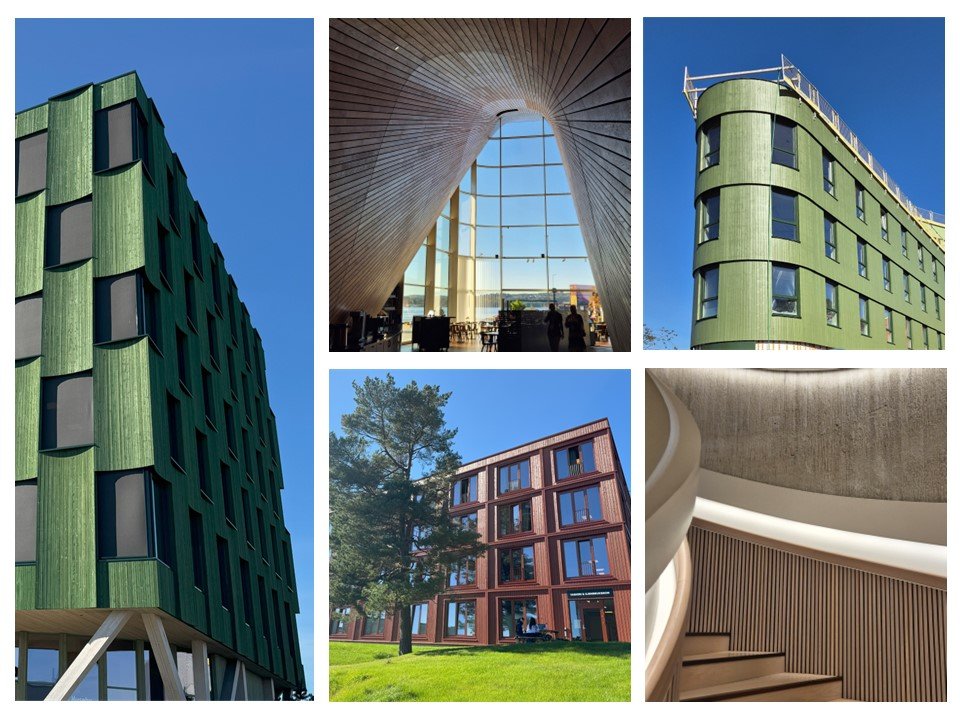
Gorgeous wooden buildings in Kristiansand
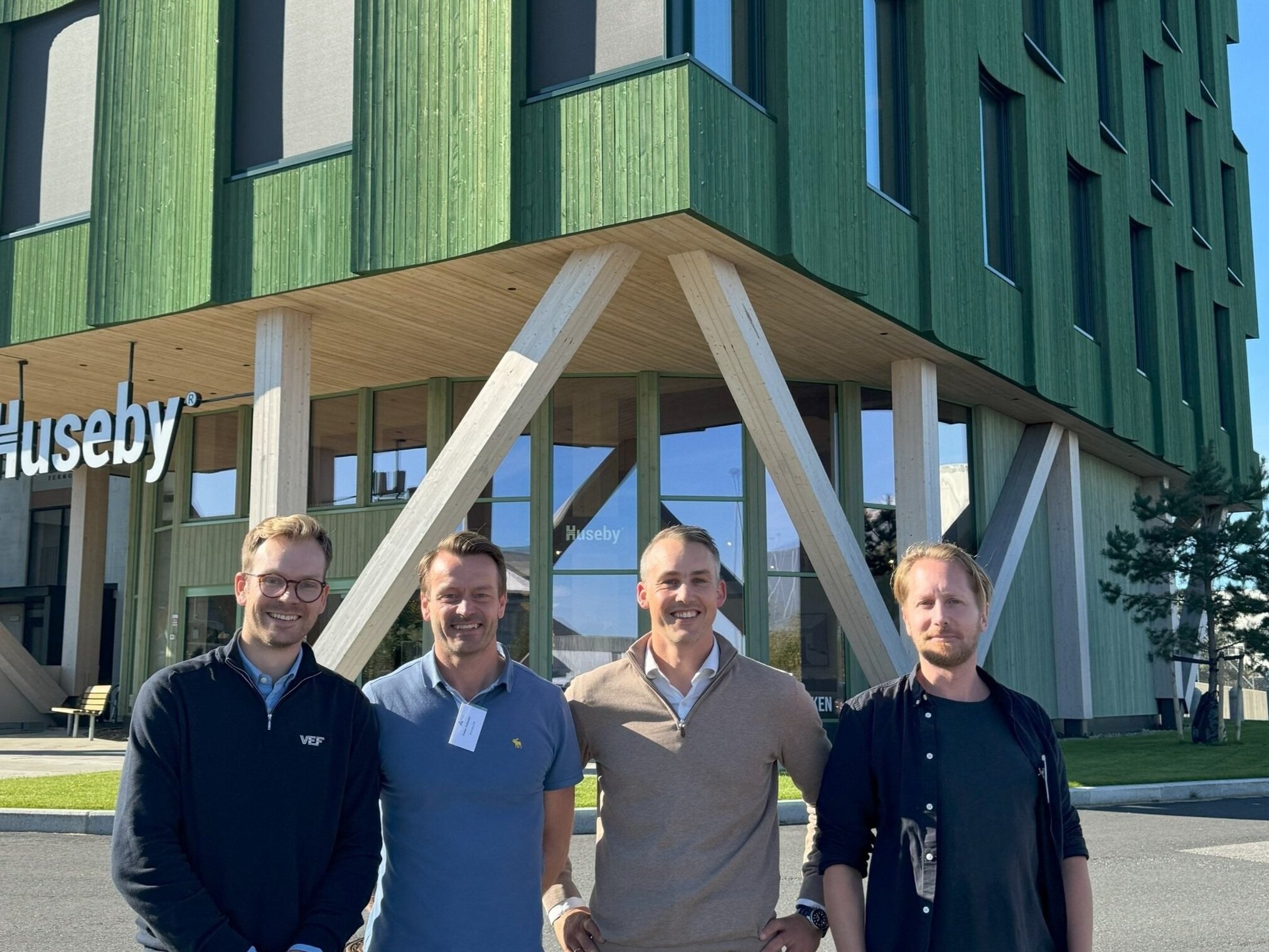
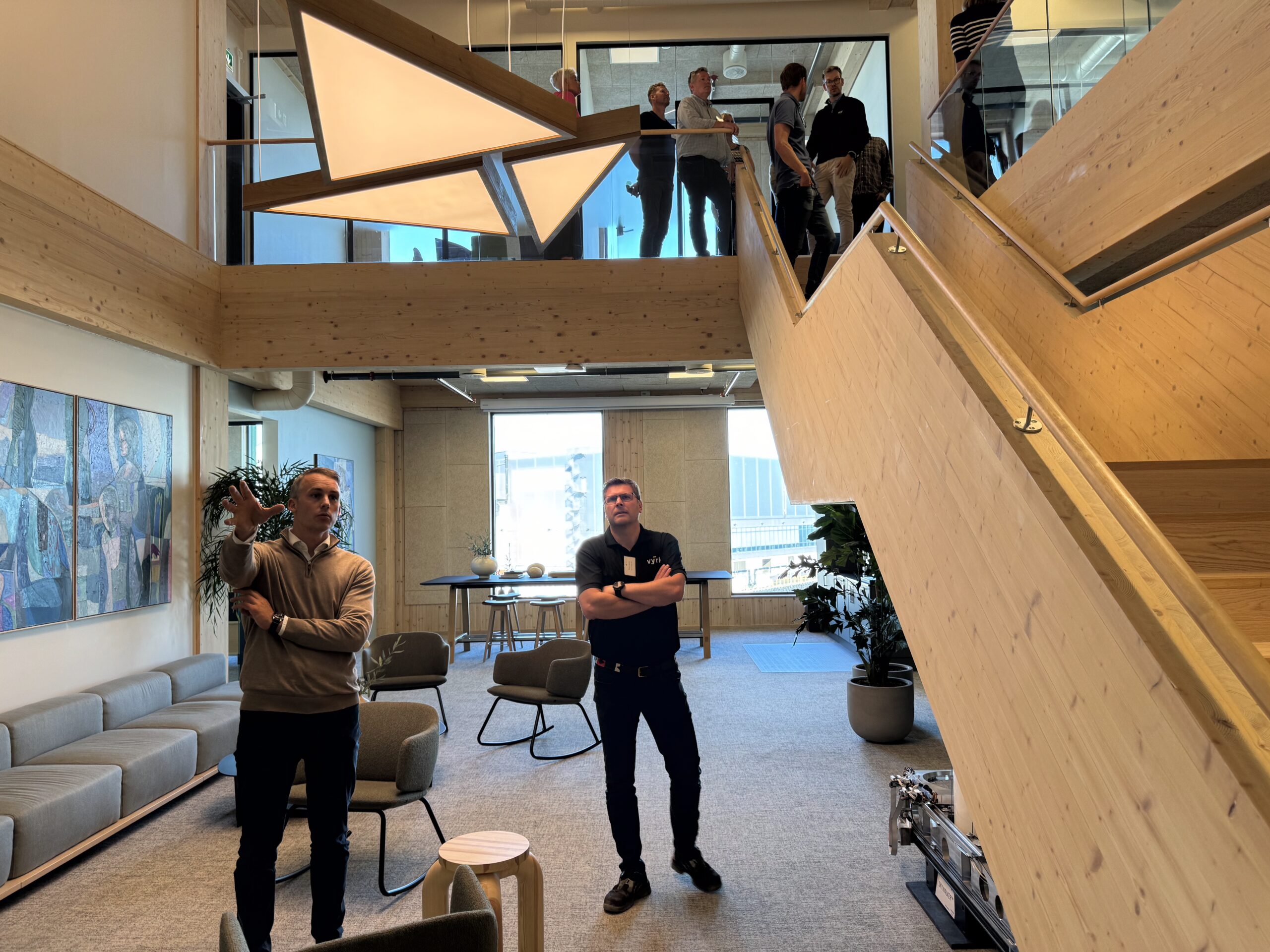
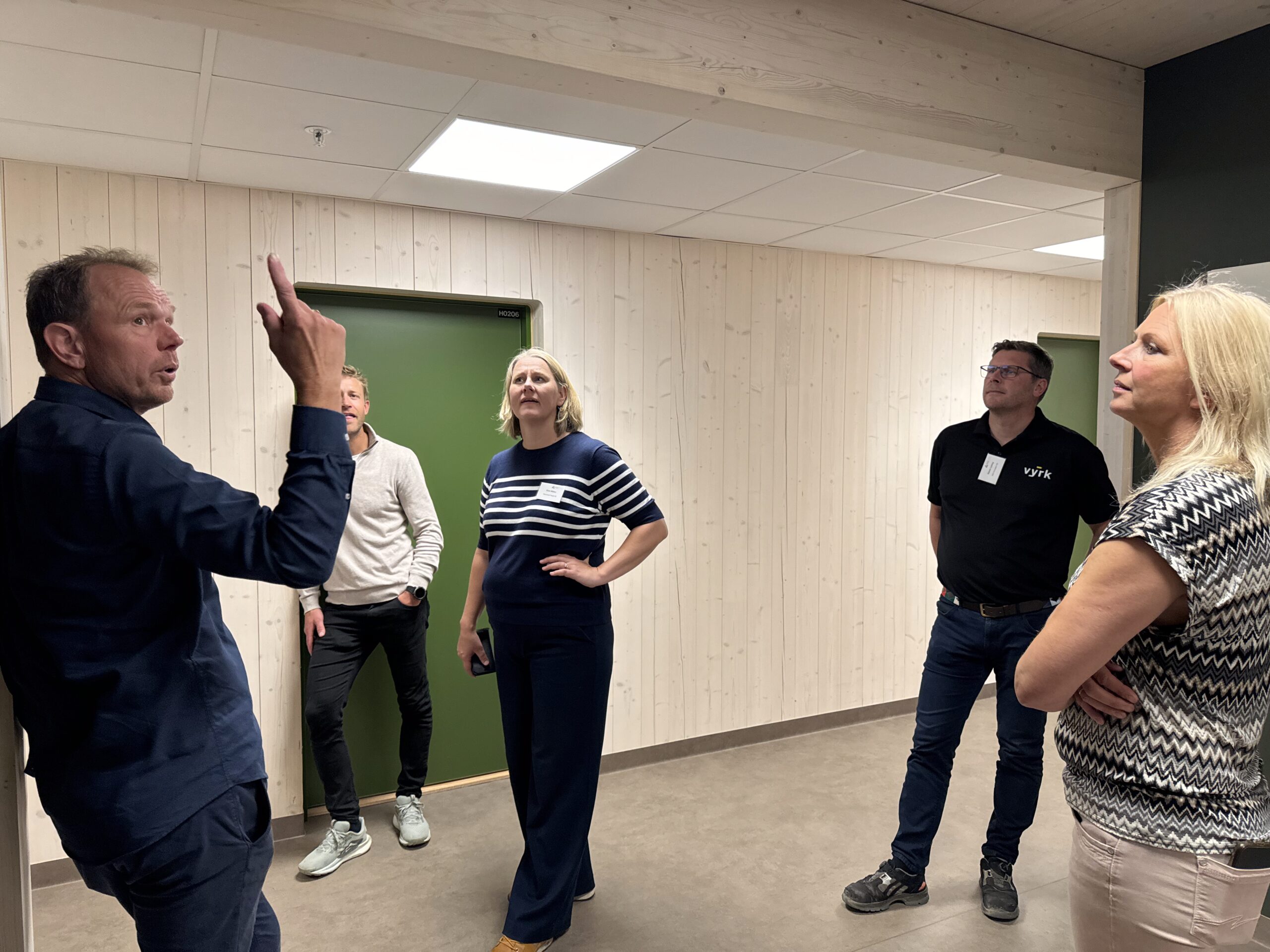
The study tour to Norwegian Wood Cluster included an award-winning office building, new student housing and a look at a new apartment building in the city. There was a lot to be inspired by.
LUMBER 4 is a six-storey commercial and office building. It is built as a wooden structure with glulam columns and beams. All load-bearing structures are exposed, and the prefabricated exterior walls are clad with green pigmented pine paneling/interior white pigmented spruce paneling. Oslotre has had the role of architect, interior architect and RIBtre on the project.
LUMBER 4 was built in record time. Detailed design and construction of the building took a total of just 12 months.
– With a high degree of prefabrication, the building has achieved 53% greenhouse gas reduction. “LUMBER 4 has shown that it is possible to build competitive wooden buildings, compared to standard TEK 17 concrete and steel buildings,” says architect Jørgen Tycho of Oslotre.
The building has been noticed internationally. Earlier this year, he and Oslotre were delighted that LUMBER 4 won the Architizer A+Awards for the best office building of the year in the Medium 5-15 storey category.
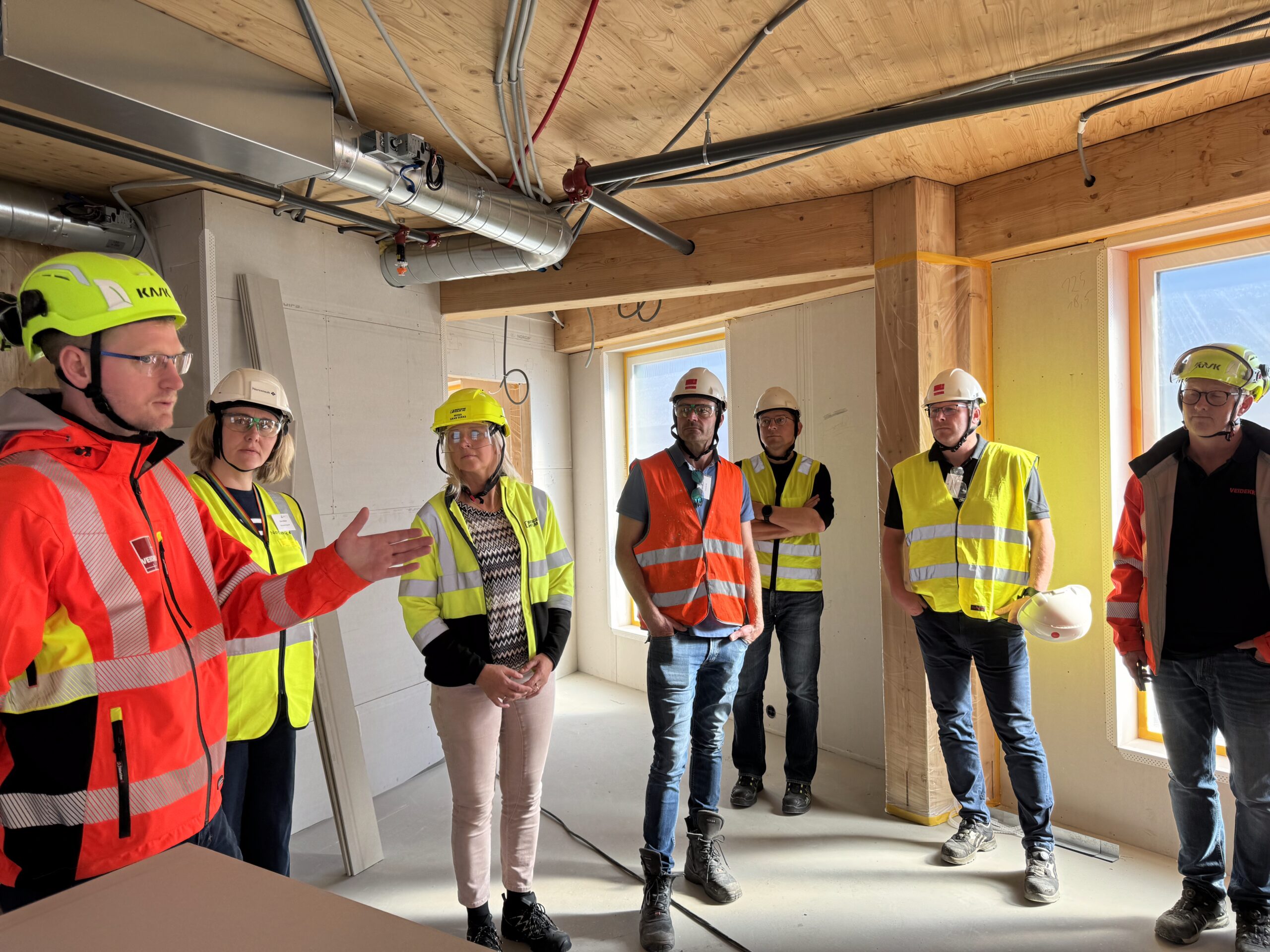
Student housing under construction at Lund Torv
Studentsamskipnaden i Agder is behind the new student housing at Lund Torv in Kristiansand, located between the city center and the university. Veidekke was commissioned to build the 371 student apartments for 400 students and is on schedule to deliver the buildings in June 2025. Project manager Tor Harald Ihme and project developer Sveinung Larsen from Veidekke gave a briefing on the project and a tour of the construction site.
– The zoning plan requires the use of wood in the supporting structures. In these student residences, the wooden structures consist of solid wood and glulam,” says project developer Sveinung Larsen.
– “High demands regarding acoustics, short delivery time and sensitive quick clay in the ground are among the challenges we have solved in this project,” says project manager Tor Harald Ihme.
Popular student housing at Gimle
Studentsamskipnaden i Agder chose the contractor HSH to build three student housing buildings at Gimle in Kristiansand as a turnkey contract. The buildings are constructed in solid wood and have prefabricated wooden facades. The project consists of a total of 184 apartments with a total of 271 beds. Work started in spring 2022 and was completed in summer 2023.
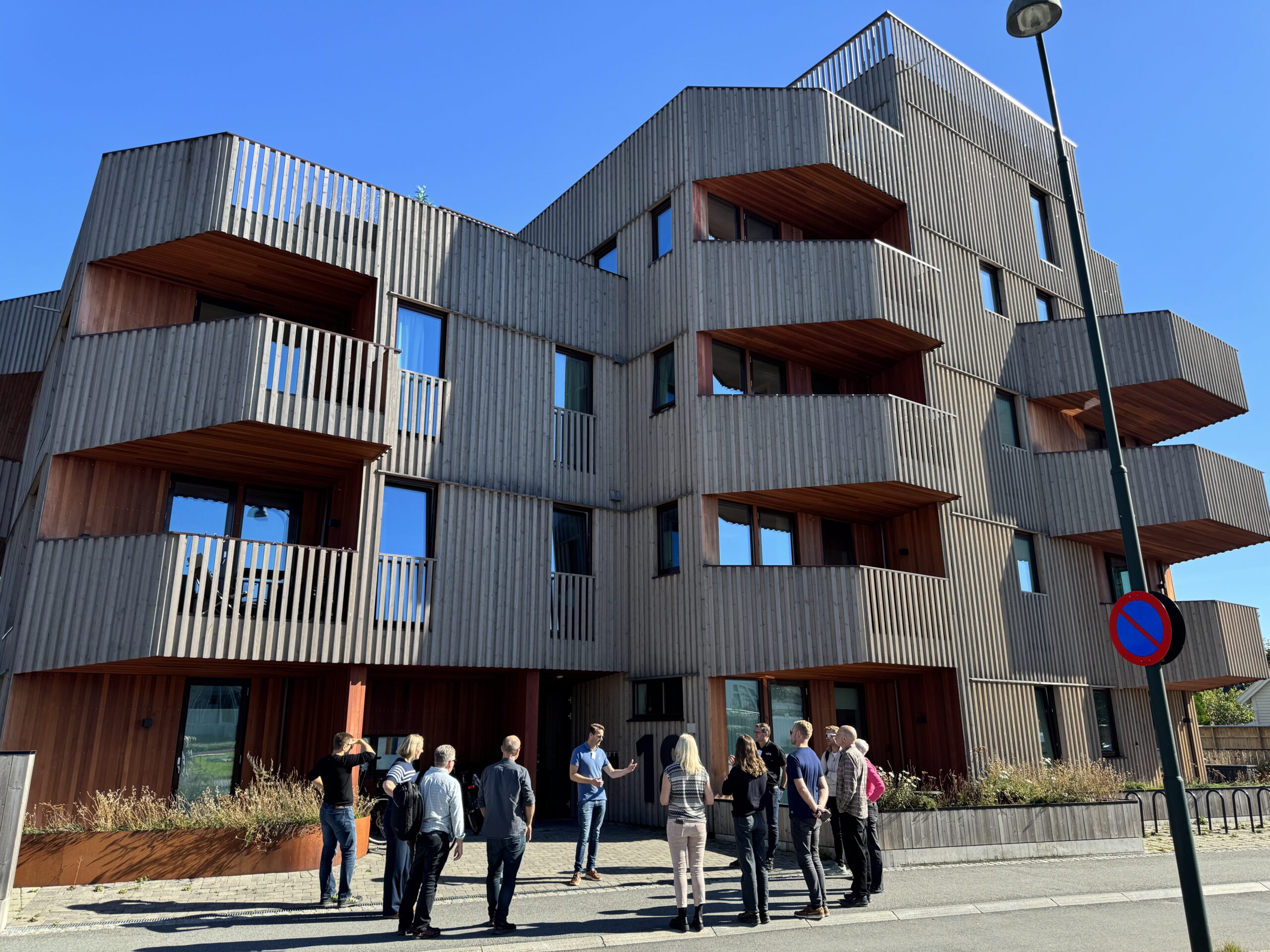
Unusual wooden apartment building
An unusual five-storey wooden apartment building has been erected at 18 St. Olavsvei. Oslotre AS is the architect behind the building, while Innovatre AS has been the project manager. The building houses 28 apartments and is built in solid wood from Splitkon combined with glulam from Moelven Limtre. The facade has pine cladding treated with gray paint, which means that the paint will slowly wear away and expose unison grayed wood.
Norwegian-Swedish collaboration on the reuse of wood in buildings
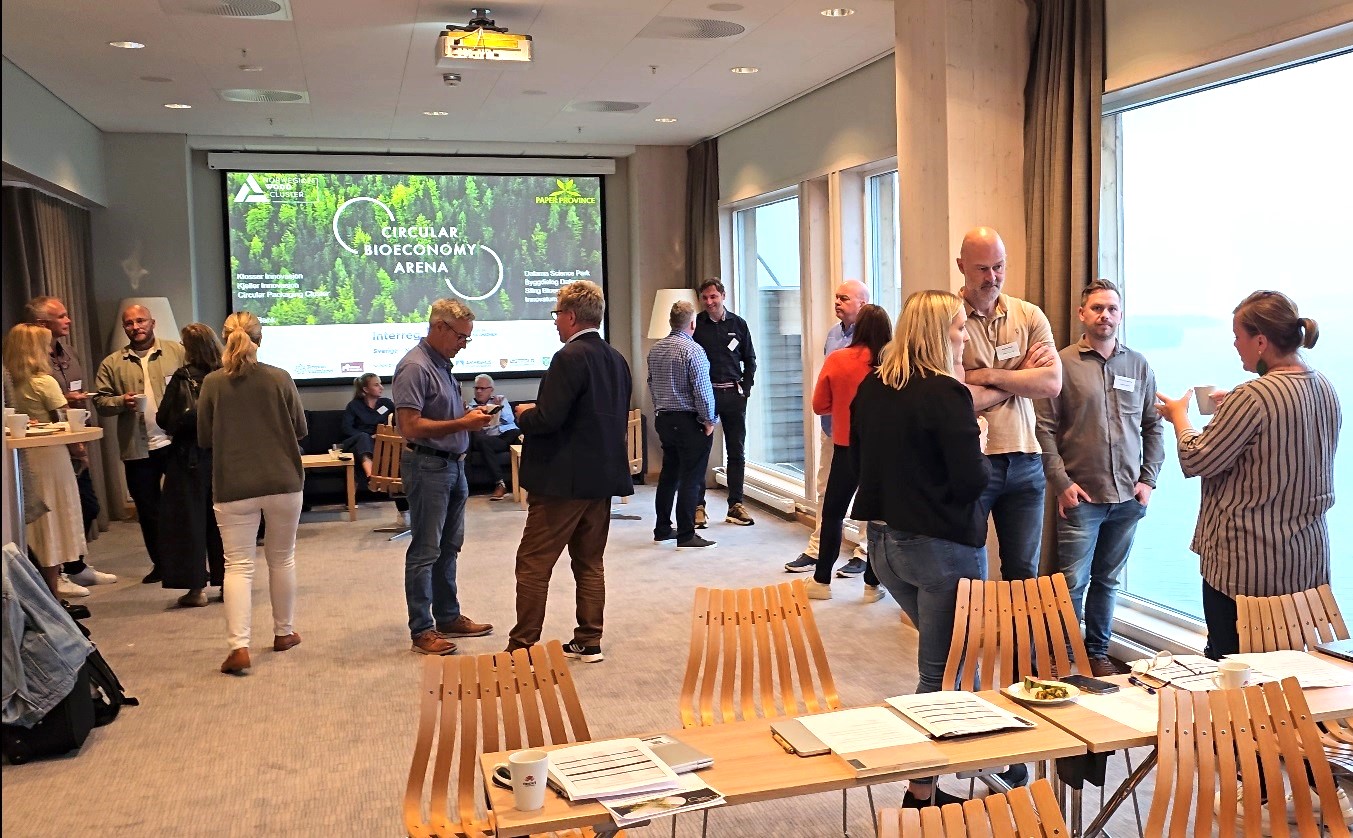
The aim of the workshop was twofold; to exchange experiences of reuse in practice to learn about what works well, and at the same time identify obstacles to scaling up.
Reuse from different perspectives
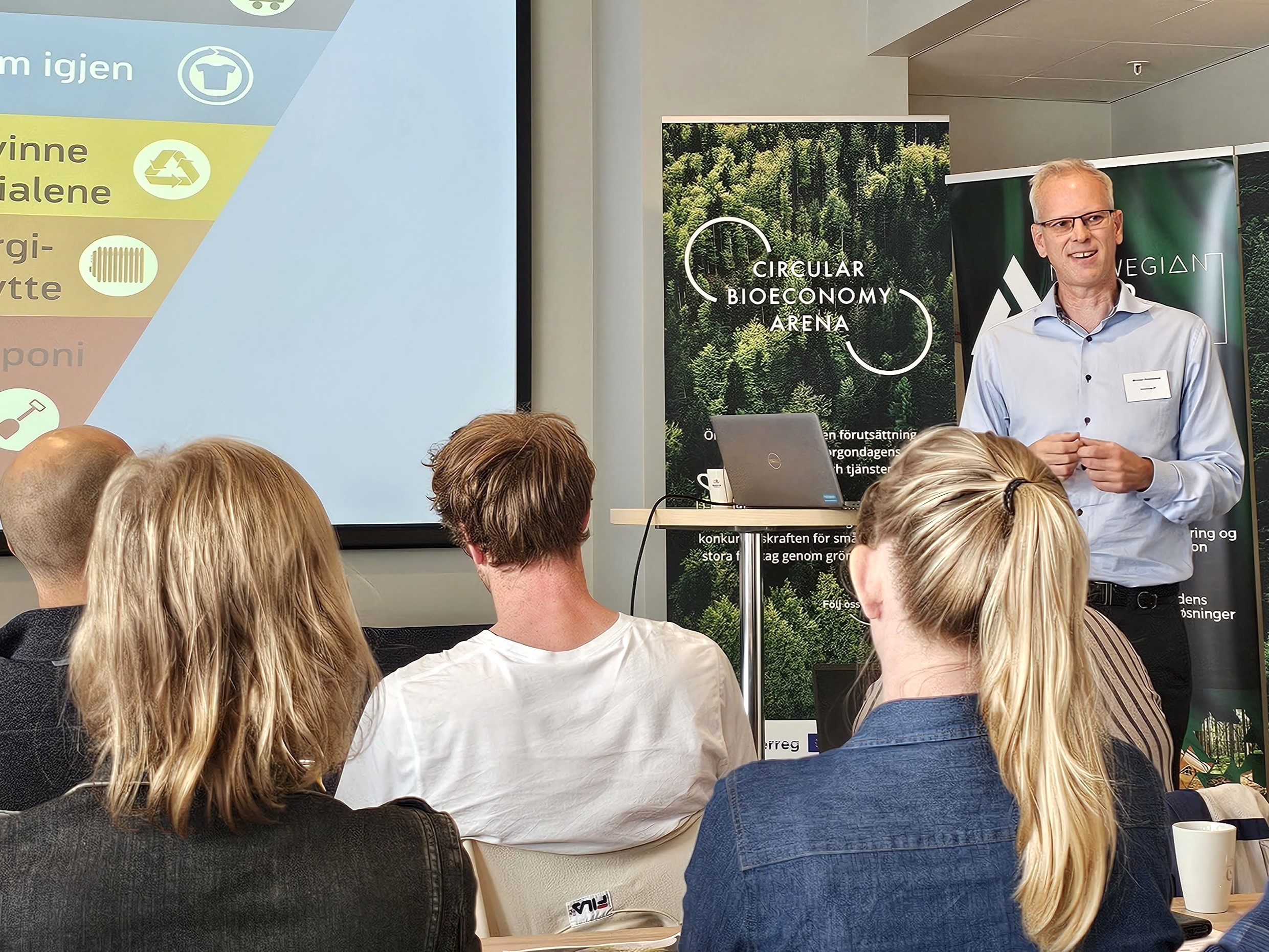
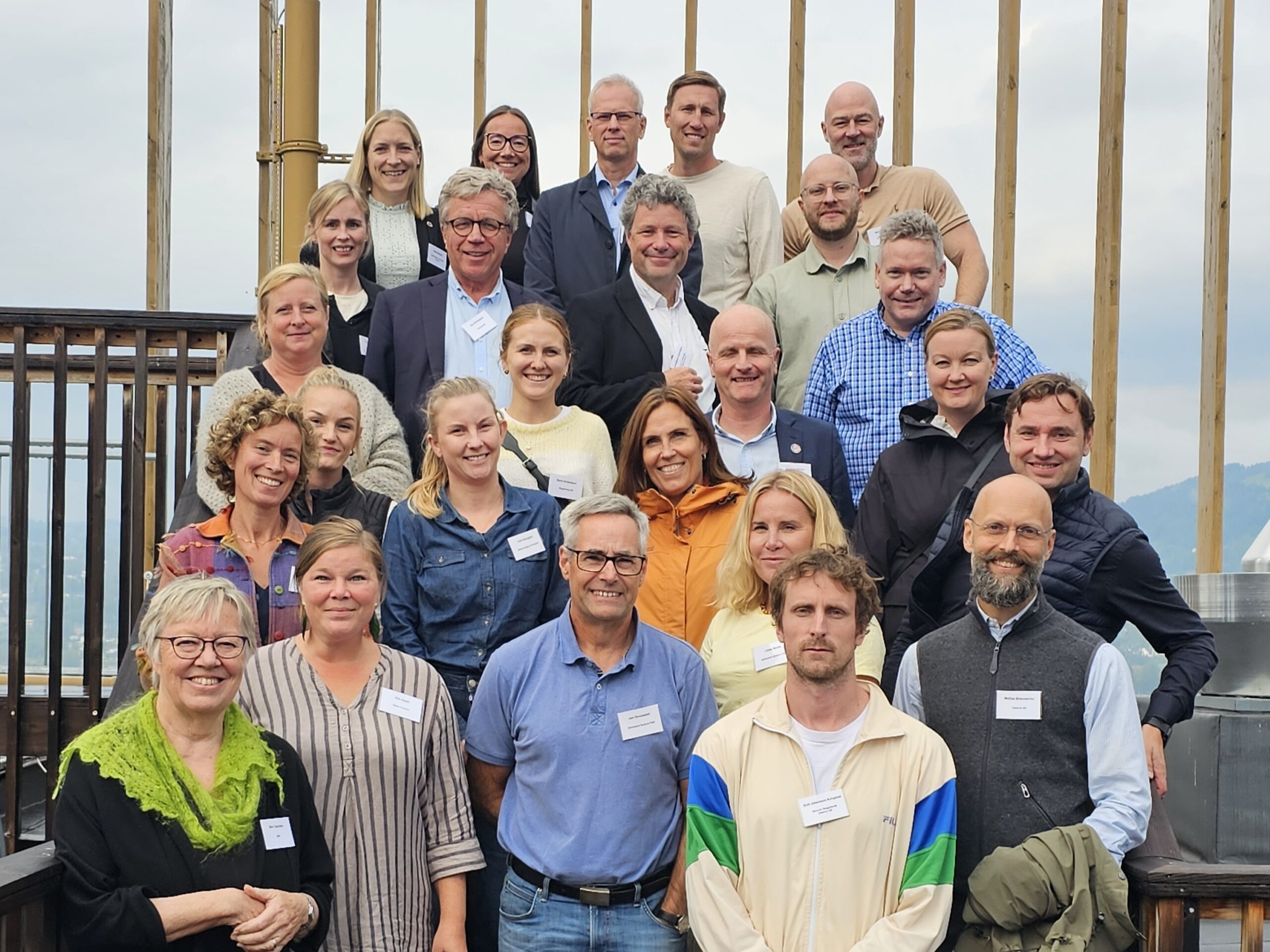
The speakers at the workshop represented both countries and different parts of the value chain.
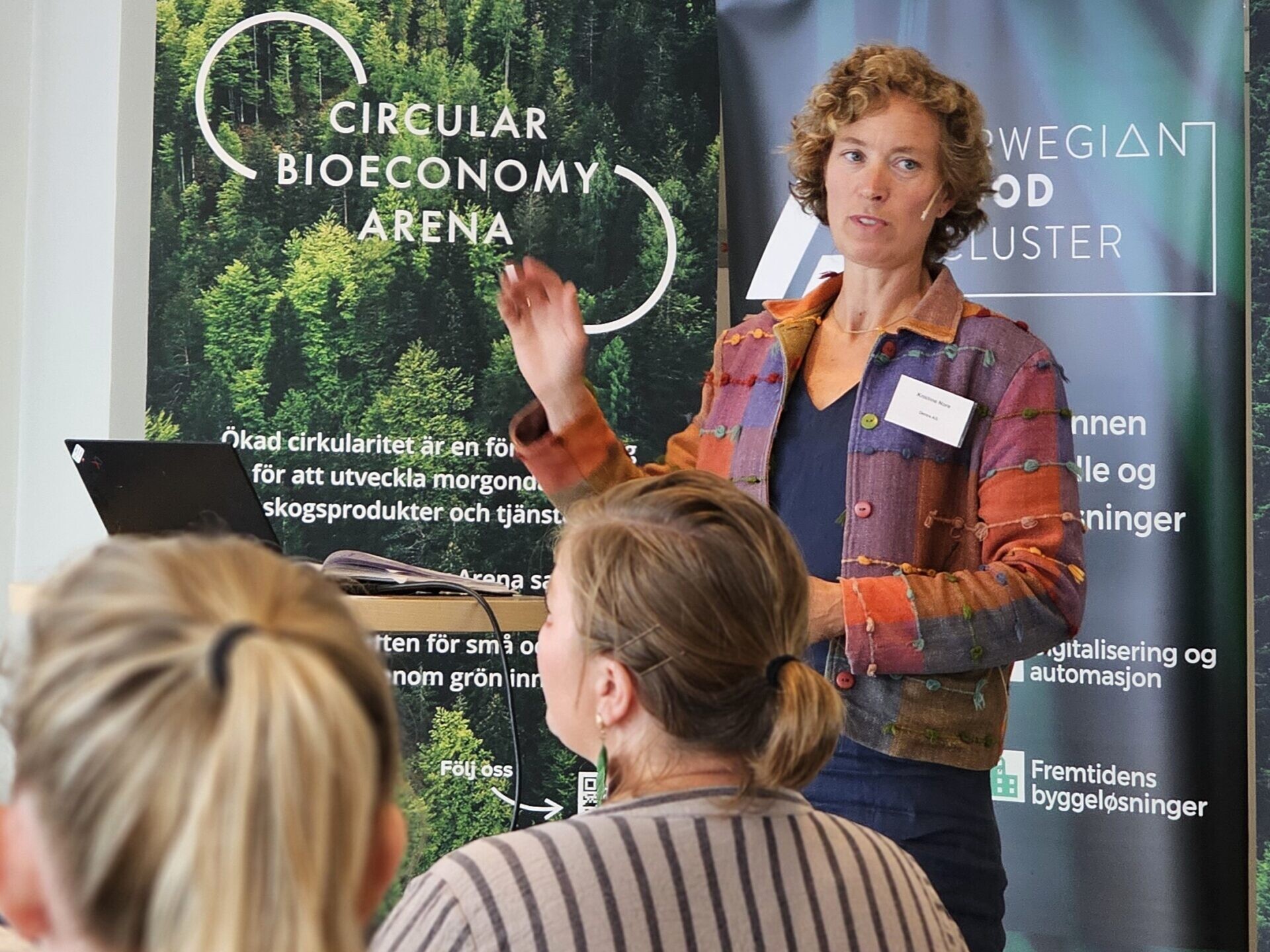
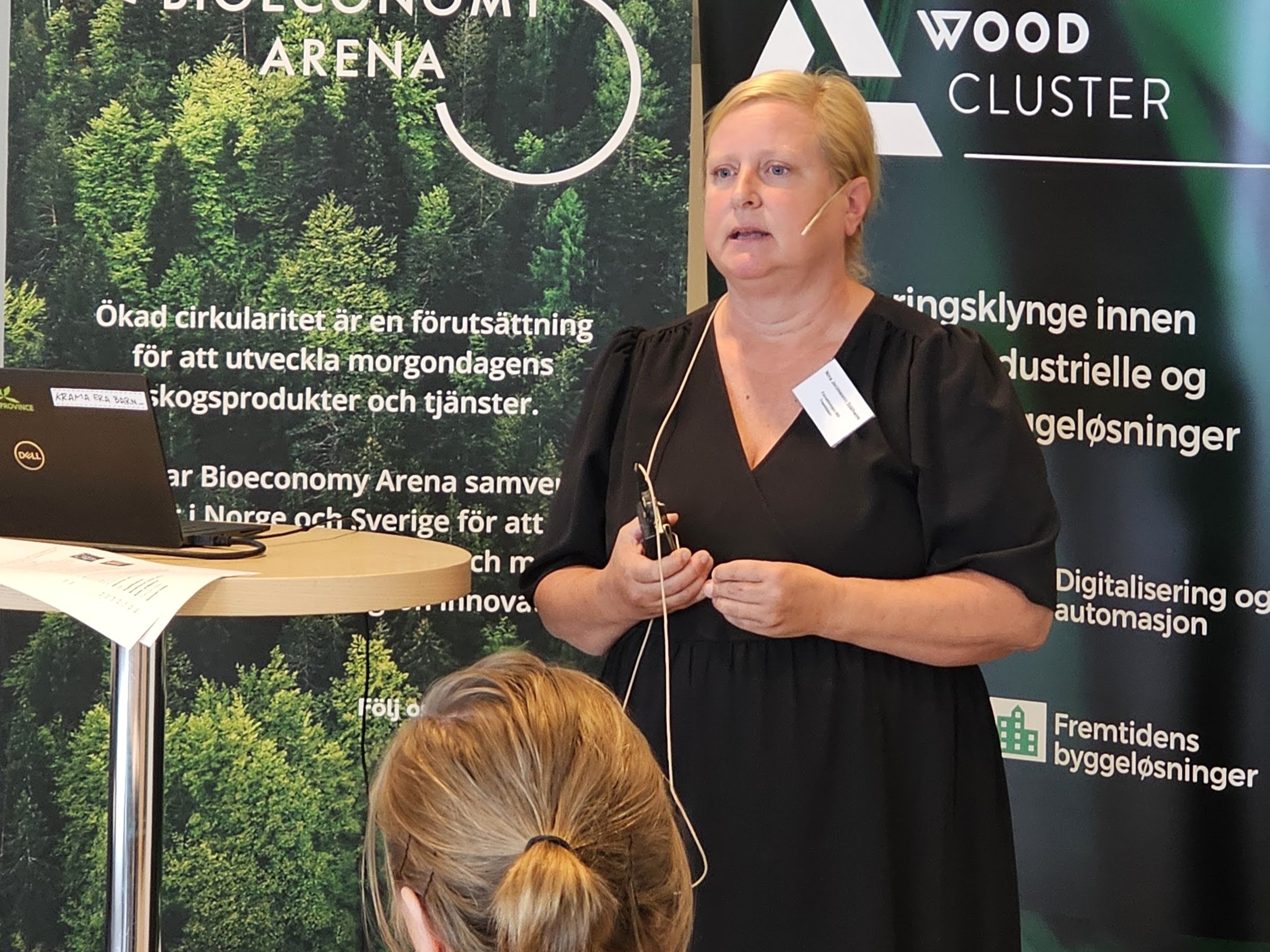
Kristine Nore, project manager for the circular project “SirkTre”, painted a picture of the market situation for the reuse of wood. Nina Jacobsson Stålheim from the City of Gothenburg showed us how the city is actively working to achieve its ambitious goal of becoming an “ecologically sustainable city” by 2030. Morten Dybesland from Statsbygg opened with a proposal for discussion: “What can Statsbygg achieve together with the wood industry?”.
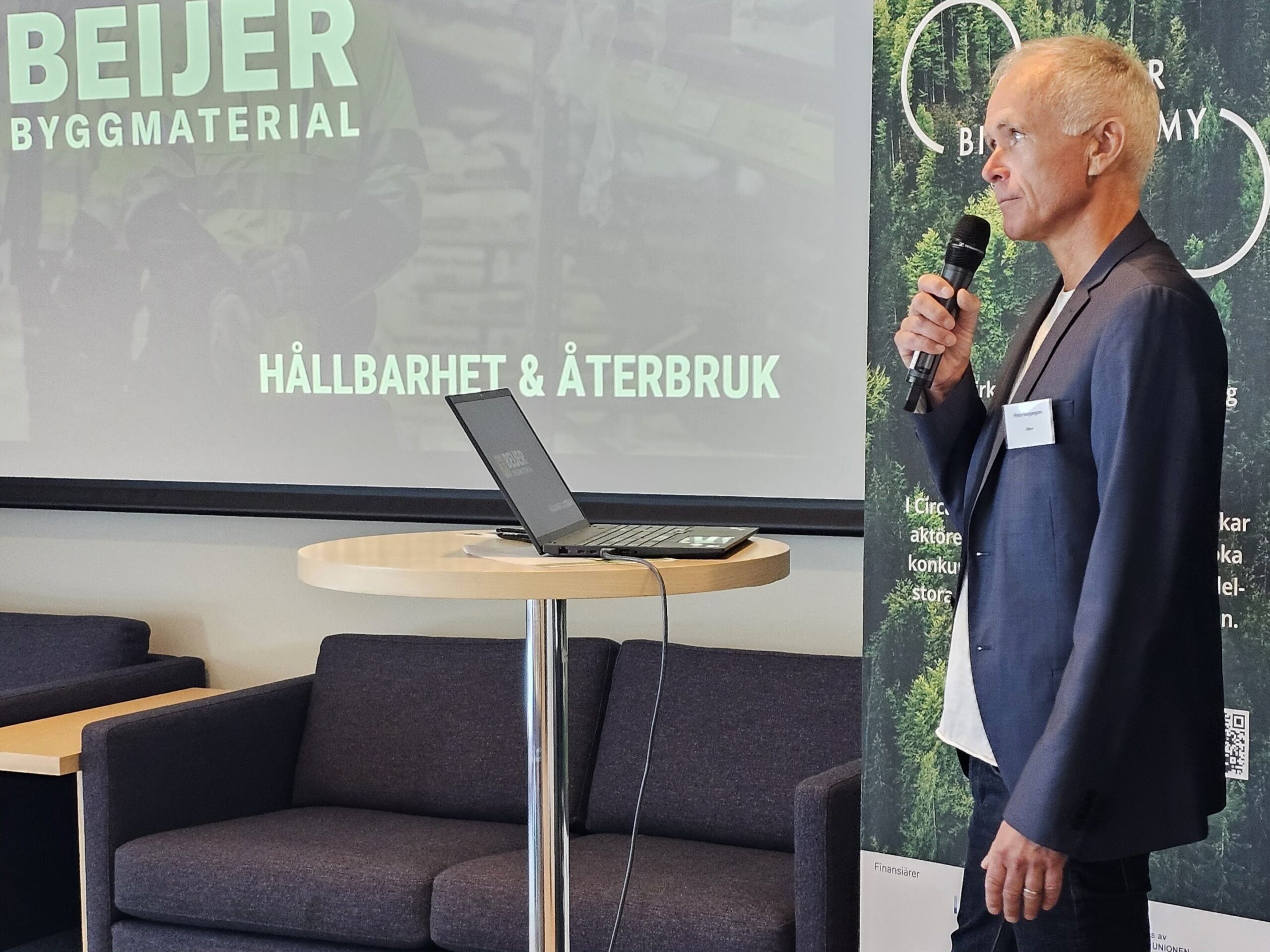
From the building materials chain Beijer, Peter Bergengren presented a number of measures that have been taken to reduce waste on construction sites and facilitate the reuse of materials in new buildings. The Norwegian building materials trade was represented by Optimera and Saint-Gobain Distribution, where Ingrid Kalstad and Kathrine Backe highlighted logistics as an essential key to success.
Useful discussions
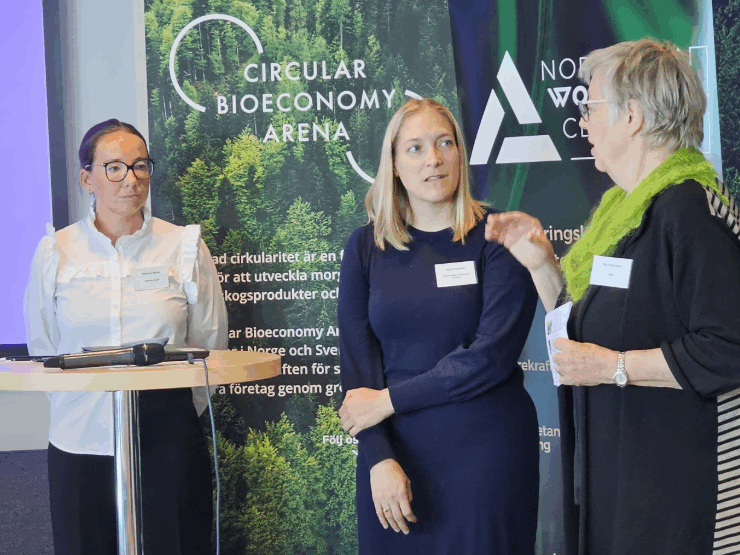
Plenty of time was set aside for discussions during the workshop to gather as much experience as possible from the participants. What are the opportunities and obstacles when it comes to using wood recovered from previous construction projects? What support needs do companies already working with reuse see? How can you take smaller experiments with reuse and scale them up?
The workshop was organized by the Interreg project Circular Bioeconomy Arena, owned by Paper Province and Norwegian Wood Cluster, in collaboration with Omtre AS, which leads the SirkTre project in Norway. On the Swedish side, Innovatum Science Park and Dalarna Science Park are partners in the Interreg project. On the Norwegian side, Kjeller Innovation, Klosser Innovation and Circular Packaging Cluster are important suppliers to the project.
Follow-up of the global nature agreement
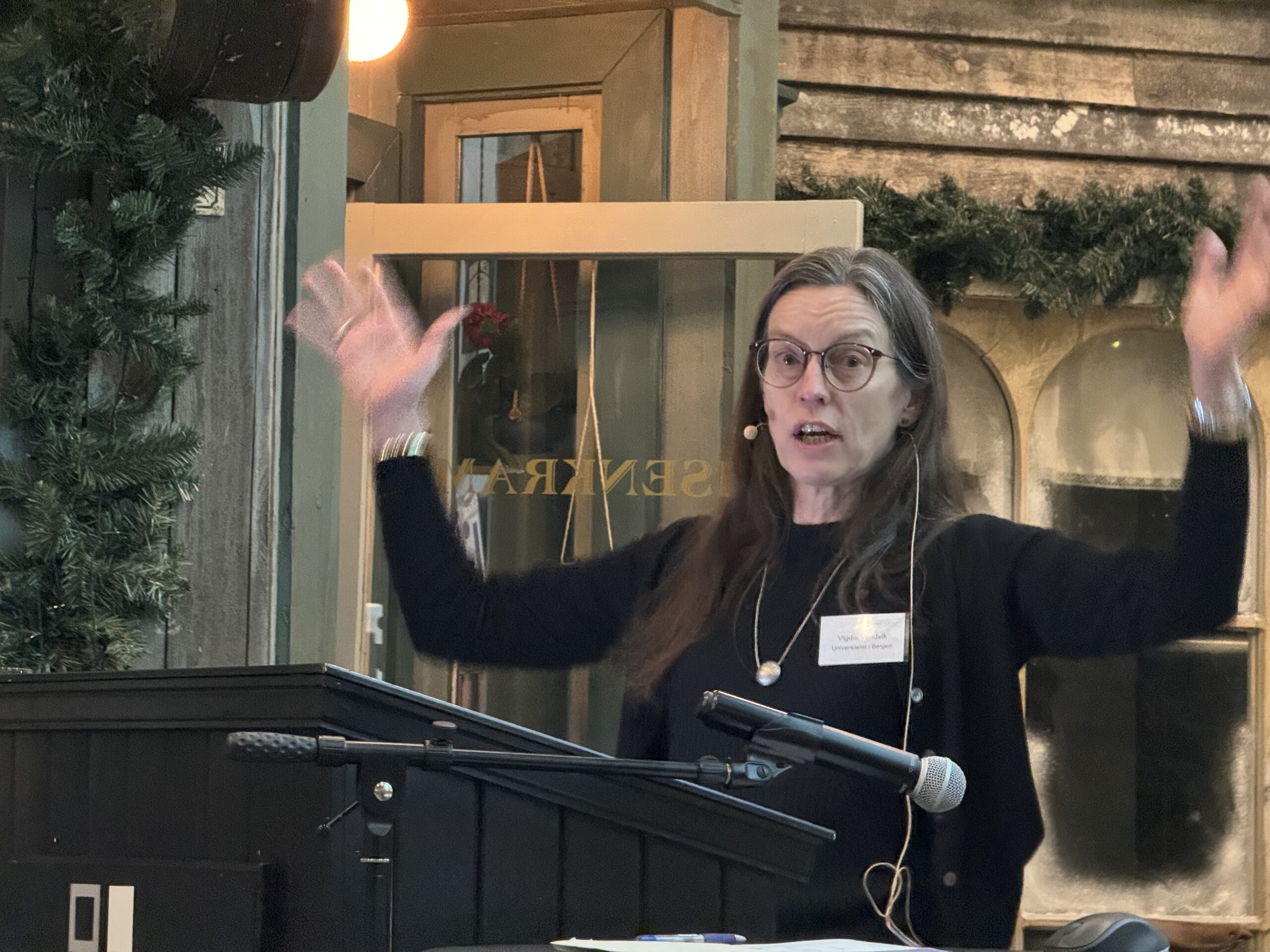
Professor Vigdis Vandvik, University of Bergen, is a member of the UN’s Panel on Nature and was a member of the Natural Hazards Committee that recently submitted its recommendations. She was invited to the owners’ meeting in NWC on April 17 to give the participants better insight into the nature agreement and the consequences for the forest and wood industry.
We won’t stop doing forestry
Vigdis Vanvik advised the industry to be a little ahead of the game and reduce the level of conflict. She had the following message about sustainable forestry:
– “We need to have an eternal perspective and not consume the foundation. We’re not going to stop forestry, but we need to look at the entire food chain, reduce waste and make products that last longer. The footprint of the forest must be reduced, and resources must be extracted in a way that causes less damage to the ecosystem. Not everything can be solved through protection,” said a committed Professor Vigdis Vandvik to an attentive audience.
Solar energy and nature
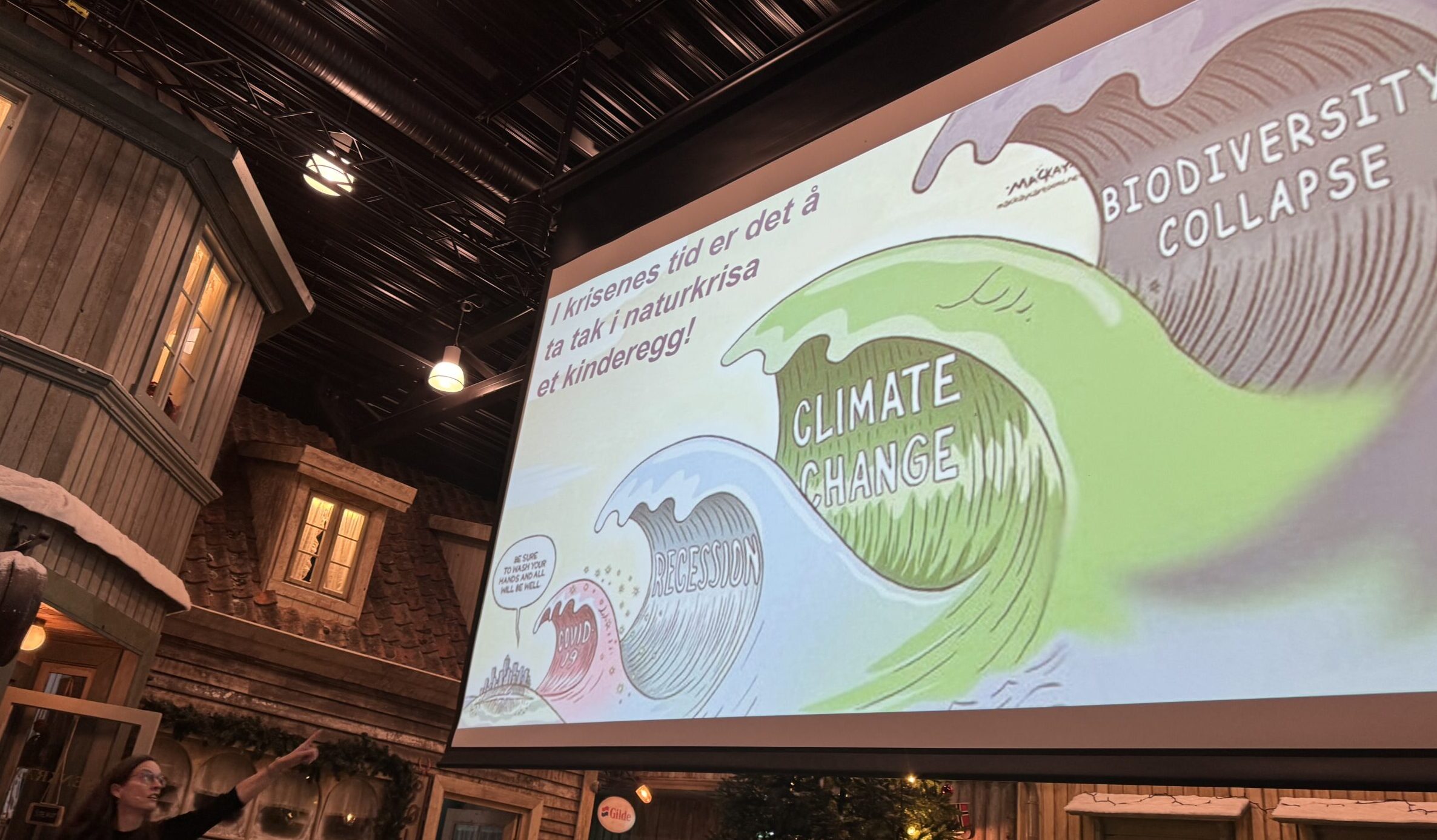
– We have a global climate crisis, but it could also be much worse, and we have more room for maneuver than we are exploiting. The biggest impact will come from using more solar energy. The second most important thing we can do for the climate is to take care of more of the nature we have. The climate crisis exacerbates the nature crisis,” said Vandvik.
Nature agreements
The UN Nature Panel has laid much of the foundation for the global nature agreement that was adopted in Montreal in 2022. The nature agreement aims to stop and reverse the loss of nature and ecosystems.
– The Nature Panel compiles knowledge. It is an important arena for showing what we agree on. A total of 24 members of the Nature Panel were present in Montreal during the negotiations. “There were 10,000 participants from the business community,” said Vandvik. She believes that nature is Norway’s environmental policy Achilles heel.
– “Land use change is the biggest threat to Norwegian species and Norwegian nature,” said Vandvik.
Large carbon storage
Norwegian nature stores almost three times as much carbon as the world average due to very large underground storage.
– CO2 molecule that is sequestered in a tropical forest lasts about 14 years. With us, we are at 60. This means that our carbon is retained much longer in the ecosystems,” said Vandvik.
– “For Norway, the nature agreement means that we must economize more with nature and prioritize needs, we must move from a linear to a circular view of resources, and we must think a little less economic gain here and now. We need to take a more long-term view in order to contribute to a system that will work into the future,” said Vandvik.
dialog
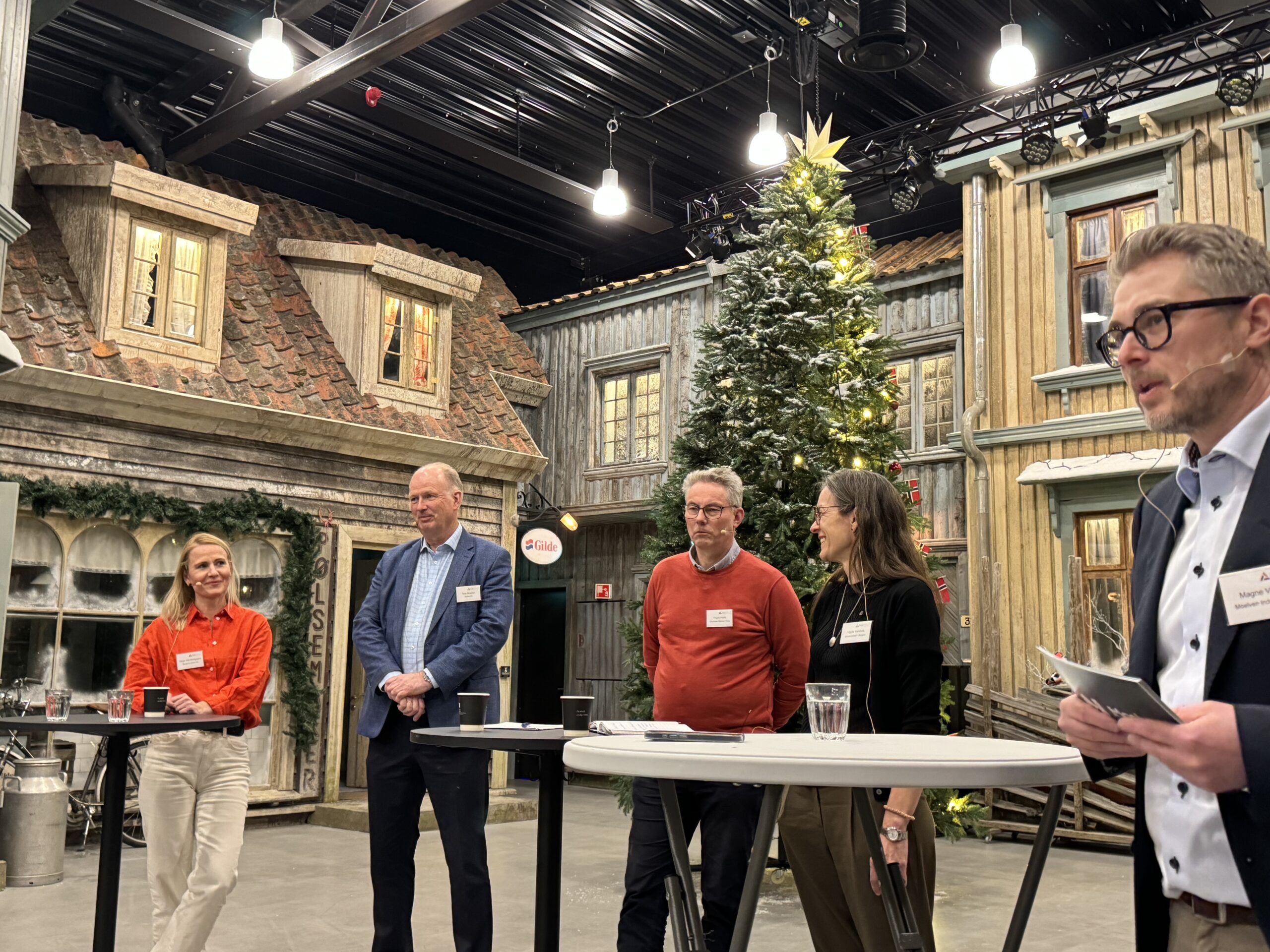
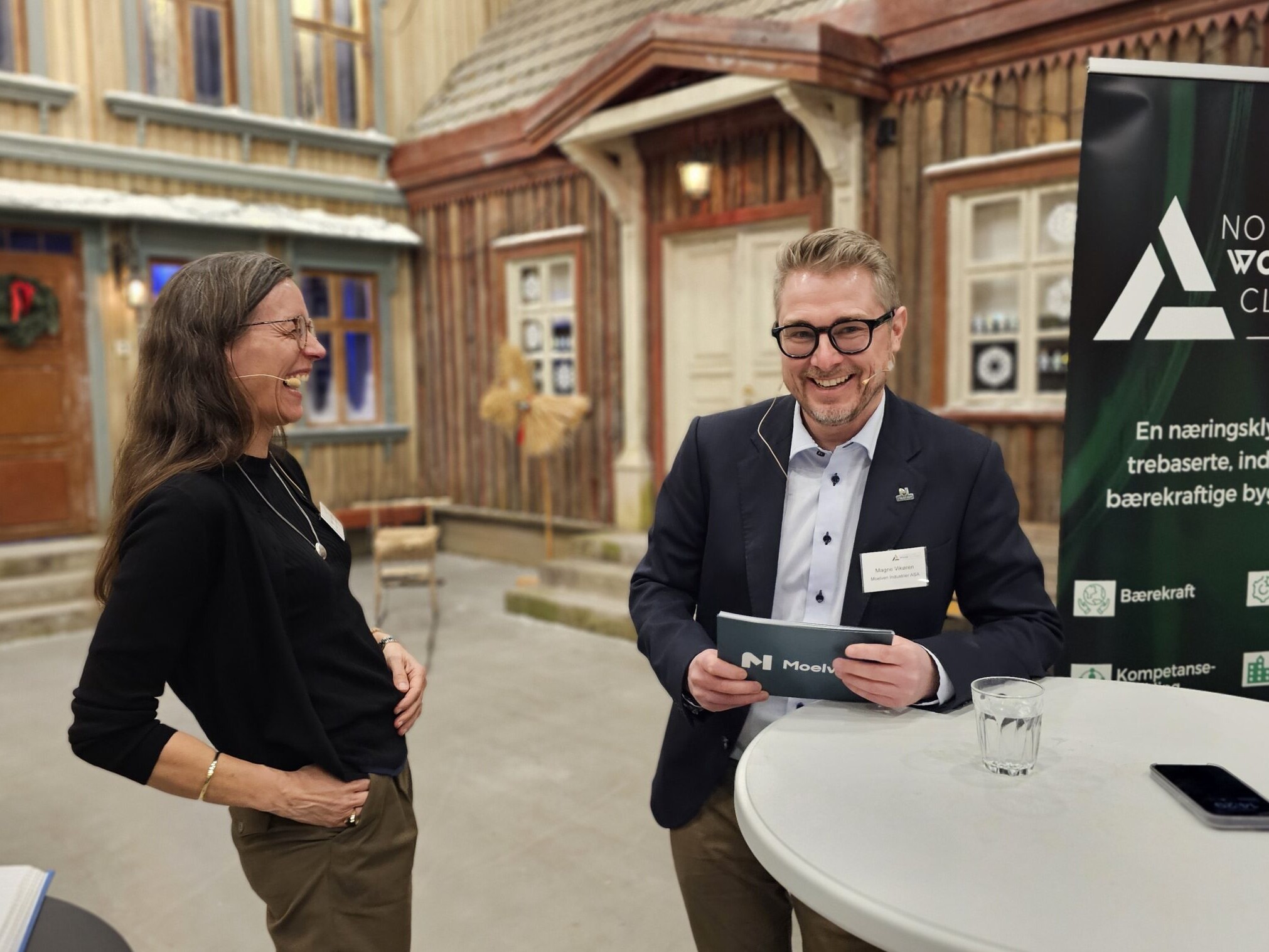
Magne Vikøren, Communications Director at Moelven Industrier, led the subsequent dialog between Professor Vigdis Vandvik and representatives of the forest and wood industry in an excellent manner.
– In recent years, there has been a lot more focus on our value chain; surface harvesting, lifespan, documentation, climate declarations, transport emissions. Because we make our living from a natural product, the focus will be on us going forward. Forestry must be sustainable. What does that mean for us?” asked Vikøren.
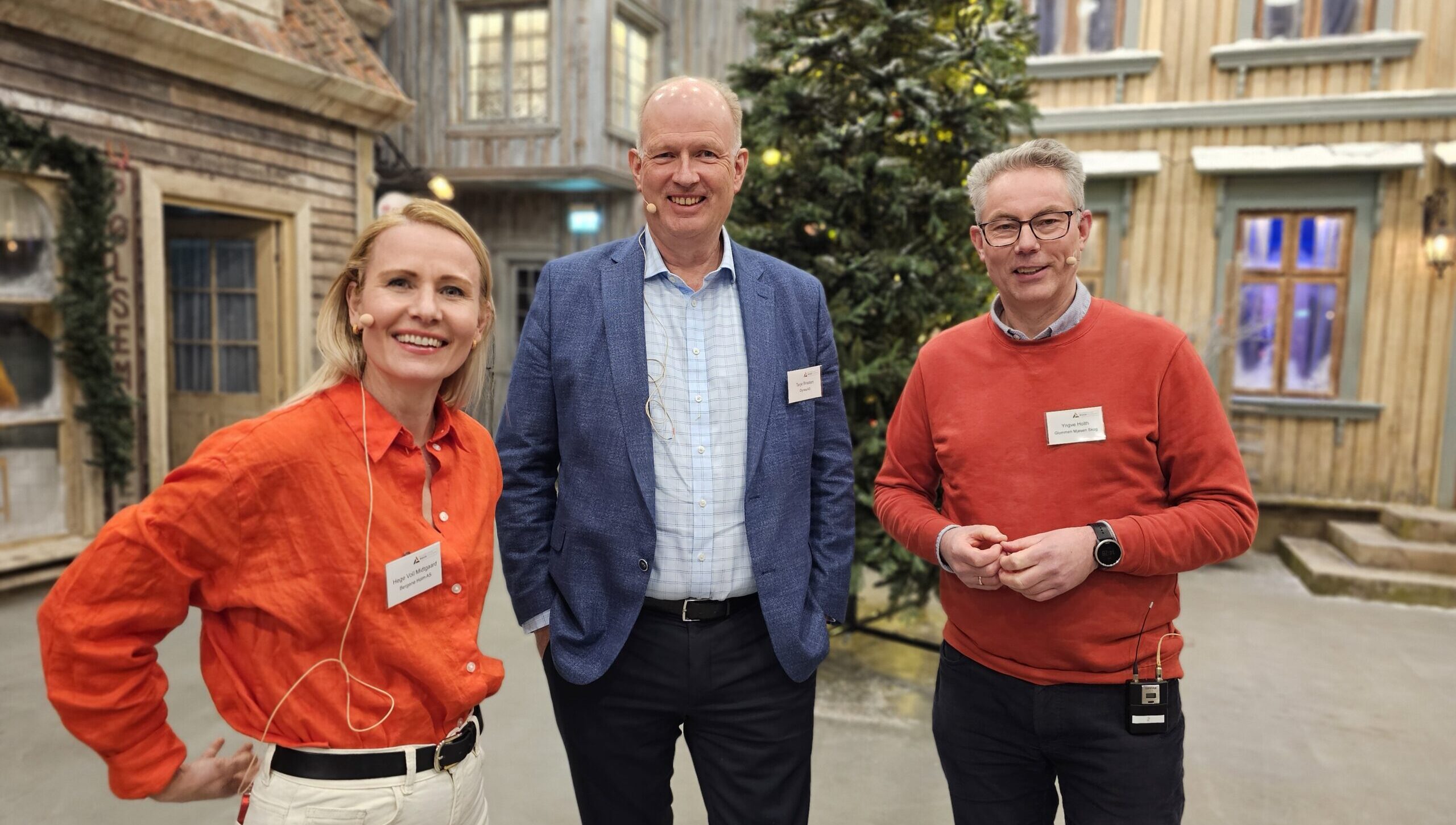
– “There are significant changes in the forestry we’re doing now compared to 30 years ago, so I’d say we’re showing a great willingness to change in forestry. The challenge for the social debate we have today is that people are bringing up something that happened in the 1960s. The problem for our industry is that it takes 30 years before you see the results of implemented changes. The time perspective is also a problem with regard to carbon accounting systems,” said Yngve Holth, Business Policy Manager at Glommen Mjøsen Skog.
– “I think there’s a lot of good stuff going on and that we have the momentum to make the innovation race happen. I see the NWC as a great way to join forces, so I’m optimistic about the future. We need to work more together, get more involved in standardization, make it easier to use wood, reduce waste throughout the value chain and increase the proportion of long-life products,” said CEO Tarje Braaten, Dynea. Tarje Braaten, Dynea.
– There are a lot of opportunities and challenges, but we need to move forward on documentation. We need to take on board the nature part. For example, how to reuse the materials. If we’re to achieve this, we need to plan correctly from the start. And then there’s the question of who picks up the bill for more circularity. By the way, solid wood doesn’t solve everything; we need to use the right structures in the right place. Then we know that the building can last much longer than 80-90 years,” said Sustainability Manager Hege Voll Midtgaard, Bergene Holm.
– So what should this value chain do more of, and what should we do less of in the future,” said Magne Vikøren and received a brief summary from Vigdis Vandvik.
– “If you can manage to be a little ahead of the curve, collaborate more and give a little to the nature side in the public debate, I think there’s a lot to be gained from that. If you reduce the level of conflict, both the industry and nature will have a lot to gain,” Vandvik concluded.
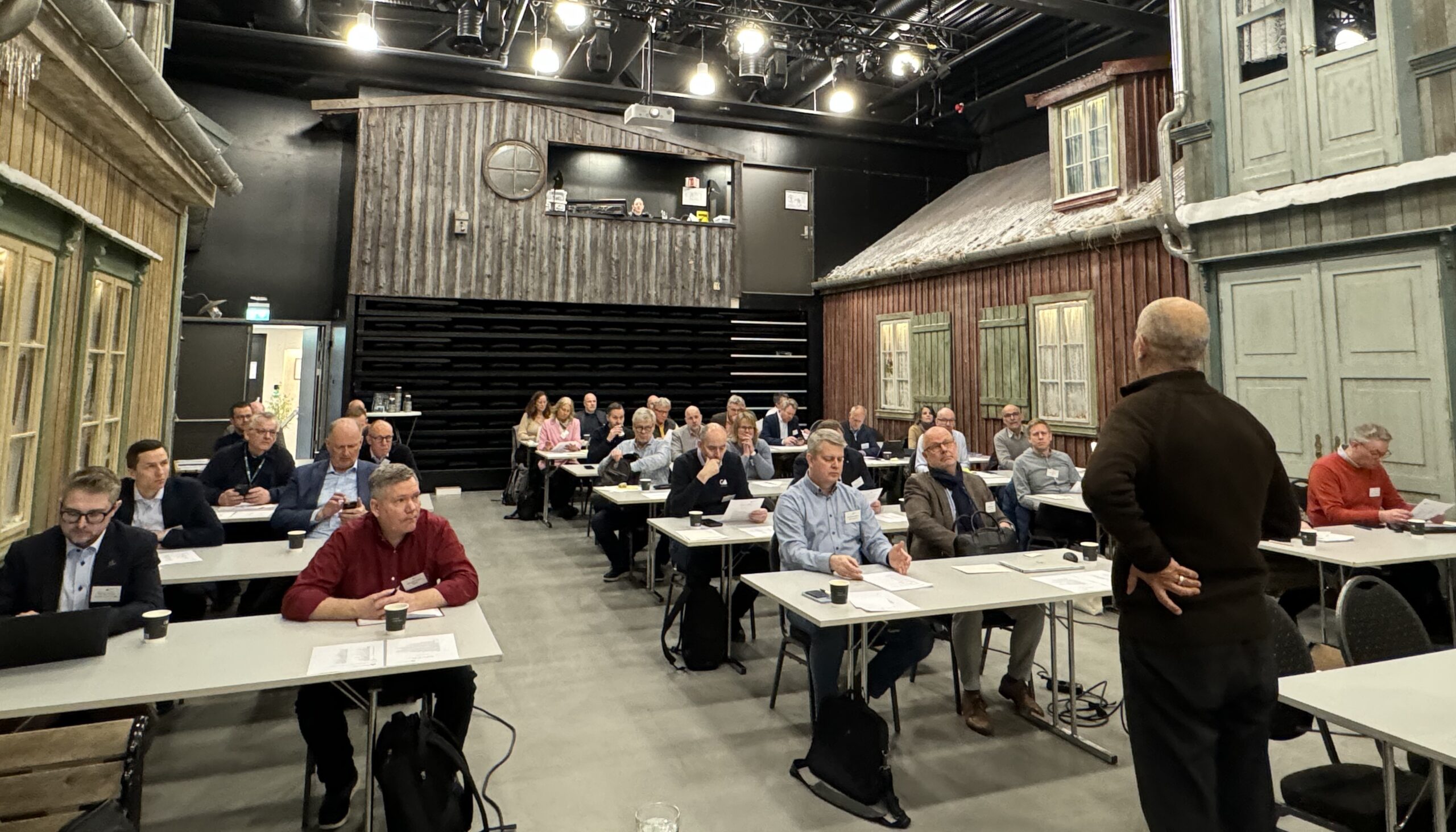
Annual meeting 2024 - positive development
Once again this year, there was a good turnout of members at the annual meeting of the Norwegian Wood Cluster, which this time was held at Prøysenhuset in Ringsaker on Wednesday, April 17. The premises provided an unusual and pleasant setting for the meeting.
Good support for cluster work
– Despite a demanding market, the cluster continues to attract interesting members and activity in key areas is high. Thanks to support from Innlandet County Council and Innovation Norway, we are developing the cluster further this year, with the ambition of being promoted to the cluster program,” said Chairman of the Board Jan Tore Meren, who thanked the members for their support of the cluster’s work.
– Climate crisis and nature crisis, various demands in the wake of the EU’s Green Deal… There are many challenges for our value chain, but also some opportunities. The value chain’s commitment to circular solutions has increased in recent years. During 2024, as part of our strategy work, we will consider whether the cluster should take a more active role in this area,” said Meren.
The annual report and financial statements for 2023 showed a positive trend in terms of both activity and finances. The board received full support in all matters at the annual meeting.
Study tours as a new offering
Cluster manager Berit Sanness reviewed the status of ongoing projects and informed about the plans for new projects that member companies want to be prioritized.
– “We try to let new projects have one of the subject groups as their ‘home’. Right now we have a new project underway in the circular area, and this topic belongs within the Sustainability theme group. We also have a new project underway within the Future Building Solutions subject group,” said Berit Sanness. She was pleased that the cluster is now recruiting a further full-time project manager, this time in the competence area of wooden structures.
– With an additional resource person in the cluster administration, we should be able to capture the companies’ needs to an even greater extent and rig relevant projects,” said Sanness.
– “Until now, we haven’t organized study tours to look at construction solutions. As more member companies want this, we are now organizing study tours at the end of May, in June and in September,” said Sanness.
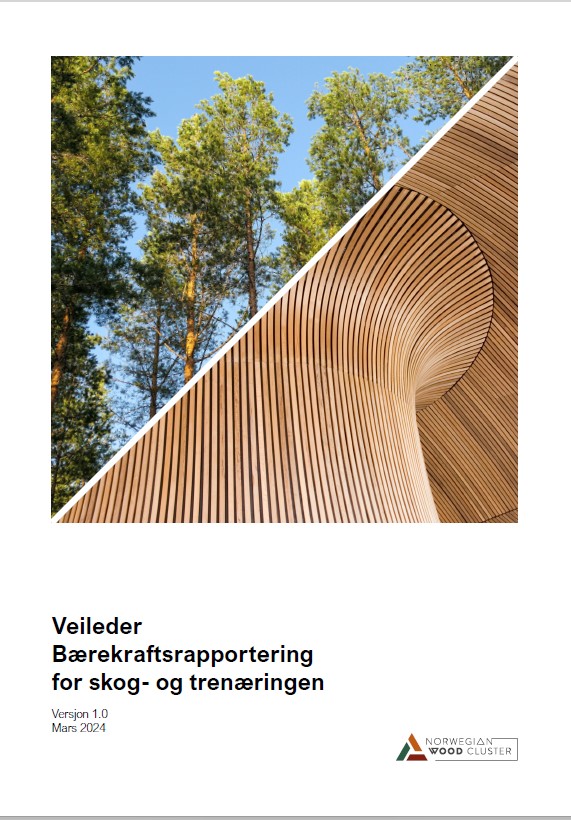
Sustainability reporting guide is available
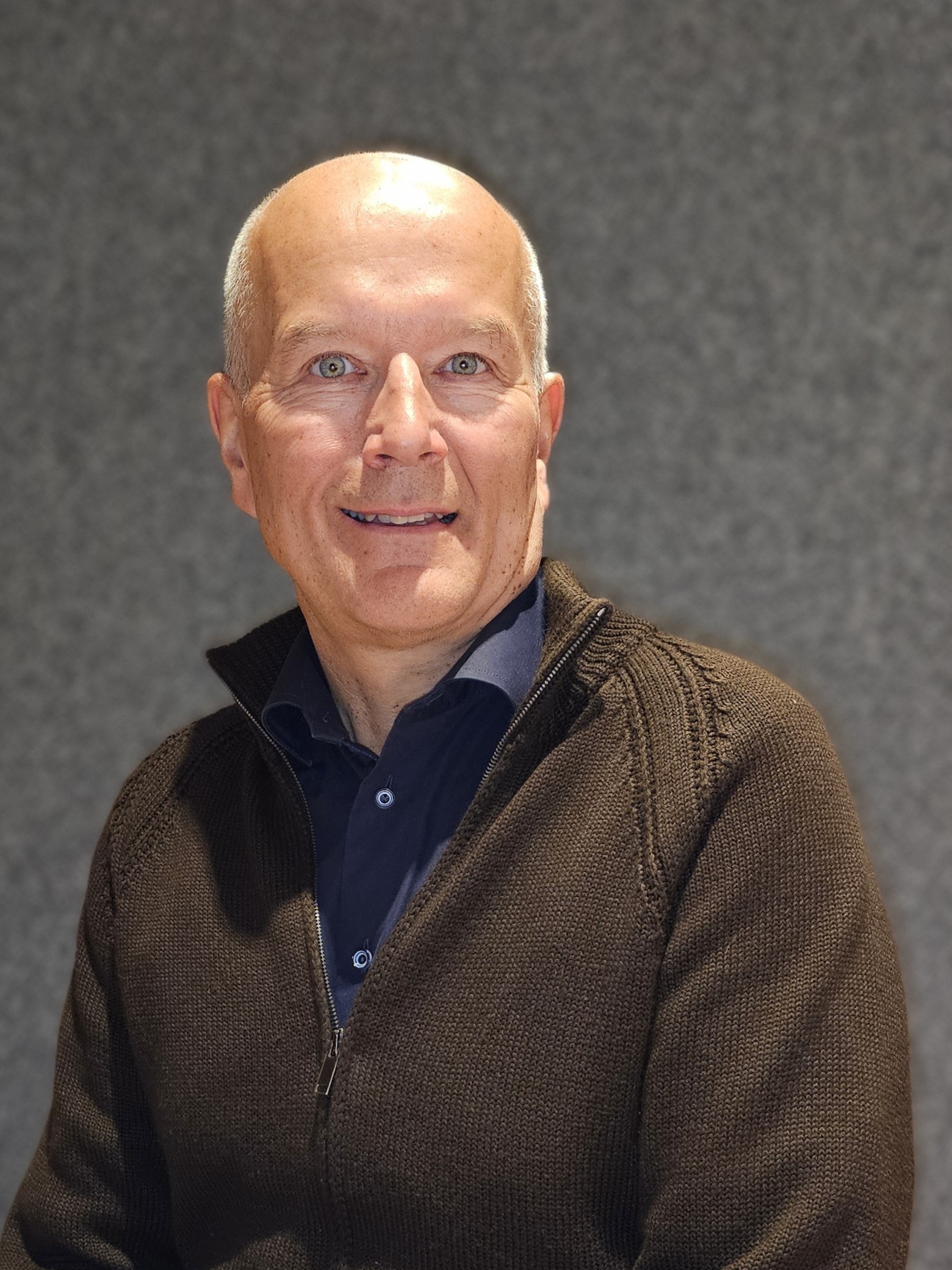
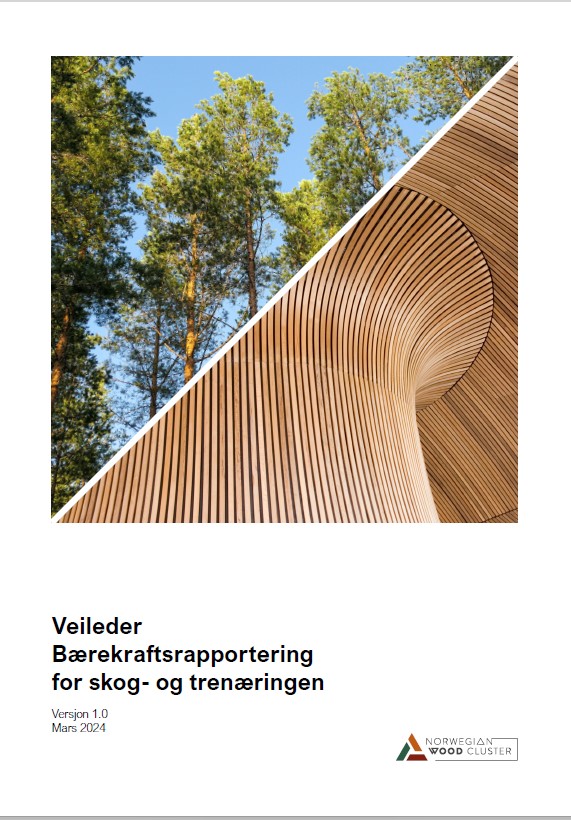
The guide is part of the project “Finance and Sustainability”, which Norwegian Wood Cluster is currently conducting. The project “Finance and Sustainability” is part of the comprehensive Green Platform project “SirkTRE”, which is supported by Innovation Norway, the Research Council of Norway and SIVA. Read more about “SirkTRE” here: www.sirktre.no
The main objective of the project “Finance and sustainability” is to create increased insight into ongoing work within finance and sustainability with relevance to the forest and wood industry, both to meet documentation requirements and to exploit opportunities. This applies in particular to the consequences of the EU taxonomy. The need for sustainability reporting is central. Reuse, material recovery and recycling are among the many topics the company must consider when preparing its own sustainability report.
Partners in the project
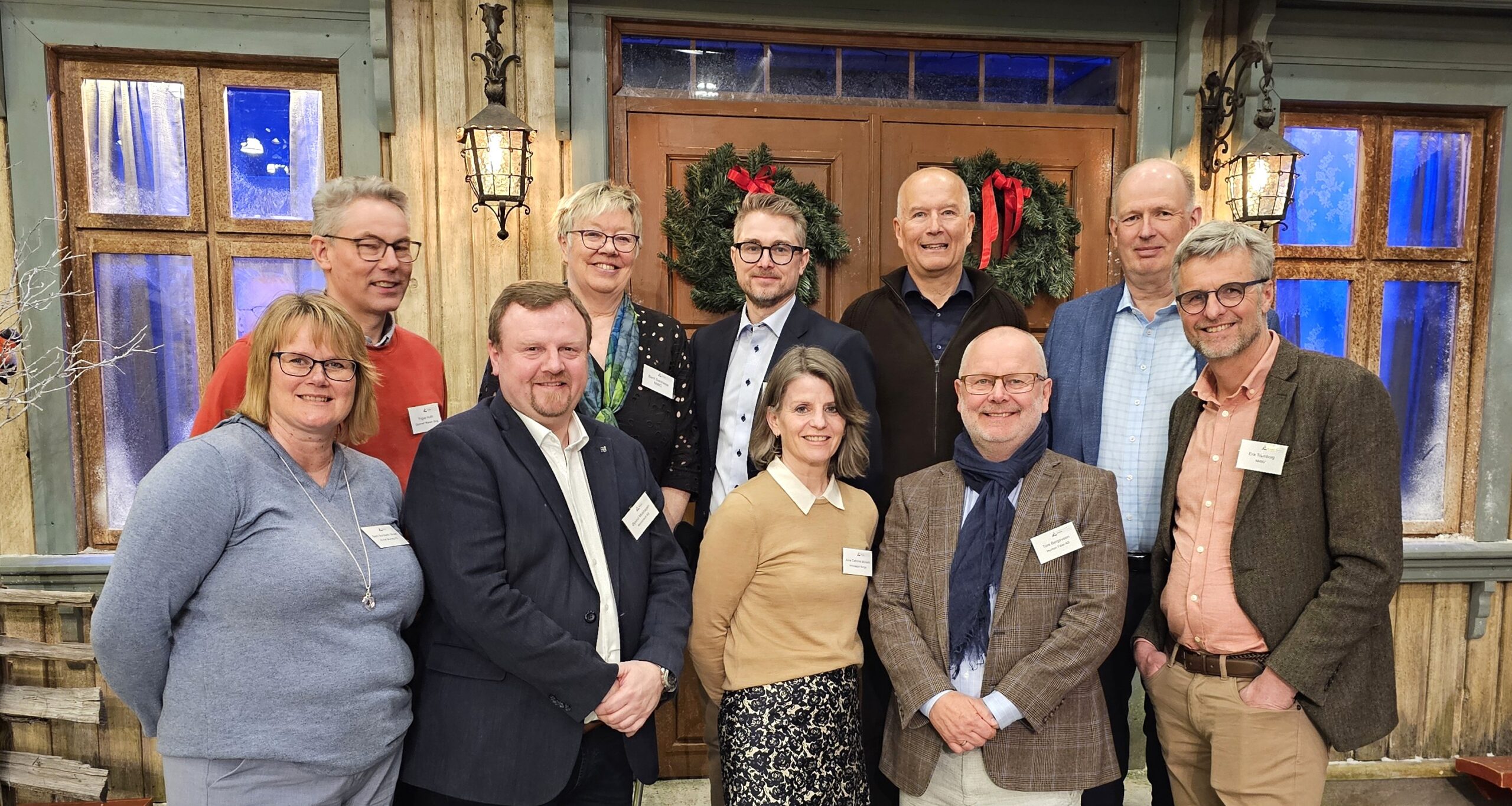
The project “Finance and Sustainability” is owned by Norwegian Wood Cluster and will be implemented 2022-2024. The project group has consisted of representatives of the partners in the project:
– Berit Sanness, Norwegian Wood Cluster SA (project manager)
– Rune F. Andersen, Moelven Industrier ASA
– Carl Christian Heiberg, Forestia AS
– Gunnar Aakrann Eek, Glommen Mjøsen Skog SA
– Vibeke Teslo-Andersen, Viken Skog SA
– Aasmund Bunkholt, TreFokus AS
– Geir Inge Brelin, SpareBank 1 Østlandet
– Ellen Alfsen, Norwegian Forest Owners’ Association
Structure of the guide
The guide is divided into five parts.
Part 1 provides an overview of the regulations you need to comply with and gives advice on how to get started with sustainability reporting. This part has been prepared by Karoline Kjos-Nordli, Glommen Mjøsen Skog, on behalf of Norwegian Wood Cluster. She has also prepared Part 2, with suggestions for reporting areas for the forest and wood industry, as well as Part 3, with an overview of requirements for sustainability-related information.
– “We would like to give special thanks to Karoline Kjos-Nordli for her efforts. She has made a significant contribution to the development of the guide and managed to make a complicated subject both clear and accessible,” says cluster manager Berit Sanness, Norwegian Wood Cluster.
In order to simplify the work of companies in the forest and wood industry, Norwegian Wood Cluster has received assistance from NIBIO to compile relevant parameters for the forest and wood industry in Part 4.
– The assignment was carried out by Aksel Granhus with assistance from Simen Gjølsjø and Rune Eriksen at NIBIO, and we thank them for their valuable help in gaining access to relevant data on forest resources, harvesting methods, forest biodiversity, tree species and productive capacity, regeneration and forest management, and energy,” says Sanness.
As a result of the “Finance and sustainability” project, the cooperative area has been added as a separate stratification variable in NIBIO’s freely available web application where users can download compilations of data from the National Forest Census.
– “We expect this to be useful for the forest owner cooperatives. The solution has been developed as part of the project, but this will also be a variable in the future,” says Sanness. She explains that transport was also a desired topic in the guide.
– We are therefore grateful to Dag Skjølaas of the Norwegian Forest Owners’ Association for ensuring that this topic is also covered. The topic is summarized in Part 5,” says Sanness.
Useful process
In order to best meet the needs of the forest and timber industry, the “Finance and Sustainability” project has conducted two workshops and three course days on the topic of sustainability reporting. The workshop on June 22, 2022 identified a number of parameters that were followed up in the work on Part 4 and Part 5, while draft content in Part 1, Part 2 and Part 3 was presented and discussed at the workshop on November 16, 2023.
– The great willingness to share among the companies during the project has been encouraging. The input in workshops and meetings has been very useful. So has the input from the project team. We thank everyone for their valuable contributions. A special thanks goes to Sustainability Director Rune F. Andersen, Moelven Industrier, for being an important contributor both in the meetings and as a sparring partner during the development of the guide,” says Sanness.
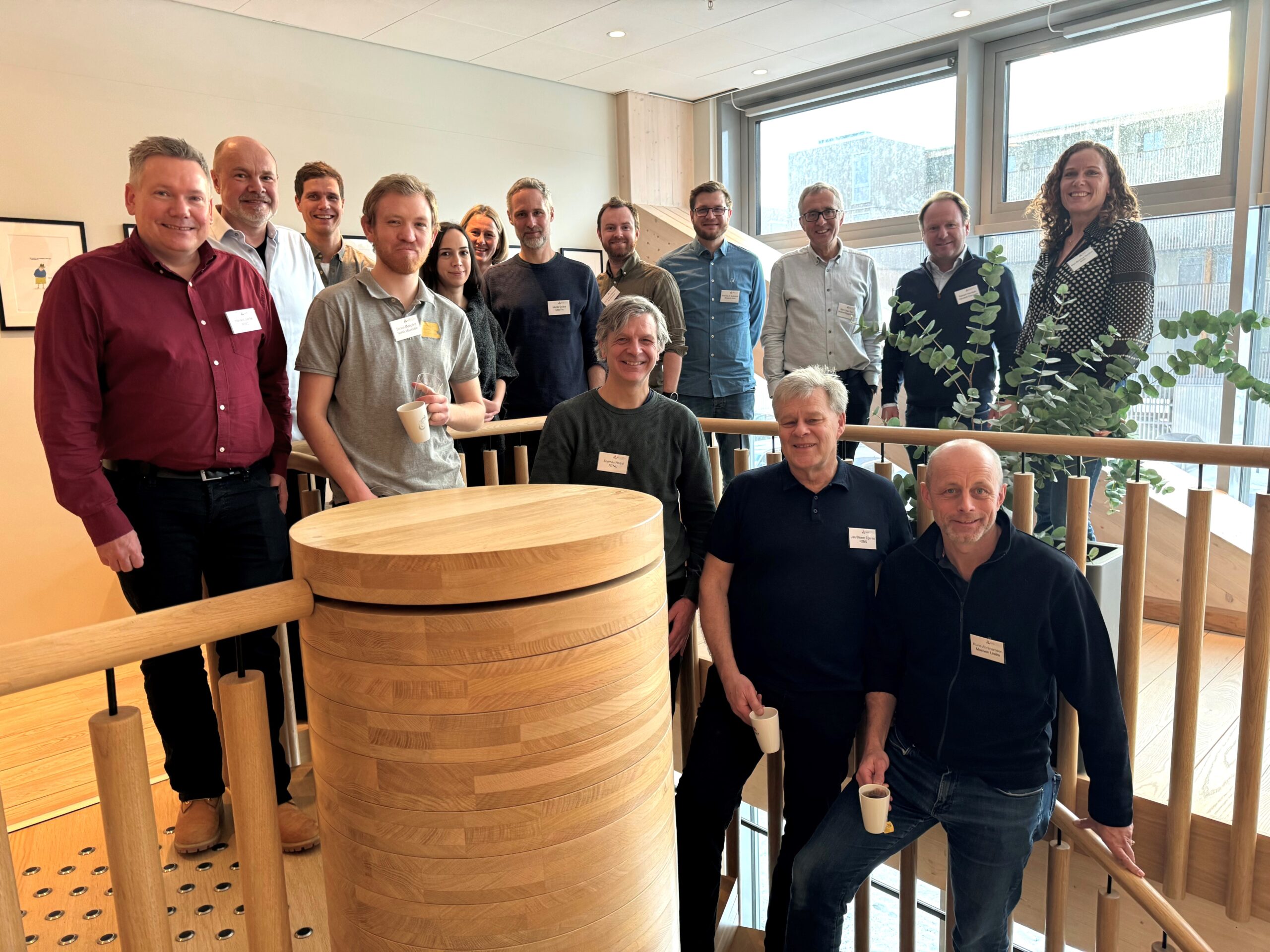
Listening audience at Mjøstårnet
Cluster leader Berit Sanness manages the NWC Professional Group Future Building Solutions and is very pleased with the meeting.
– The members of the specialist group have previously defined acoustics/vibration and fire resistance as the most important areas to address for the cluster in the area of wooden structures. The aim is to develop projects that can provide more preaccepted solutions for wooden buildings. “We have now turned the spotlight on sound and had a useful meeting on the subject, where members provided important input for a project outline in this field,” says Berit Sanness.
As a backdrop for discussion of the project outline, NWC had invited two interesting speakers; CEO Reinert Hersleth from Hersleth Entrepren. Reinert Hersleth from Hersleth Entreprenør AS and partner Erik Brett Jacobsen, Kontur Arkitekter AS. Both shared their experiences, and the presentations created great interest among the participants in the meeting.
Hersleth Entreprenør shared experiences
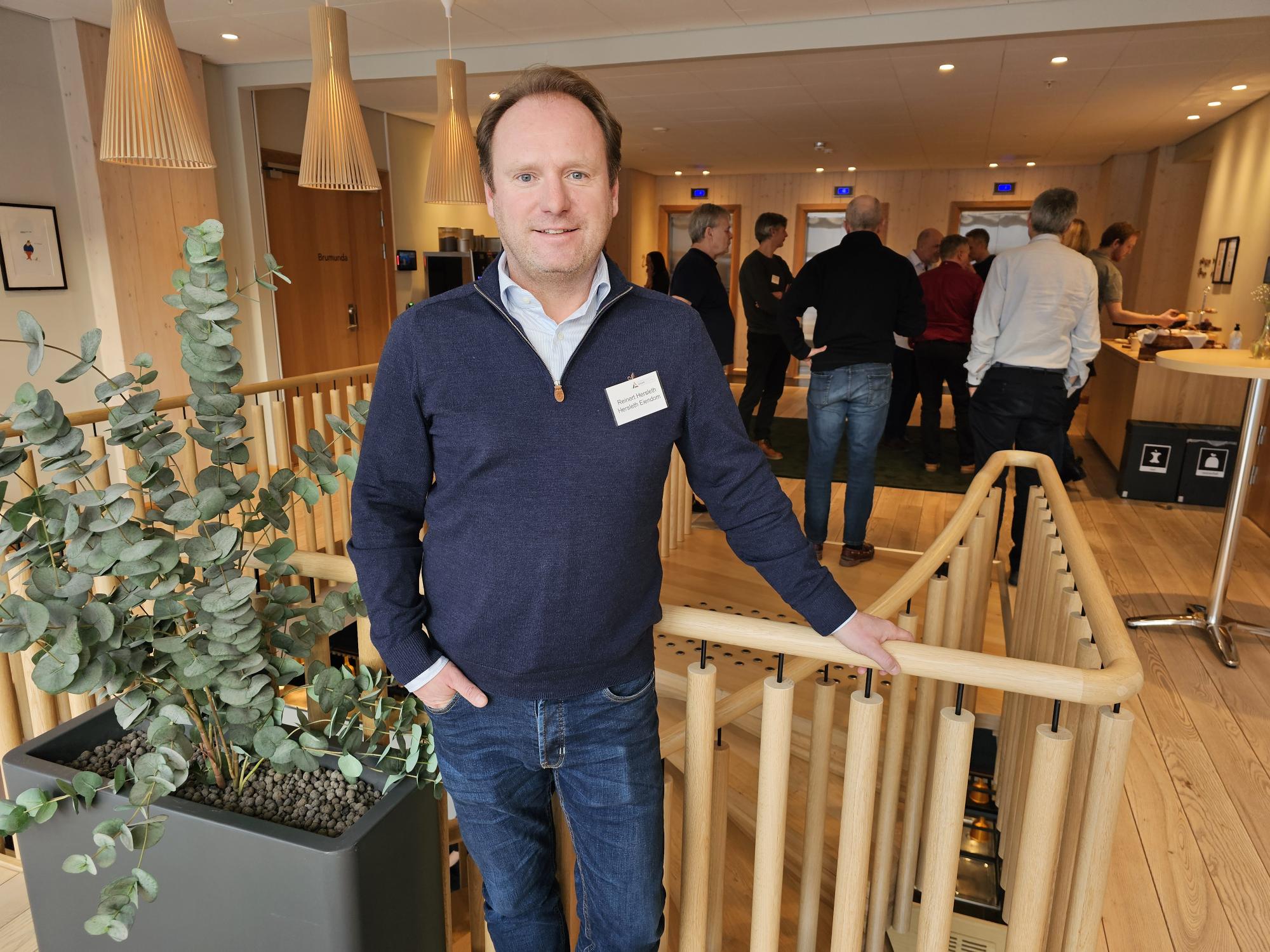
Hersleth Entreprenør AS is a family-run contracting company with main activities within traditional building and construction activities. The market area is Østfold, Follo and southern Oslo. At the meeting, CEO Reinert Hersleth talked about the company’s experiences. Reinert Hersleth talked about the company and his experience with floor dividers in wooden buildings.
– “We carry out all types of assignments in new builds, conversions and refurbishments in both the private and public sectors, including multi-purpose halls, schools and apartment buildings. Our company builds in different materials and chooses the most industrialized solution,” said CEO Reinert Hersleth, Hersleth Entreprenør. Reinert Hersleth, Hersleth Entreprenør.
In Vestby, Hersleth Entreprenør is currently building Vestbyhagen III, a new development of 64 apartments in five buildings on three and four floors. The assignment is being carried out as a turnkey contract for Husjordet AS. The apartment buildings are three and four storeys high.
– The buildings will have floor partitions in solid wood and exterior wall elements (studs) in wood from our own element production at Årvoll. We have developed the solution with floor partitions ourselves, and the construction method has been developed to achieve a more industrialized construction process. We want the same craftsmen to be able to build both the walls and the floor partitions. That’s why we’re combining stud walls with solid wood floor partitions,” said Hersleth.
– “In the area of sound, we have had innovation projects in collaboration with Brekke & Strand. It’s a key area, so it’s good that the NWC is taking a closer look at the topic of sound,” said Hersleth.
KONTUR Architects presented an interesting building
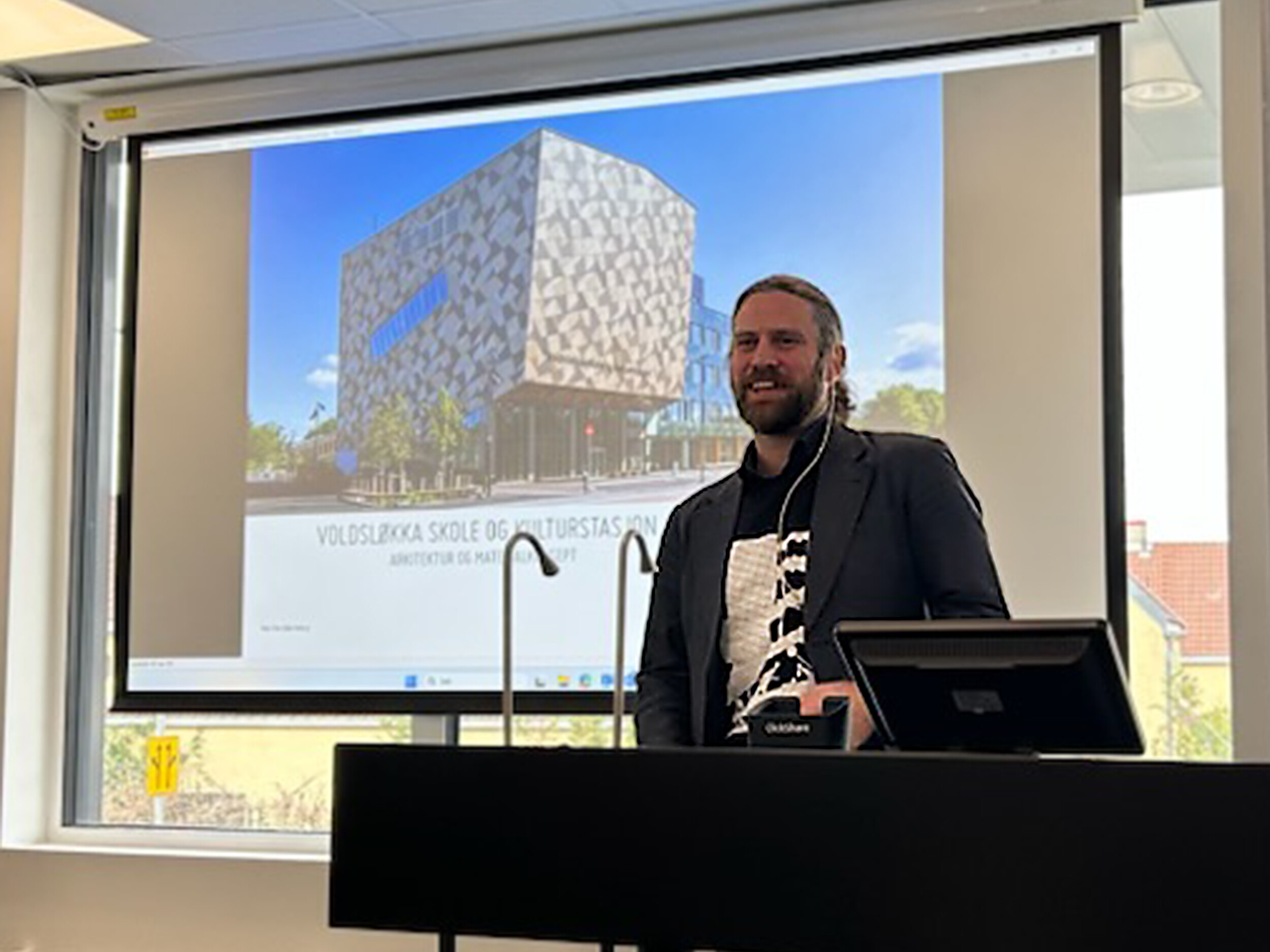
KONTUR Arkitekter AS, which has been a member of the cluster since 2019, is an interdisciplinary architectural firm that works on a wide range of construction projects, with an emphasis on residential facilities, commercial buildings, schools and care buildings. The company is headquartered in Gjøvik. At the meeting, partner Erik Brett Jacobsen talked about the company and gave a briefing on the Voldsløkka school and cultural center project in Oslo, where sound was one of the important issues.
Voldsløkka School and Cultural Center in Oslo was opened in August 2023, with Oslobygg as the developer. It is Norway’s first school with a plus house standard and combines solar and earth energy, environmentally friendly building materials, an energy-efficient building and a unique outdoor area into a European model project.
– “The project used a lot of solid wood. “We chose to deliberately highlight wooden support structures where possible for sound reasons,” says partner Erik Brett Jacobsen, who was KONTUR Arkitekter’s architect in charge of Voldsløkka School and Cultural Center, where all architectural design from preliminary project to finished building was carried out in close collaboration between KONTUR and SPINN architects.
– One of the challenges in the project was sound in rehearsal rooms and classrooms. “As a passive measure to prevent construction noise from propagating between rooms, we chose, for example, to place columns in the middle of classrooms instead of in the walls between classrooms where possible,” said Jacobsen. He explained that the cultural hall had higher sound requirements than the school building and was therefore constructed as a steel and concrete structure.
– The solution in the floor divider between the cultural hall and the areas below was a 500 mm perforated ceiling with floating screed on vibration blocks. In addition, mineral wool of varying thickness was installed above and below the main structure, air insulation layers as well as space for technical guides, a minimum of three layers of plaster and sound-absorbing ceilings. This made the floor partitions approximately 2 meters thick,” said Jacobsen.
– Voldsløkka School and Cultural Center was an exciting project to be involved in, and it required very close follow-up. Among other things, we built a solid wood structure inside the listed building that was connected to the new school building and the new cultural center. Here, we also retained the original wooden structures as environment-creating elements inside parts of the building. They did not contribute to the load-bearing capacity, but were not demolished to preserve the historical and visual aspects. It was a good solution,” says Erik Brett Jacobsen.
Lillehammer: Interest in climate planning of buildings
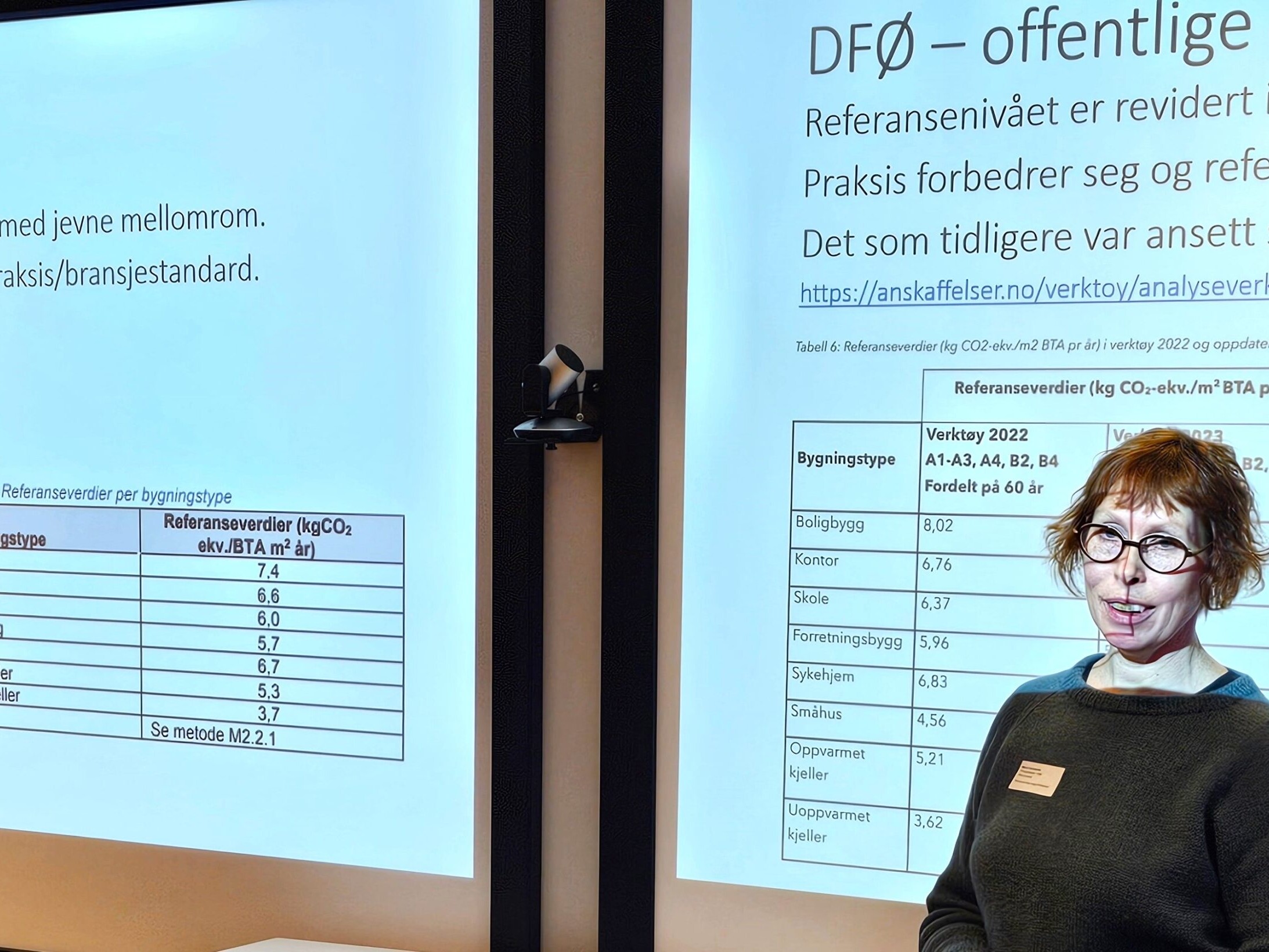
“It would be nice to have a simple answer to that question,” says Marit Smidsrød from the project management team, “but there are a lot of factors that come into play, including the choice of materials, which we have chosen to focus on in this project, but also energy solutions, emissions at the construction site, location in terms of transport, land use, etc.
Reference values will come
In July 2022, TEK 17 introduced a requirement to prepare greenhouse gas accounts for materials in apartment blocks and commercial buildings. So far, however, there are no requirements for how much greenhouse gas emissions the materials can have. “Both Denmark and Sweden have already adopted reference values for greenhouse gas emissions in buildings. In Norway, similar work is underway, but we don’t know anything about the time perspective,” said Smidsrød. “One thing is certain, however: requirements and criteria will be introduced. Among other things, this will mean that the public sector, which currently accounts for 10.3 million tons of CO2 emissions per year, will need more knowledge about the climate footprint of its procurements.
– We are committed to taking responsibility
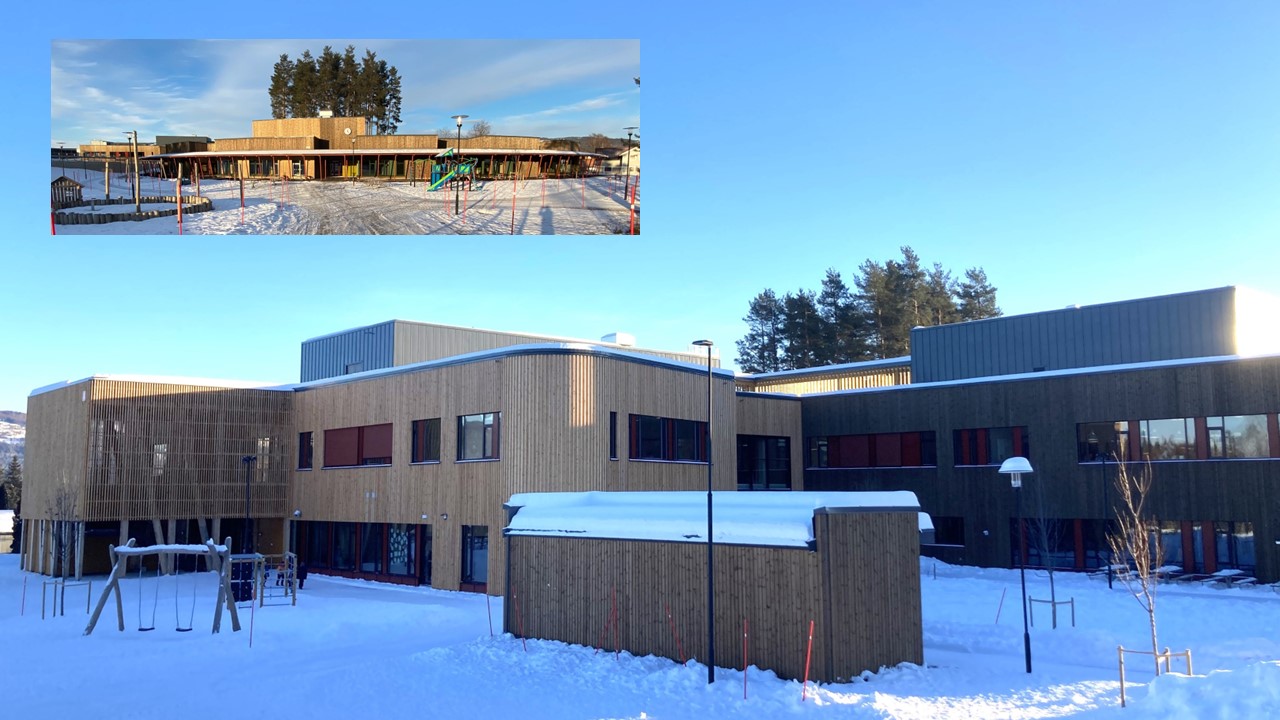
Kjetil Ulset is employed by Gjøvik Municipality, and has participated in the project group and steering committee for Biri kindergarten and Biri primary school.
– As a municipality, we do not have unlimited money. But we do have guidelines for the climate, and we cannot ignore these. We have national and regional commitments that form the basis for our local guidelines, set out in Gjøvik municipality’s climate plan. One of the goals in the climate plan is to “reduce the climate footprint in the building and construction industry”, and then we must set requirements so that this is met, Ulset explained.
Want clients who set clear requirements
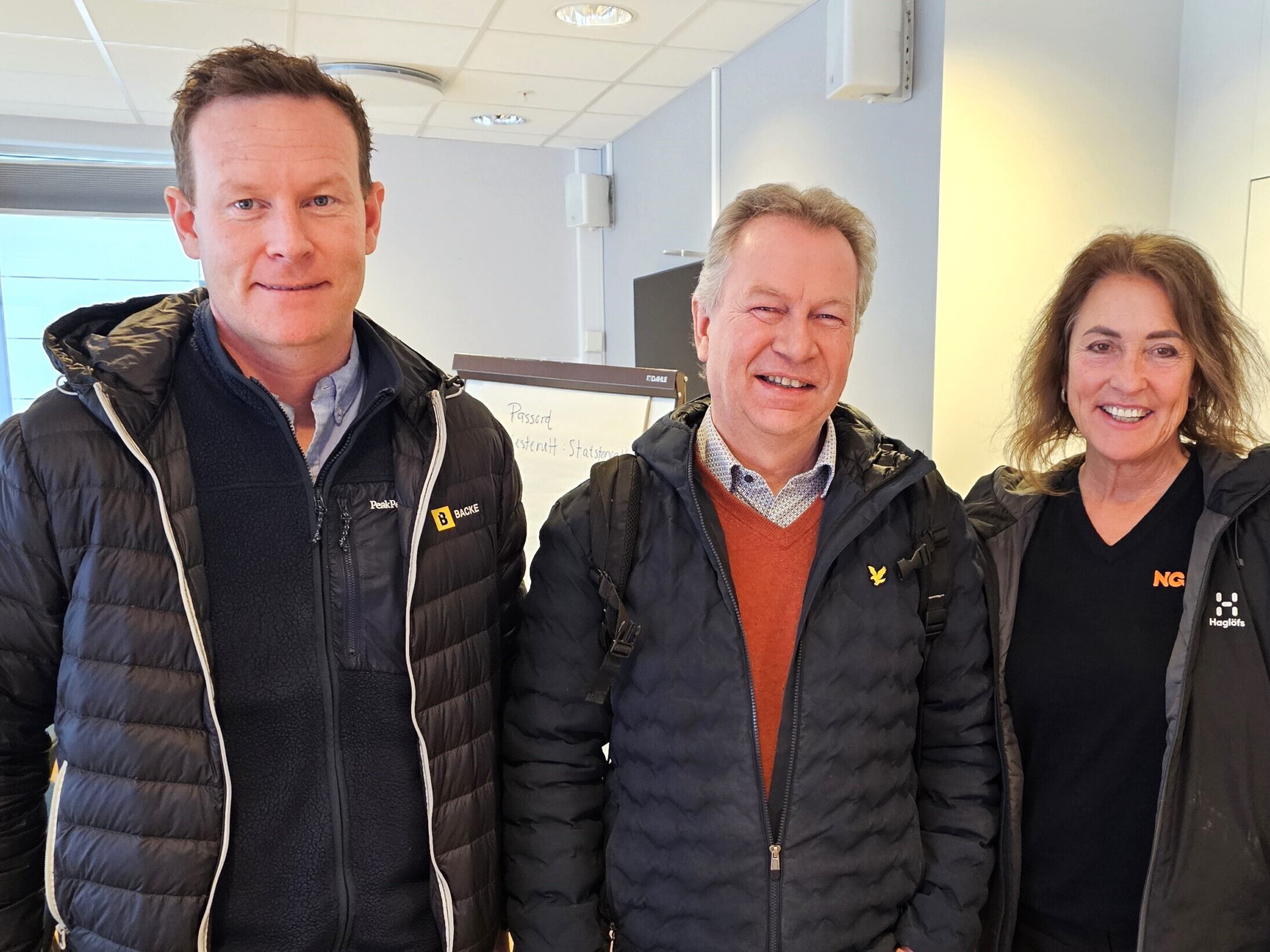
Hans-Jørgen Bjøralt is general manager of Backe Oppland, which was commissioned to build the school and kindergarten. The Backe Group is Norway’s largest family-owned construction company, and is the largest construction company in Innlandet (Backe Oppland and Martin M. Bakken).
– “In this project, the municipality set a number of requirements. It’s important to emphasize that these were requirements and not guidelines, which I think is absolutely essential,” said Bjøralt.
Examples of specific environmental requirements in the project:
The building must satisfy requirements for greenhouse gas emissions for materials including A1-A4, cutting and waste in A5, B4-B5 and C1-C4. The emission limit to be satisfied is 199 kg CO2/m2 GFA. Greenhouse gas emissions must be documented with calculations in accordance with. NS3720. Documentation must be available before the start of construction work.
Materials used must be low emitting. Emission requirements according to tab. 14 BREEAM Nor 2016 hea 02. The requirement applies to all interior materials and surface treatments.
– The municipality has used a number of requirements from the Breeam manual and selected requirements that are important to them. I think this is the right way to work. For this type of building, project-specific targets are more appropriate than Breeam certification. It looks different for a private developer selling a commercial building in an attractive area, where it may be worthwhile to deliver a high level of Breeam certification. But for public service buildings, a full Breeam certification can entail a lot that you have to pay for but don’t need,” said Bjøralt.
Examples of environmental adaptations in the project:
– Solid wood in all load-bearing structures, ceilings, auditorium, parts of the roof
– Wood in all interior and exterior walls
– High degree of precut materials
– Low carbon concrete class A
– Flooring with a low greenhouse gas footprint
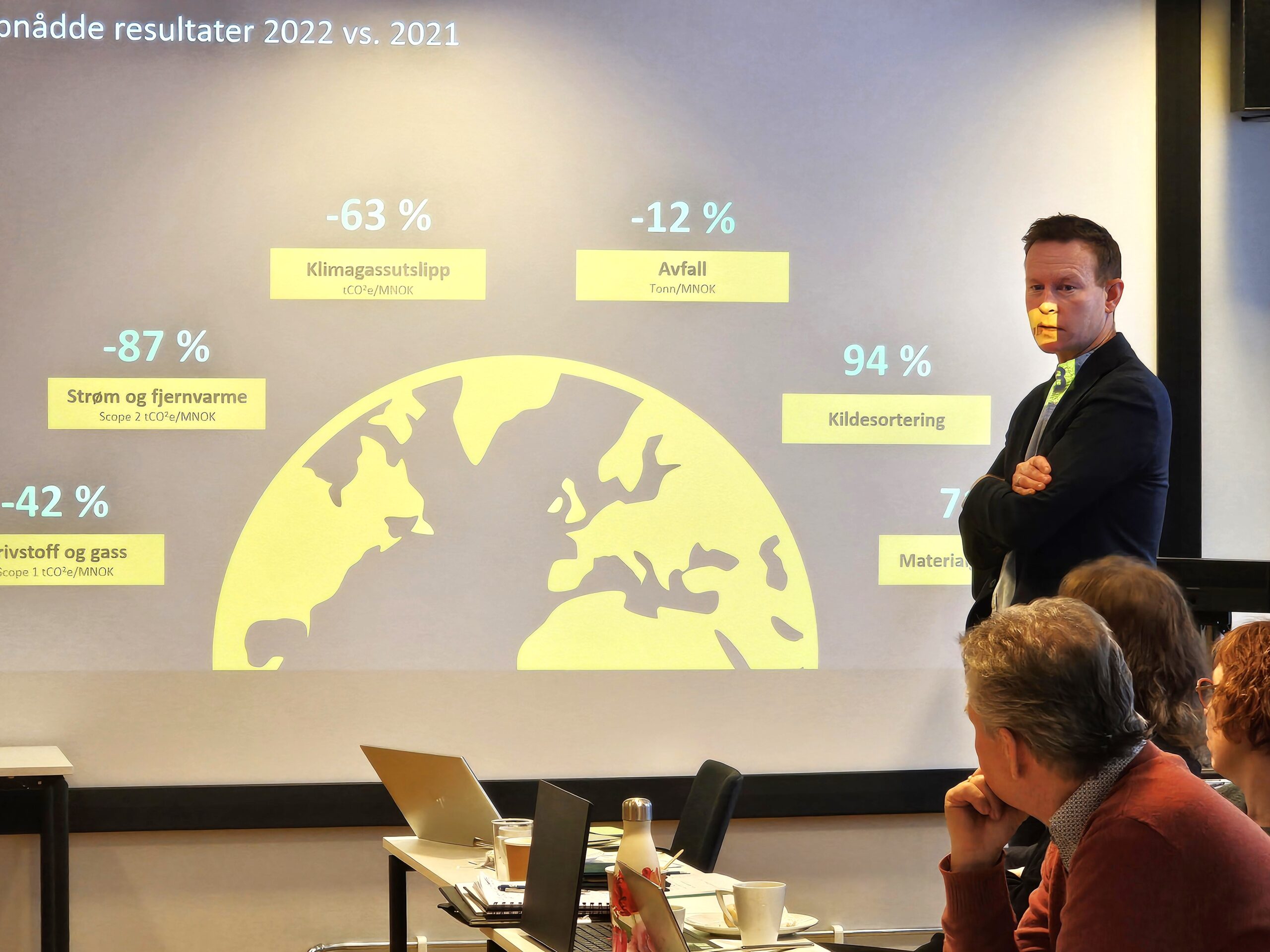
– Waste: 99% sorting rate, 79% material recycling
– Energy: Solar cells on the roof and local, waterborne heating (also used during the construction period)
Involve the recycler from the start
Anita Storli represents Norsk Gjenvinning, which was responsible for commercial waste from the project. She said that the project has achieved a very high degree of both sorting and material recycling, thanks to early involvement.
– “It’s absolutely essential to get good results that we are involved right from the start-up meeting and follow the process. In this project, Backe Oppland has involved us right from the start, which is why we managed to achieve a 99% sorting rate and 79% material recycling rate,” she explained. Storli also highlighted other success criteria, such as ensuring resource-efficient packaging for the products, working with precap and returning as much as possible of what can be returned, such as pallets. “Waste should always be part of the construction meetings, so that you can follow the statistics and intervene when things don’t go as planned,” Storli said.
Upcoming breakfast seminars from project Climate-friendly buildings Innlandet:
About Climate-friendly buildings Innlandet
Project (2023-2026) that will contribute to more climate-friendly construction in inland Norway
Funded by Innlandet County Council and Innovation Norway
Focus areas: Climate-friendly materials and building systems
Target group: The entire value chain, from client to developer, architect, contractor and building product supplier.
The project will raise competence in areas such as
– Greenhouse gas calculations
– Climate footprint for different materials and systems
– Certification schemes for climate-friendly buildings
– Reuse and repurpose
– Financing schemes
Duration: 2023-2024-2025
The project is run by Norwegian Wood Cluster, Civitas and Norconsult
More info at www.klimavennligebygg.no
Would you like to receive newsletters from Klimavennlige bygg Innlandet? Click here
Fresh start for new project manager in NWC
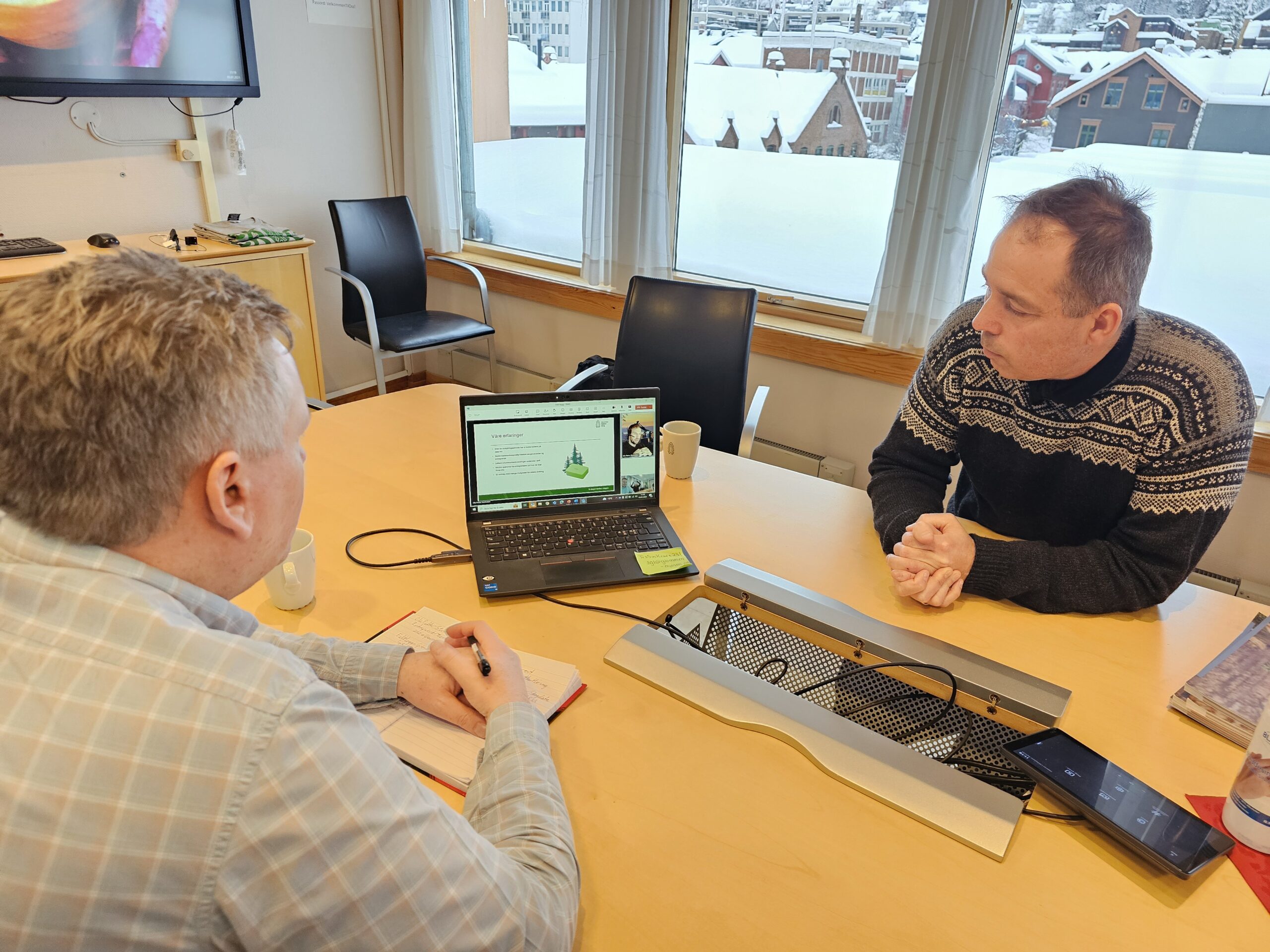
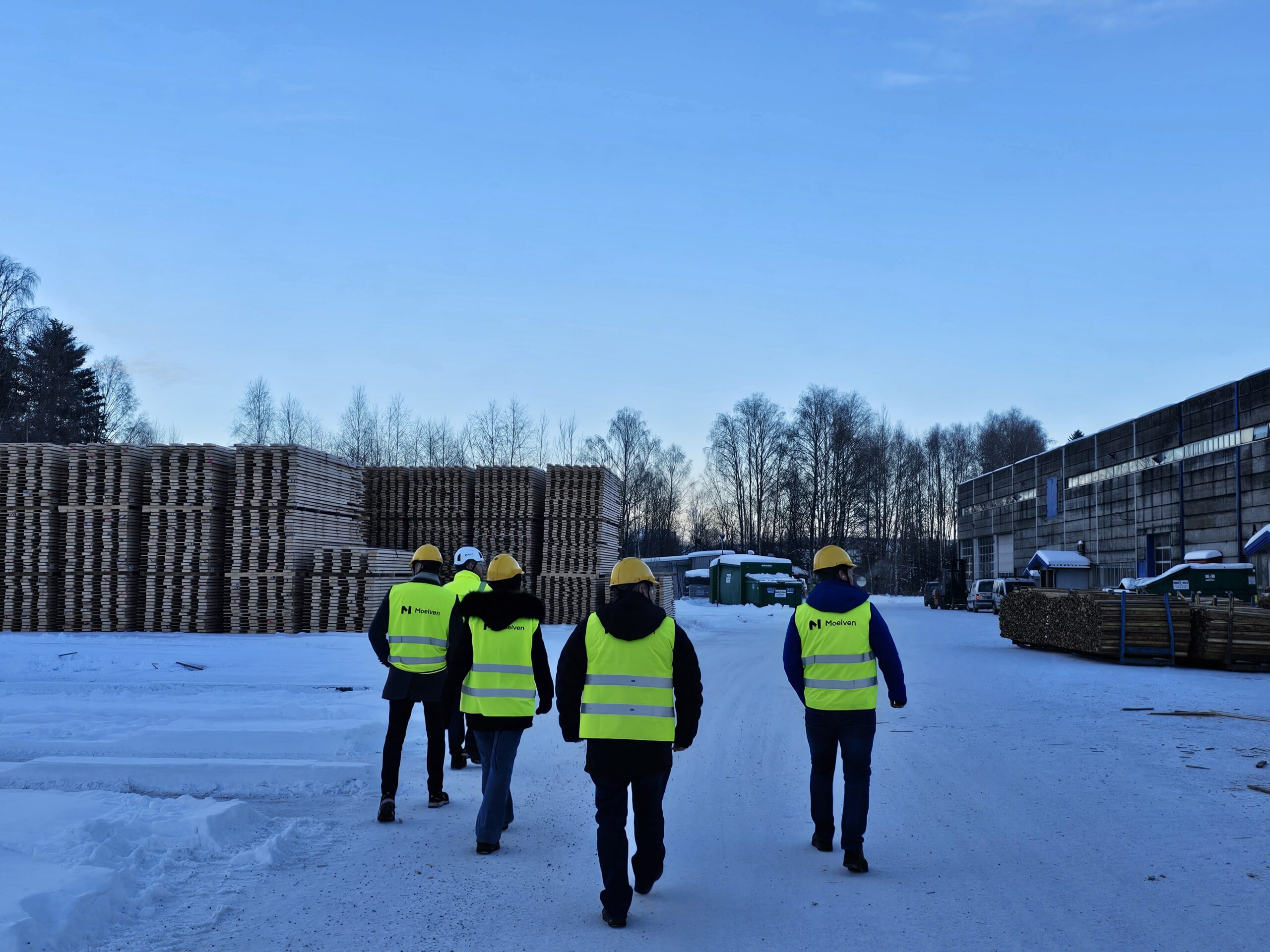
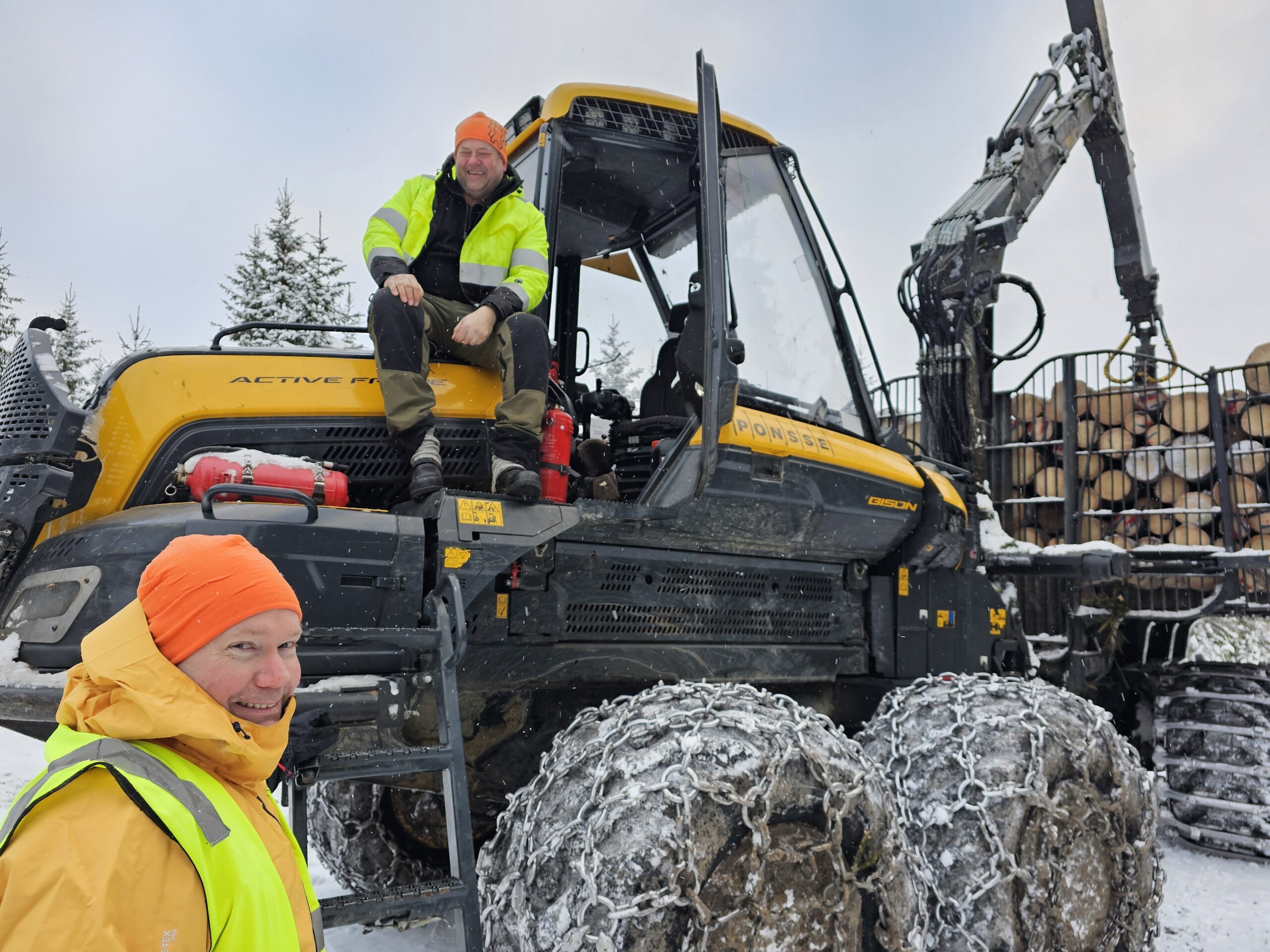
At Glommen Mjøsen Skog, Håvard and his NWC colleague Mari Blokhus Nordtun were given an introduction to the digital data flow in forestry. Jan Gaute Lie, regional manager in the Mjøsa region, gave a good, professional review of how the forest owner cooperative works.
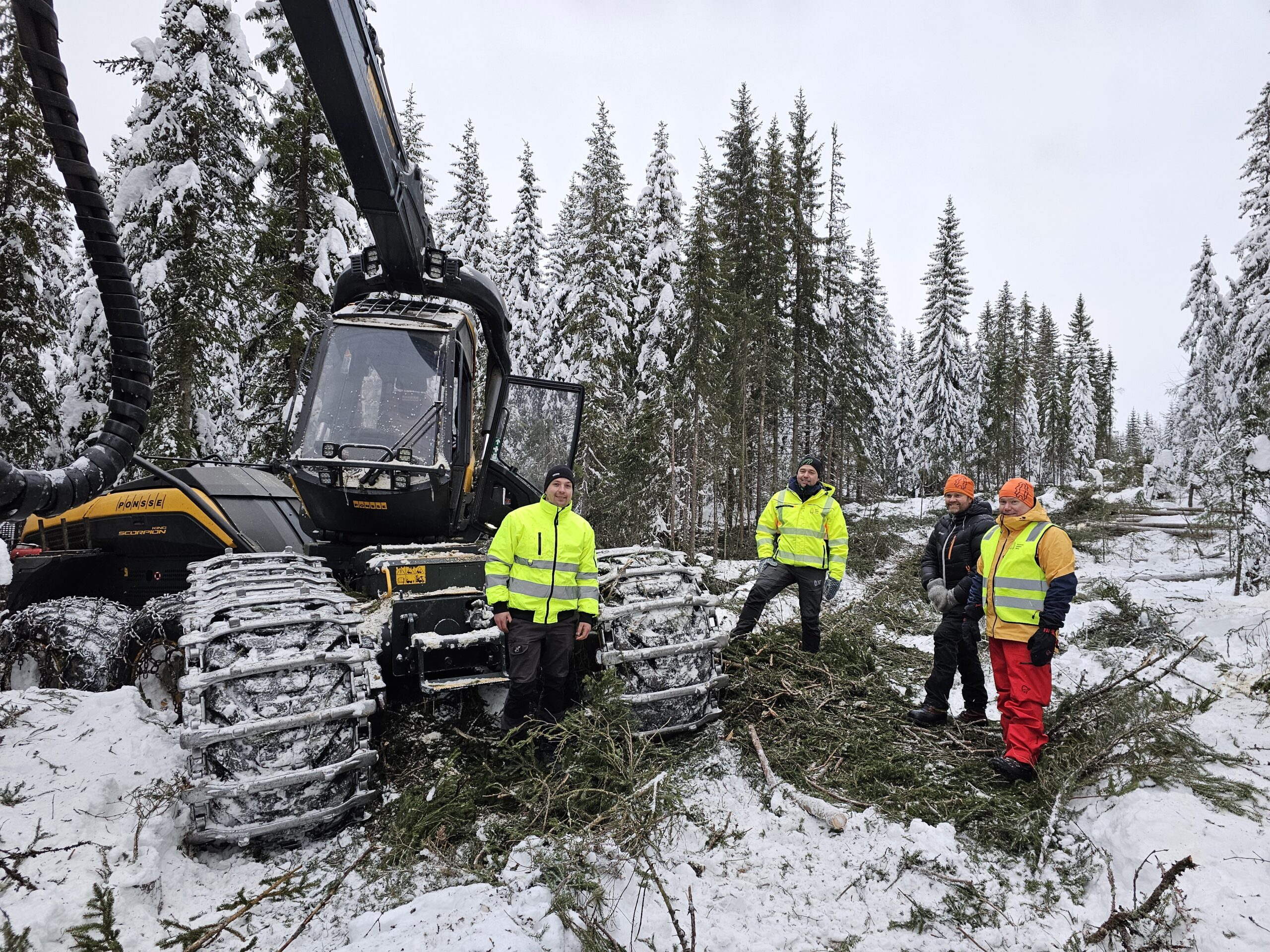
With the help of Odd Arne Brenn and Ole Petter Storbråten, the NWC project managers learned about Allma and forestry plans, how these are linked to national map databases and, not least, about the link to FeltLogg, which is used by forestry managers and forest machine contractors. Then it was off to the forest, where forestry manager Jon Grande Dahl took us to a forestry operation in Roterudbygda in Ringsaker. There we met Embret Kristiansen and Anders Adolfsson from Kristiansen Skog to learn about forestry and the use of FeltLogg in the field.