



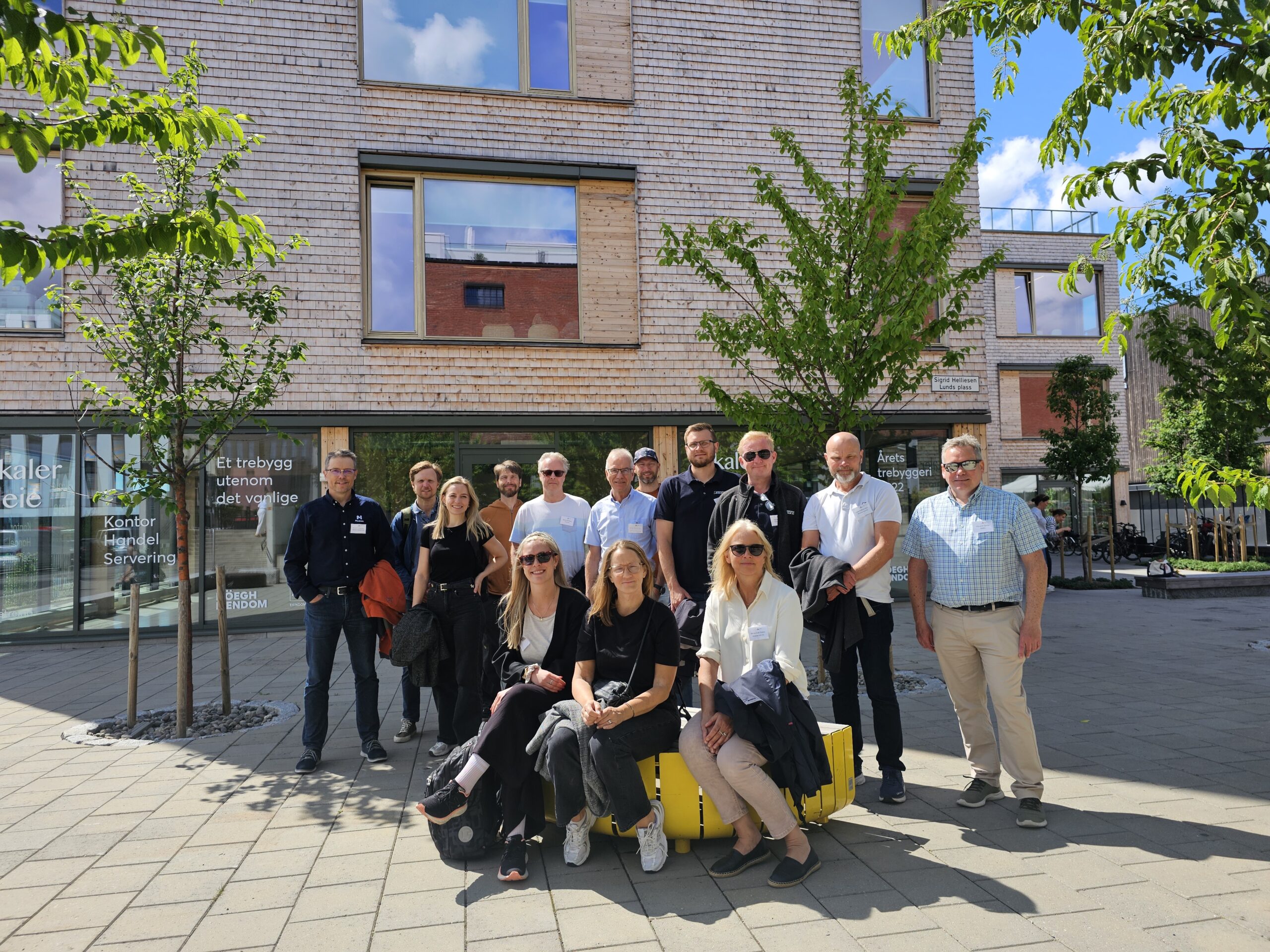
Circular and inspiring at Økern
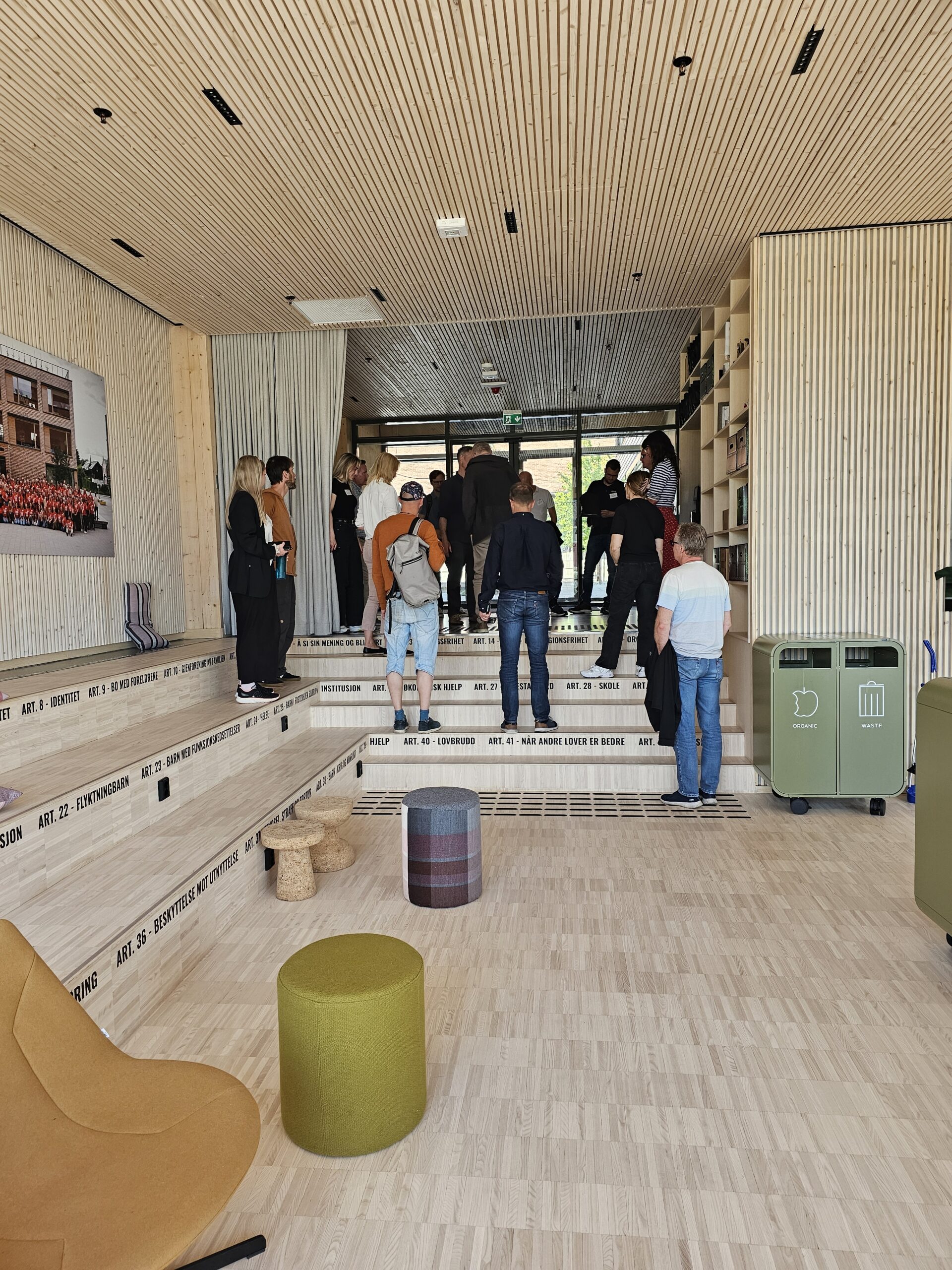
On a summery May day, a group of circularly engaged people gathered at Bylab Økern to be inspired by people who work with reuse in practice.
Emil Andresen Rygh is the general manager of the Circular Resource Center and works extensively with projects and testing to reuse materials from buildings that are being demolished or rehabilitated.
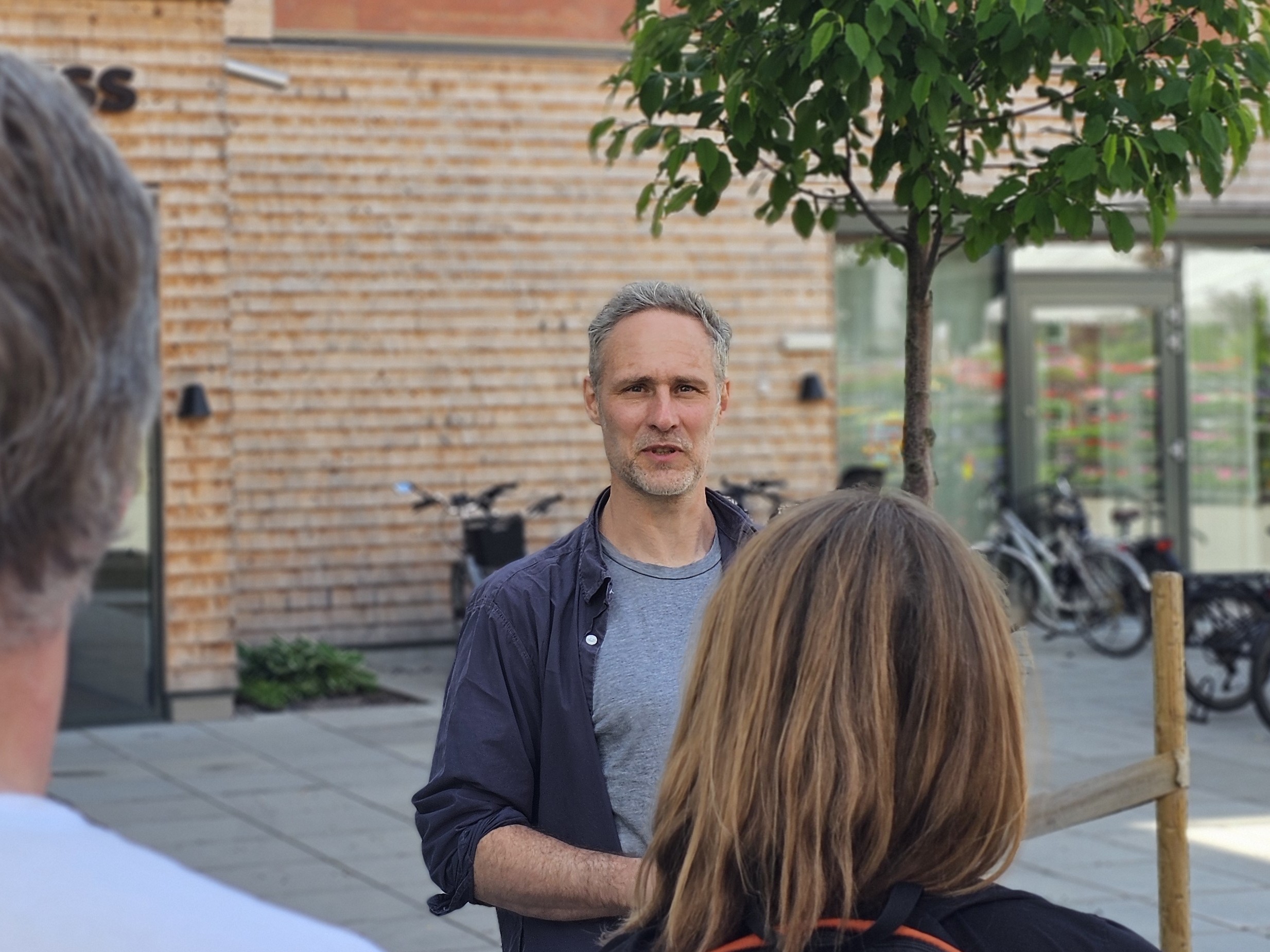
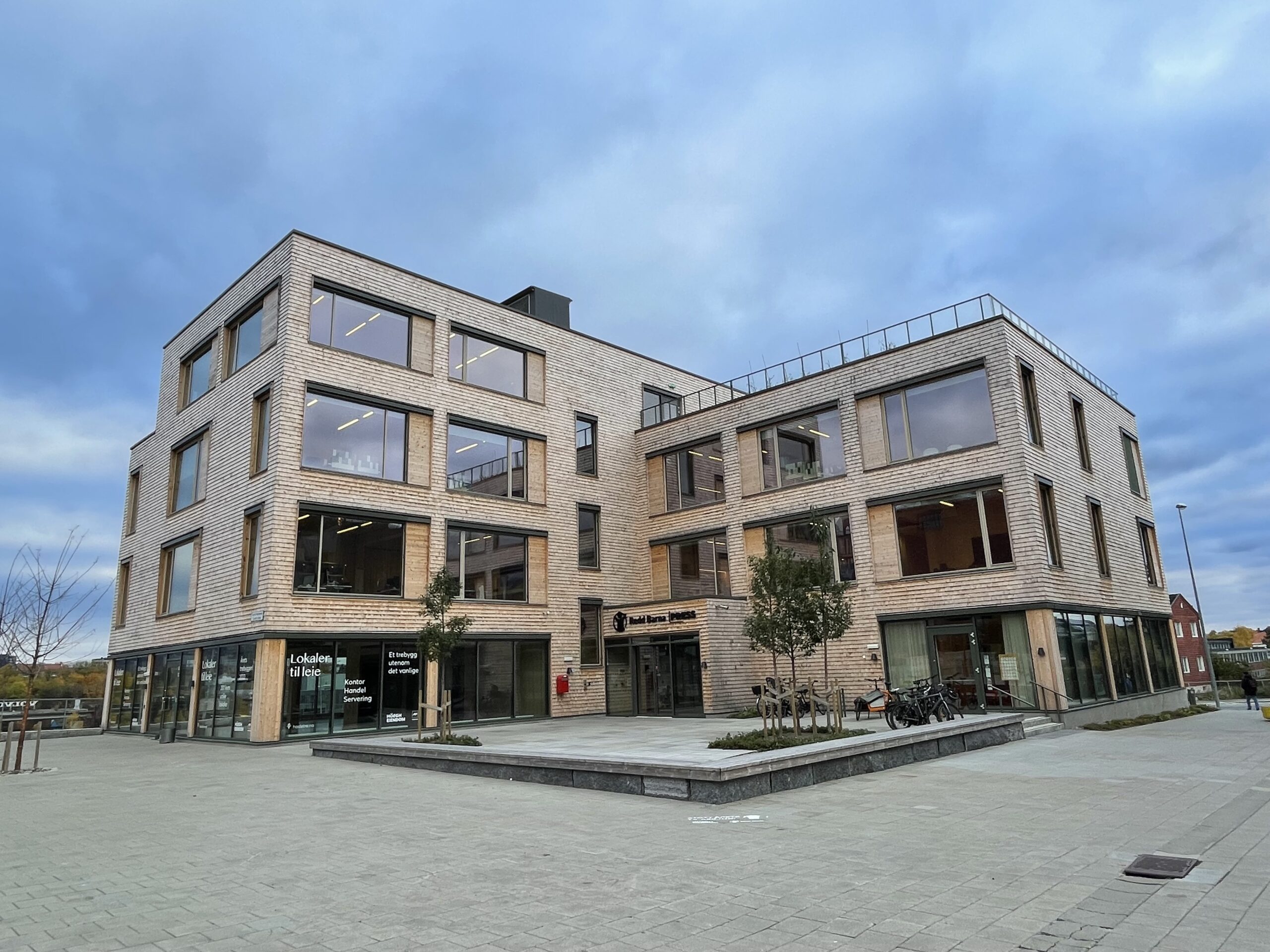
Moritz Groba is an architect and partner in OsloTRE, which has built “the country’s most reusable office building”, Save the Children’s head office at Hasle. Through these two, we got to see and learn that the road to circular solutions goes through being exploratory, fearless, patient and having good players on the team.
What is the Circular Resource Center and why was it established?
Emil Andresen Rygh, CEO, explained the background – a story about a private consultancy firm with a small-scale warehouse for reused building materials, a construction tent from the Government Quarter, a public-private driver company and a number of strategic partners. The end result was the companies Sirkulær ressursssentral and Ombygg.
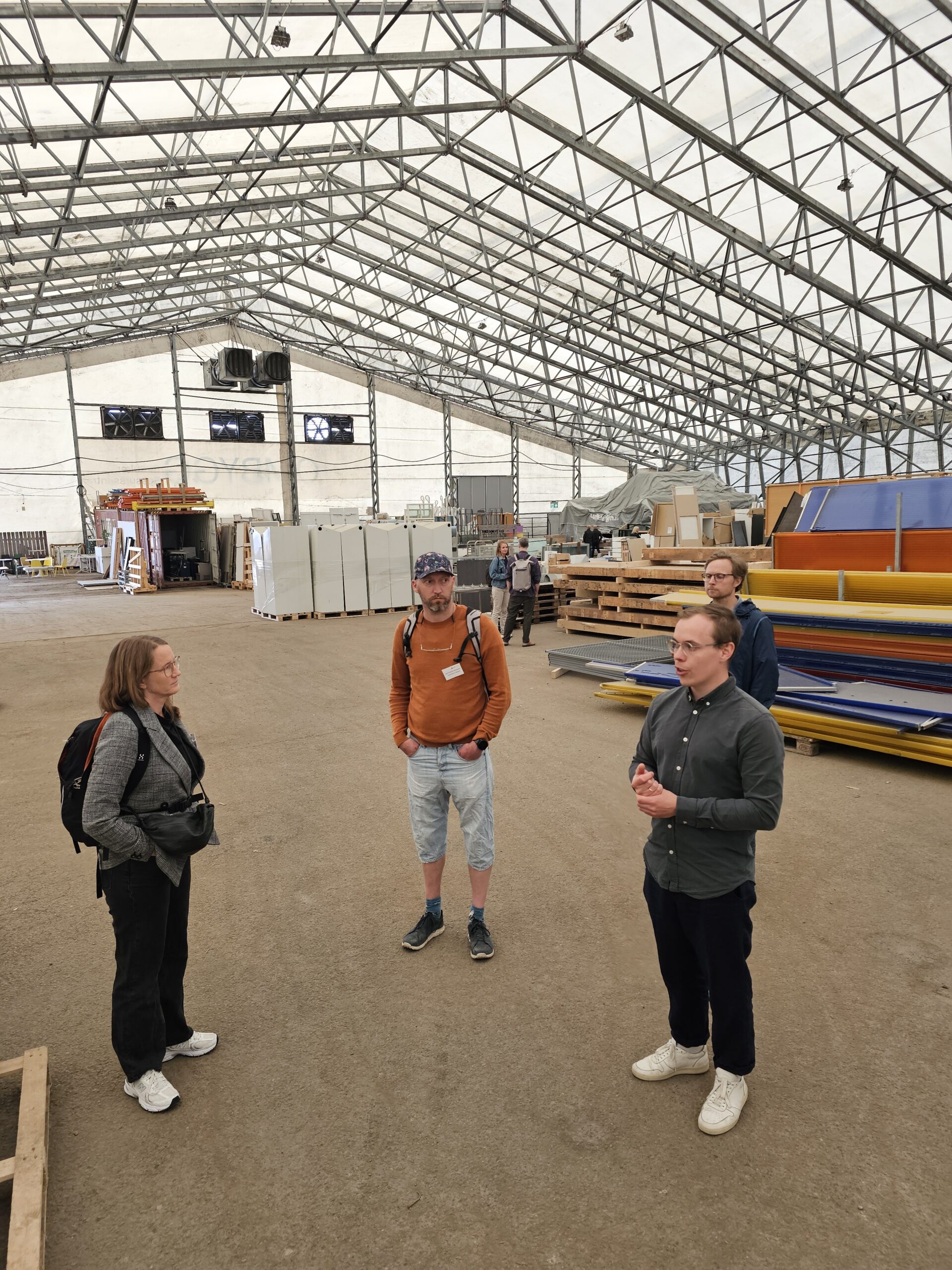
– Together, we will help make reuse the natural first choice in the construction industry. To do this, we need pilot projects that break down the barriers. The prices of reuse solutions have fallen, but much remains to be done in terms of infrastructure,” said Rygh.
We needed strategic partners to understand the needs of the market and have brought in major players such as Statsbygg, Oslobygg, Obos, Bane Nor eiendom, Gjensidige and Entra eiendom. The aim is to share everything we learn and develop so that it can benefit the whole country. Oslo was a good place to start because of the volume,” said Rygh. The company Ombygg is the building materials store itself, consisting of a large tent with used building materials, an online store and salespeople who are in close contact with the major construction projects in Oslo. The company is testing various solutions for the temporary storage and sale of building materials, both to the professional and private markets.
Why a demountable office building
– The construction industry is called the 40% industry for a reason. It accounts for 40% of the world’s waste production, resource use and climate emissions. We need to do something about this,” began Moritz Groba from OsloTRE. The architectural firm, which was founded in 2015, works exclusively with wooden architecture and runs its own solid wood production. They have experience from their own solid wood production, but are now purely a consultancy firm with architects who design buildings from A to Z, RIBtre and advice for the link between design and production. They also have OsloPre, which delivers and assembles MT structures.
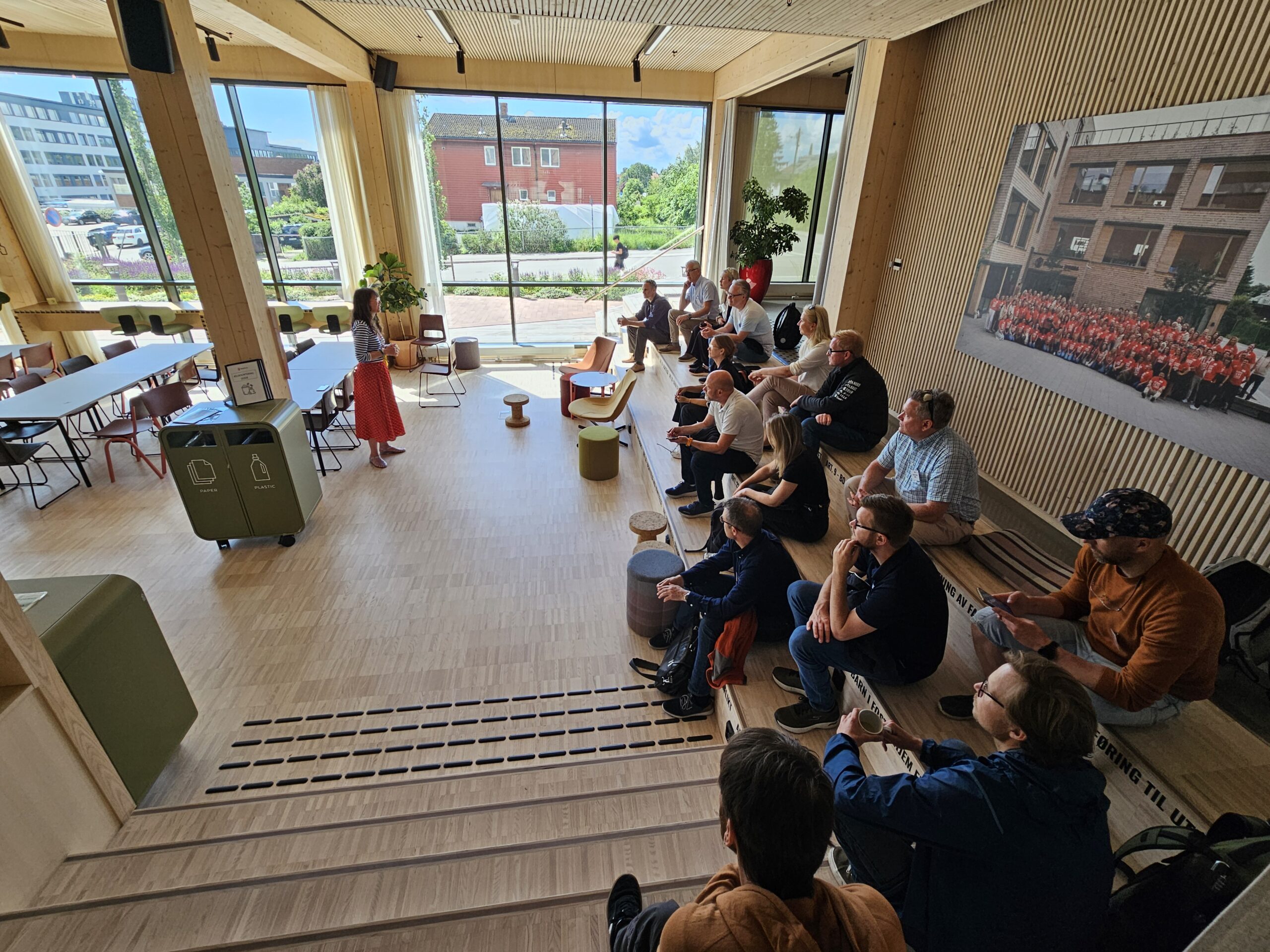
Two years ago, OsloTRE completed its work on the building that has been named HasleTre. In the commissioning and construction process, both the developers Höegh Eiendom and AF Eiendom and the tenant Save the Children were concerned with sustainability and demountability.
Linn Huse-Amundsen, Director of People and Technology at Save the Children, explained why they chose to move to a climate-friendly and reusable office building: “We belong to the world’s largest child rights organization. Most refugees today are fleeing because of climate change leading to drought and food shortages, natural disasters and war. So it’s extra important that we keep our own house in order and contribute to the lowest possible climate footprint,” said Huse-Amundsen.
Climate-friendly and demountable
Moritz Groba talked about the process of building a climate-friendly and demountable building: “We started with sky-high ambitions, but the spinal reflex in the construction industry is to do things the way we’ve always done them. So the first proposal for the wooden structure had slotted nodes with steel plates. We went back to the workshop to show, in a mock up, that we could use wooden dowels. After a hard-fought battle, the choice fell on beech dowels,” said Groba.
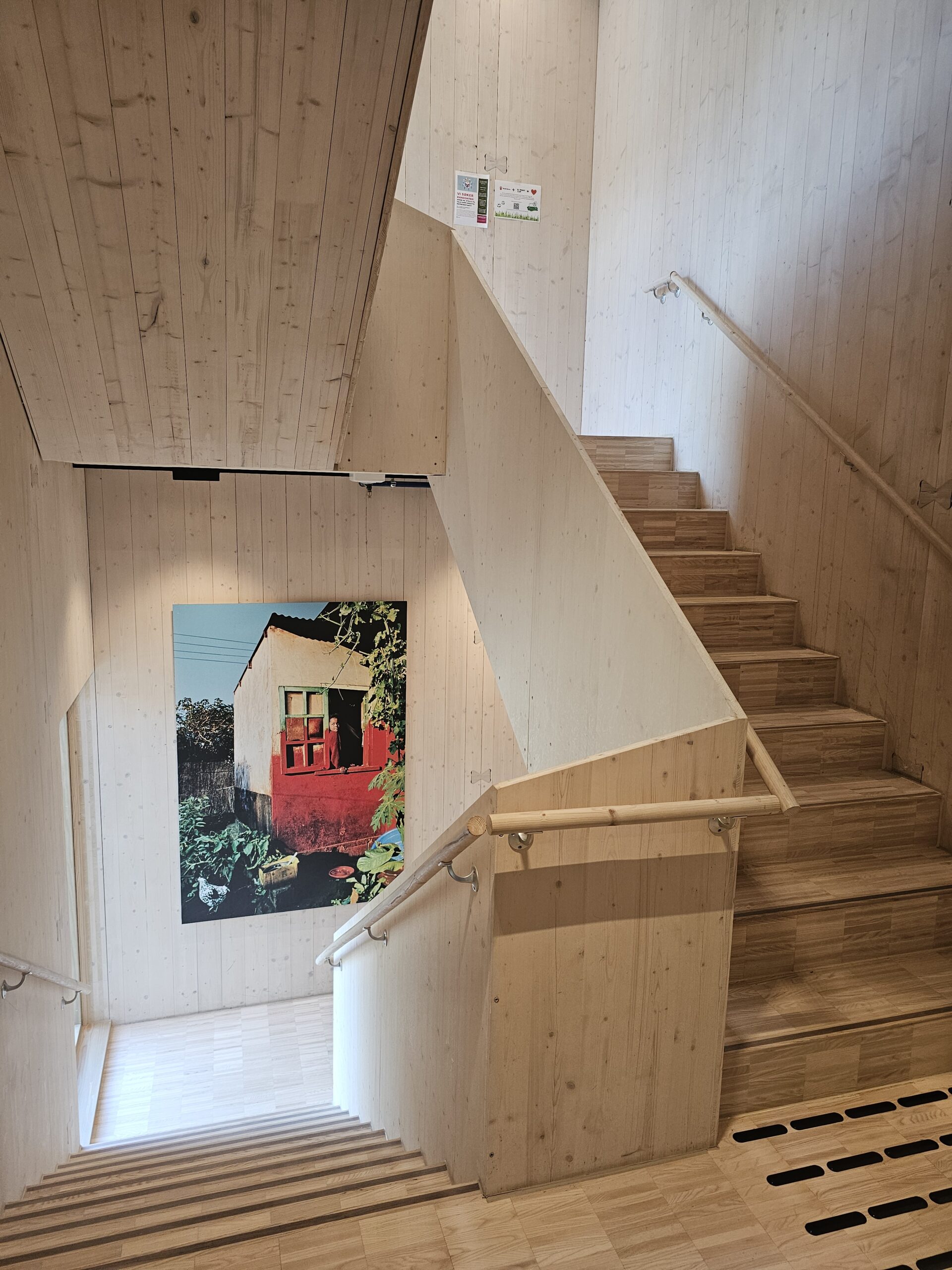
HasleTre is built with large, minimally processed solid and glulam elements and minimally processed wood materials. Along with the use of wooden dowels and dovetail joints that replace steel plates, screws and nails. These measures simplify dismantling, reduce the carbon footprint and increase the resale value of the components.
– But the aim isn’t to dismantle the building; we want it to be used for as many years as possible. That’s why we’ve designed the building to accommodate two tenants per floor, which has affected the location of stairwells, toilets and doors. In addition, we have built with a grid of about 5×5 meters, which leads to effective spans in the wooden structure while at the same time providing a high degree of flexibility for moving furniture and interior walls,” explained Groba.
We heard about a number of measures, from load-bearing structures with open guideways for technical infrastructure, reused absorbers on wooden slatted ceilings, goat hair carpet 80% cashmere wool, facade shingles in pine heartwood and interior walls clad with ash veneer and wooden nails.
Oslo tree inspires with award-winning building
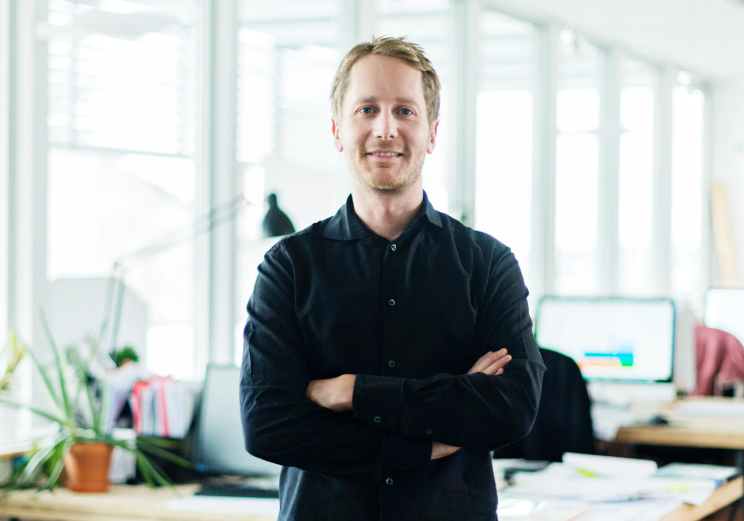
– Winning these two awards at the same time as our two wooden buildings is a sign that the construction industry is changing. We’re moving towards a more sustainable, circular and biologically based architecture, something Oslotre has been working towards for almost 15 years. It’s great to finally be able to reap the benefits of our work,” says a clearly proud Jørgen Tycho, Creative Director at Oslotre.
Prestisjepris til HasleTre
HasleTre har vunnet prestisjetunge «World’s most sustainable commercial building 2024» på Architizer A+Awards.
HasleTre er et demonterbart og ombrukbart næringsbygg i tre på Hasle i Oslo. Bygget er bygget med trematerialer fra topp til tå, og holdes sammen av innovative trelåser som erstatter bruken av stål og aluminium.
Bygget er designet for ombruk i en fremtidig sirkulær verdikjede. HasleTre oppnådde hele 60% klimagassreduksjon og 80% reduksjon i stålbruk sett opp mot referansebygg. Bygget er Breeam Excellent klassifisert og ble bygget på rekordtid.
HasleTre er i dag hovedkontoret for bistandsorganisasjonen Redd Barna.
Les mer om pristildelingen HER
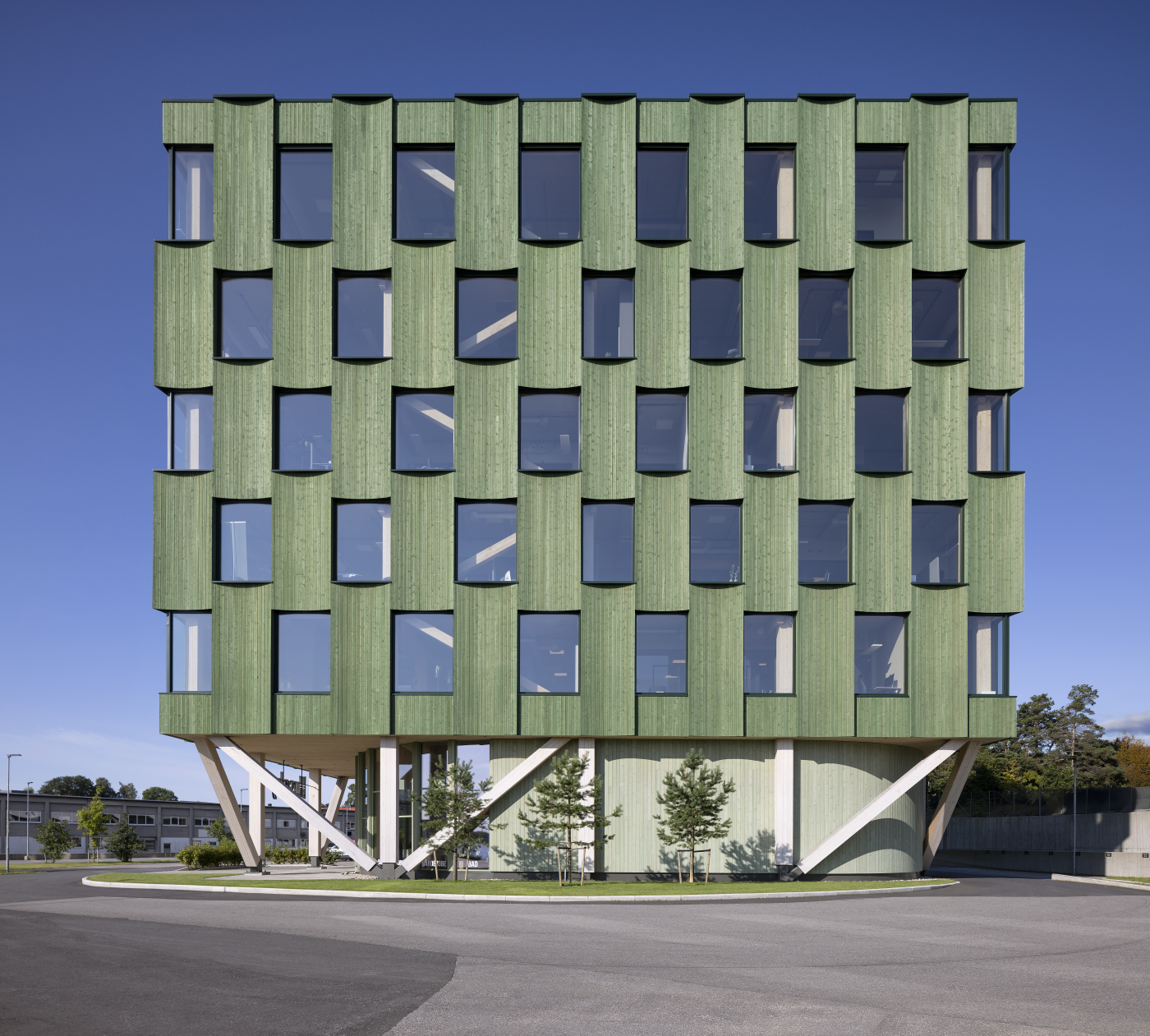
LUMBER 4 ble årets beste kontorbygg
LUMBER 4 har vunnet prisen for årets beste kontorbygg i kategorien Mellomstort 5-15 etasjer.
Bygget er Sørlandets første og største næringsbygg i massivtre. Bygget har vist seg å konkurrere økonomisk mot standard stål og betongbygg. Bygget på rekordtid og med en høy grad av prefabrikasjon har bygget oppnådd 53% klimagassreduksjon.
Den innovative grønnmalte og kuvede trefasaden har nådd internasjonal oppmerksomhet og LUMBER 4 var i 2023 et av de mest publiserte byggene på Sosiale Medier, globalt.
Les mer om pristildelingen HER
Om prisene
Architizer: The World’s Best Architecture er en årlig premiering av verdens mest inspirerende arkitektur.
Architizer A+Awards er verdens største prisprogram for arkitektur som fokuserer på å fremme og feire årets beste arkitektur og rom.
Inspirerende å besøke
Norwegian Wood Cluster arrangerte nylig studietur til Oslo og besøkte bl.a. HasleTre. Lovordene var mange. Det er også verdt å merke seg hvorfor leietaker Redd Barna valgte å flytte til et klimavennlig og gjenbrukbart kontorbygg. – Vi tilhører verdens største barnerettsorganisasjon. De fleste som er på flukt i dag, flykter på grunn av klimaendringer som fører til tørke og matmangel, naturkatastrofer og krig. Da er det ekstra viktig at vi har orden i eget hus og bidrar til så lavt klimafotavtrykk som mulig, sa Linn Huse-Amundsen, direktør for Mennesker og Teknologi i Redd Barna.
Les mer om studieturen til Oslo HER
I september arrangerer Norwegian Wood Cluster studietur til Kristiansand. Det er medlemmene i faggruppene Bærekraft og Fremtidige byggeløsninger som spesielt inviteres med på denne turen. – I Kristiansand gleder vi oss bl.a. til å besøke LUMBER 4 sammen med Jørgen Tycho i Oslotre, sier Berit Sanness.

Important mobilization completed
The “TRE-Standard” project has provided increased insight into ongoing standardization work of relevance to the woodworking industry and provided a basis for the industry to become more involved in long-term national and international standardization work in the future. Standards establish market requirements that have a decisive impact on which construction solutions are chosen.
Desired by businesses
– “With the TRE-Standard project, we have met a need in the industry. The background to the project was that our specialist group “Future building solutions” wanted us to take a closer look at this topic,” says cluster manager Berit Sanness of Norwegian Wood Cluster. She has been the project manager for “TRE-Standard”.
– There are many key company representatives in this specialist group. “The companies’ priorities are crucial to the project initiatives we take. The message was clear, and we followed it up,” says Sanness.
Before the project started in the fall of 2022, Norwegian woodworking companies had limited involvement in climate and environmental standards for the construction sector, regardless of materials. At the same time, national and international standards set the premises for how climate documentation is prepared and how the climate footprint is calculated for both individual materials and buildings.
Praise for Innlandet County Council
Berit Sanness praises Innlandet County Council for supporting the project financially.
– The Norwegian Wood Cluster has strong woodworking companies from Inland Norway as members, and they supported the project. However, these companies are dependent on a much broader mobilization to safeguard the industry’s competitiveness in this area, and the county council understood this. It is therefore a credit to Innlandet County Council for seeing the importance of the mobilization work and supporting the project financially,” says Sanness.
Awakening
One of the main initiatives under the auspices of the project was a workshop at Mjøstårnet in the fall of 2023. It had high participation and was summarized as a breakthrough. A statement from one of the 40 participants, who had previously attended several meetings on the subject, summarizes the benefits of the workshop: “Now the seriousness of standardization is starting to dawn on me”.
The workshop produced acknowledgements, insights and concrete plans for action. There was broad agreement that the industry needs to do something about this by coordinating resources and focus areas.
See the review of the workshop here: Mobilization for standardization – NWC (nwcluster.no)
Key players involved in the project
Both Moelven Limtre and Hunton Fiber have been members of the project group for “TRE-Standard”. So have Treteknisk and the Timber Industry. In addition, WoodWorks! has participated as an observer.
– At a national level, Treteknisk and the Timber Industry have the key roles in the standardization area. They have therefore also played key roles during the implementation of the “TRE-Standard” project. At the same time, it has been crucially important for us to draw on the companies’ experiences. This happened not least during the workshop, where both Dynea AS and Moelven Limtre AS shared their experiences from many years of standardization work,” says Sanness.
EU Construction Products Regulation becomes central
The project’s mobilization work has raised awareness of the importance of standardization among a number of woodworking companies in Innlandet and the rest of Norway. In addition, the project has analyzed the consequences of the EU’s new Construction Products Regulation, which will be crucial for standardization work in the future. The Norwegian Institute of Wood Technology has carried out the analysis for the project.
– “The EU’s new Construction Products Regulation will lay down clear premises in the area of climate and the environment and will take precedence over standardization work,” says CEO Audun Øvrum. Audun Øvrum, Treteknisk.
The Construction Products Regulation (CPR) is a trade law that describes how construction products must be documented in order to be legally traded in the EEA. The new CPR, which is expected to be legally approved in the EU in November 2024, introduces requirements for the declaration of climate and environmental data through CE marking, which has not previously been mandatory.
The current regulations for calculating and declaring climate and environmental properties have been developed by the European standardization committee Sustainability in construction work (CEN TC350).
Ensure consistent calculations
– “The current regulations are incomplete and leave too much room for interpretation in how to calculate life cycle accounts, where allocation, mass balance and data quality requirements are key concepts that greatly affect the results of the Environmental Products Declaration (EPD),” says Audun Øvrum, CEO of Treteknisk. Audun Øvrum, Treteknisk, who heads Standard Norway’s committee for wood and wood-based materials.
The implementation of the new Construction Products Regulation entails extensive changes to the standardization processes for CE marking of construction products. This framework is being developed in a separate process (the CPR Acquis process), which aims to improve and clarify the regulations and create overall rules for how construction products should declare climate and environmental impacts, fire properties and content of hazardous substances.
Audun Øvrum explains that current calculation practices have, for example, led to Swedish EPDs for planed spruce yielding 30% lower emission figures than Norwegian EPDs as a result of different interpretations of international standards.
– We expect the consequences of the new Construction Products Regulation to be that relevant standards will be changed so that we get the same calculation practice in the future,” says Øvrum.
NWC seeks project manager wood structures
As a project manager in the Norwegian Wood Cluster, you will work with some of the country’s best and most forward-thinking companies in the forest-wood value chain. Together we will develop tomorrow’s value chain, based on renewable raw materials from the Norwegian forest.
Here you can read more and apply for the position.
Application deadline August 20, 2024.
NWC with apprenticeship offer
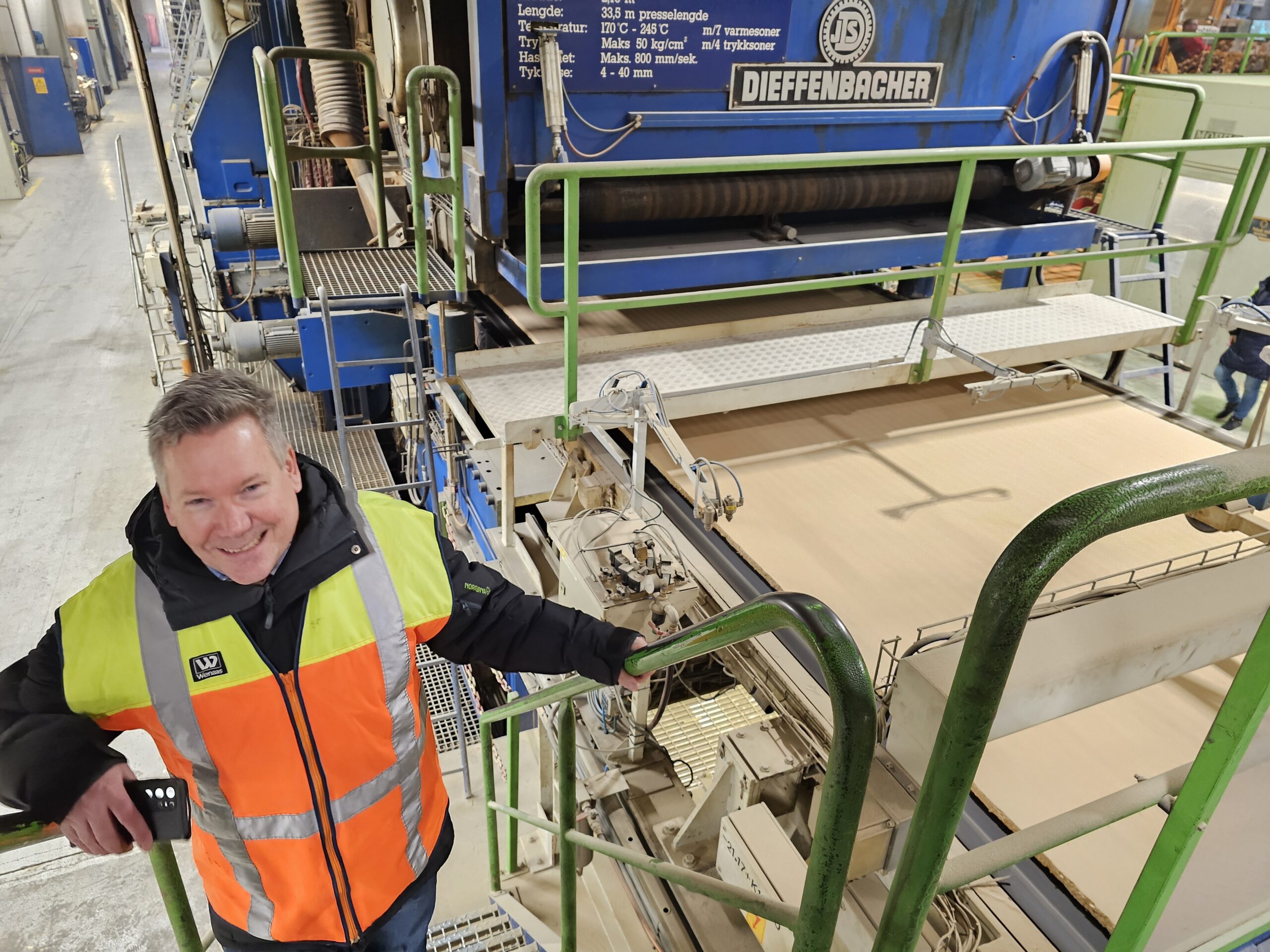
The target group is employees in NWC’s member companies, and the course is free of charge for the companies. We accept both internship candidates (with a minimum of five years of practice) and “Certificate of Apprenticeship” candidates (with a minimum of one year of practice), and the goal is an exam in production technology (PRT3103) in the fall of 2025 with a subsequent professional test.
Collections
Karriere Innlandet has previous experience of similar training, both digital and session-based. Experience and evaluation of previous courses indicate that it is demanding with purely digital sessions. Therefore, the new offer will be a combination of physical sessions (2-4) and sessions on Teams (10-12). Participants must have their own computer for digital sessions and exams. The location of the physical sessions will be determined based on which companies participate, and it may be relevant to have regional sessions in addition to joint sessions.
In 2023, Karriere Innlandet Kongsvinger arranged a vocational certificate course for the woodworking industry, with Sveinar Sætherberget as facilitator and organizer. They are now strengthening the industrial side with the appointment of Jo-Andre Brenna from September 1, and will also draw in resource persons from the industry in certain subject areas.
Costs
The county council provides grants for Fagbrev-på-jobb, and the training itself is therefore free for companies. However, the company is expected to have a contact person/supervisor to assist the candidates. Any remuneration of employees for participation and travel is agreed with the company.
Info meeting
We are now looking for contact with companies that have relevant candidates for apprenticeship training. On Tuesday, September 10 at 8.30-9.00 am, NWC and Karriere Innlandet invite you to an information meeting for companies, contact NWC project manager Karl-Einar Røste for more information:
Karl.einar.roste@nwcluster.no | Mobile 480 06 715
Creating an audio data bank for wood sound
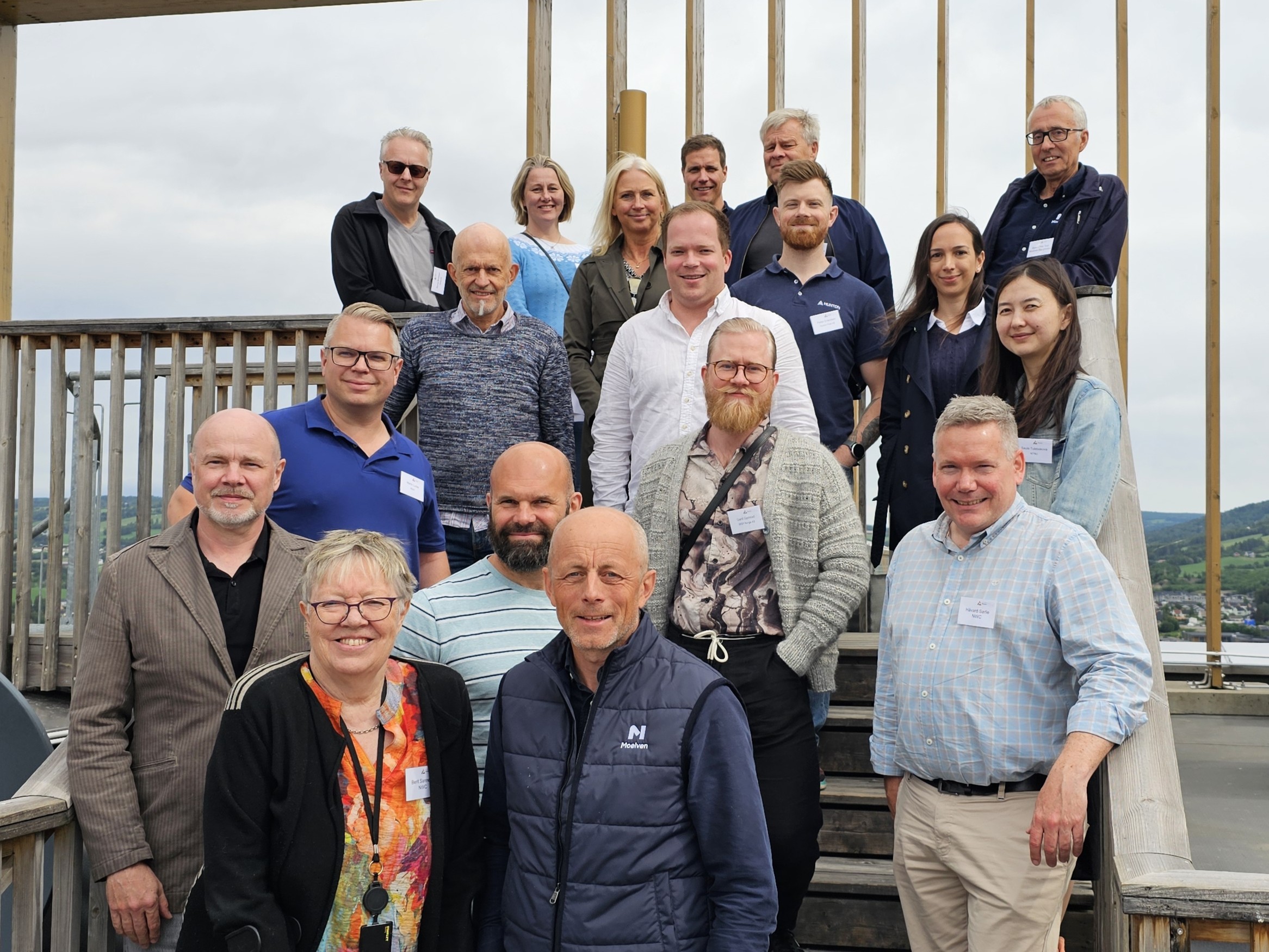
Cluster leader Berit Sanness is very pleased that Innovation Norway is supporting the new “3LYD” project, which will last until 2027. Among other things, the Norwegian Wood Cluster is working to develop the climate-friendly building and housing solutions of the future for growing markets.
Desired by businesses
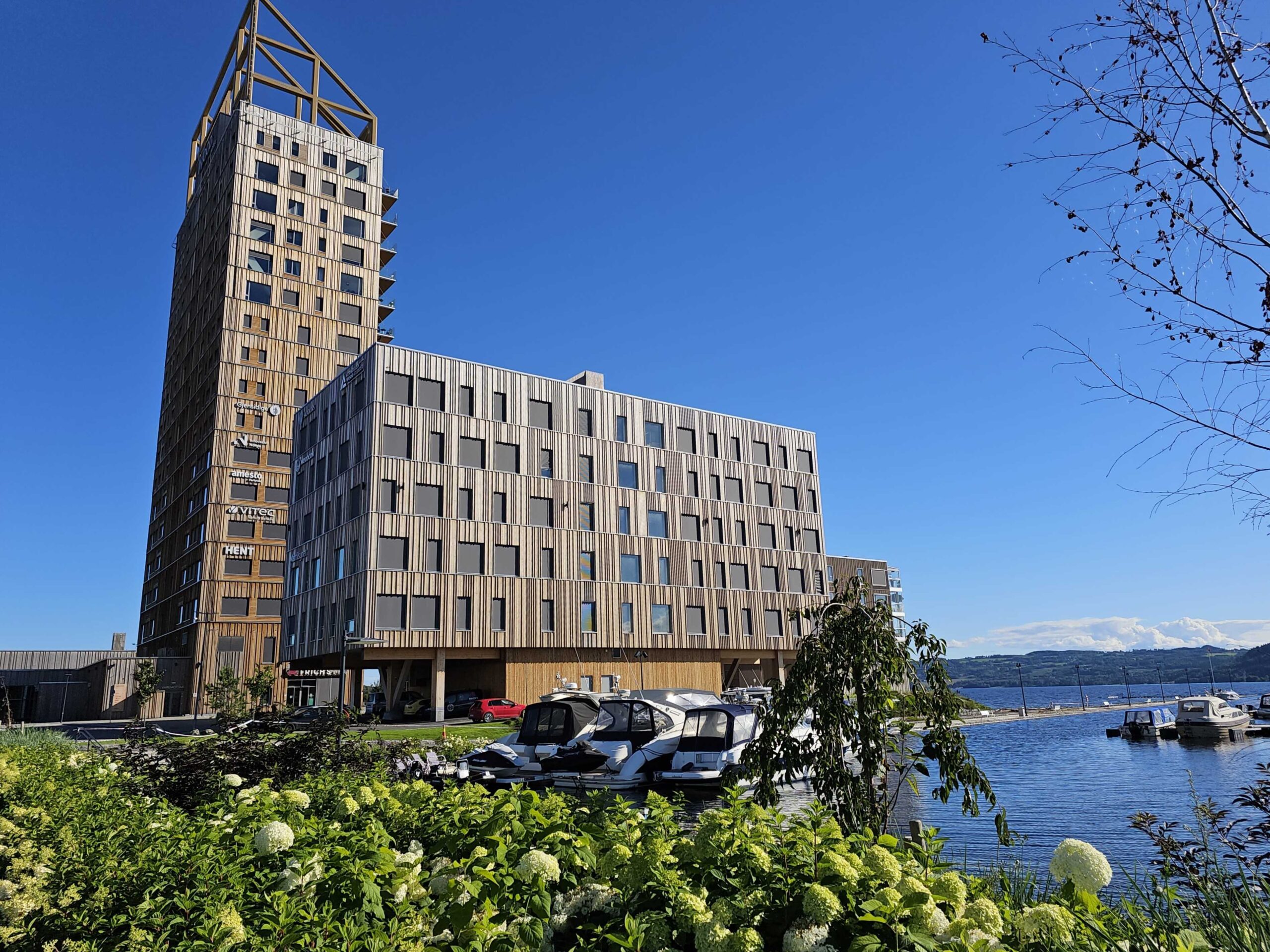
Building in height is an interesting way to reduce land degradation. Mjøstårnet has shown that it is possible to build high in wood. However, the largest volumes of tall wooden buildings are in the 4-6 storey segment.
The member companies in the Norwegian Wood Cluster have identified solutions for sound (acoustics and vibrations) as one of the main challenges for building wooden buildings up to six storeys high. At the request of the companies, the cluster has therefore initiated a project that can help to achieve preaccepted solutions in the area of sound. The results of the “3LYD” project are expected to be very useful for the companies’ competitiveness.
– “The project idea has been discussed at several meetings of our specialist group ‘Future Building Solutions’ and a large number of companies have subsequently expressed their interest and helped to finalize the project plan, so the project is well anchored,” says cluster leader Berit Sanness in NWC.
Collects completed sound measurements
The project will mainly collect existing sound measurements. These are currently not available to anyone other than the owner of the sound measurements and the company that has performed the sound measurements.
– A prerequisite for access to the sound data is, of course, that the owners of the sound measurements release them for collection in a data bank. We leave that job to those who have carried out the measurements. It will probably also be necessary to obtain supplementary documentation for existing measurements, as far as this is possible, so that, for example, the design solution can be identified,” says Sanness.
Supplementary measurements
In order for the data bank to provide a basis for preaccepted solutions, there is also a need for a large number of new sound measurements. The companies involved will contribute with supplementary measurements according to SINTEF’s template while the project is ongoing.
– In addition, we want to involve bachelor and master students at NTNU. It is also relevant to link an industrial PhD candidate to the project. We think this could be an exciting assignment for the students, who will participate in a project with many companies involved,” says Sanness.
Strong expertise combined
The project group includes resource persons from SINTEF and NTNU, as well as from the companies behind the project. These include ARE Treindustrier AS, Hersleth Entreprenør AS, Hunton Fiber AS, Kontur Arkitekter AS, Norconsult Norge AS, Norsk Massivtre AS, Ny Struktur AS, Oslotre AS and Sweco Norge AS.
– “We’ve brought in top expertise in the field of sound and acoustics. In order to get the best possible data basis, we will also be inviting representatives of other consultancy firms that carry out sound measurements to join the project,” says Sanness, who says that a couple of these consultancy firms have already expressed interest in participating in the “3LYD” project.
How can digital twins benefit the industry?
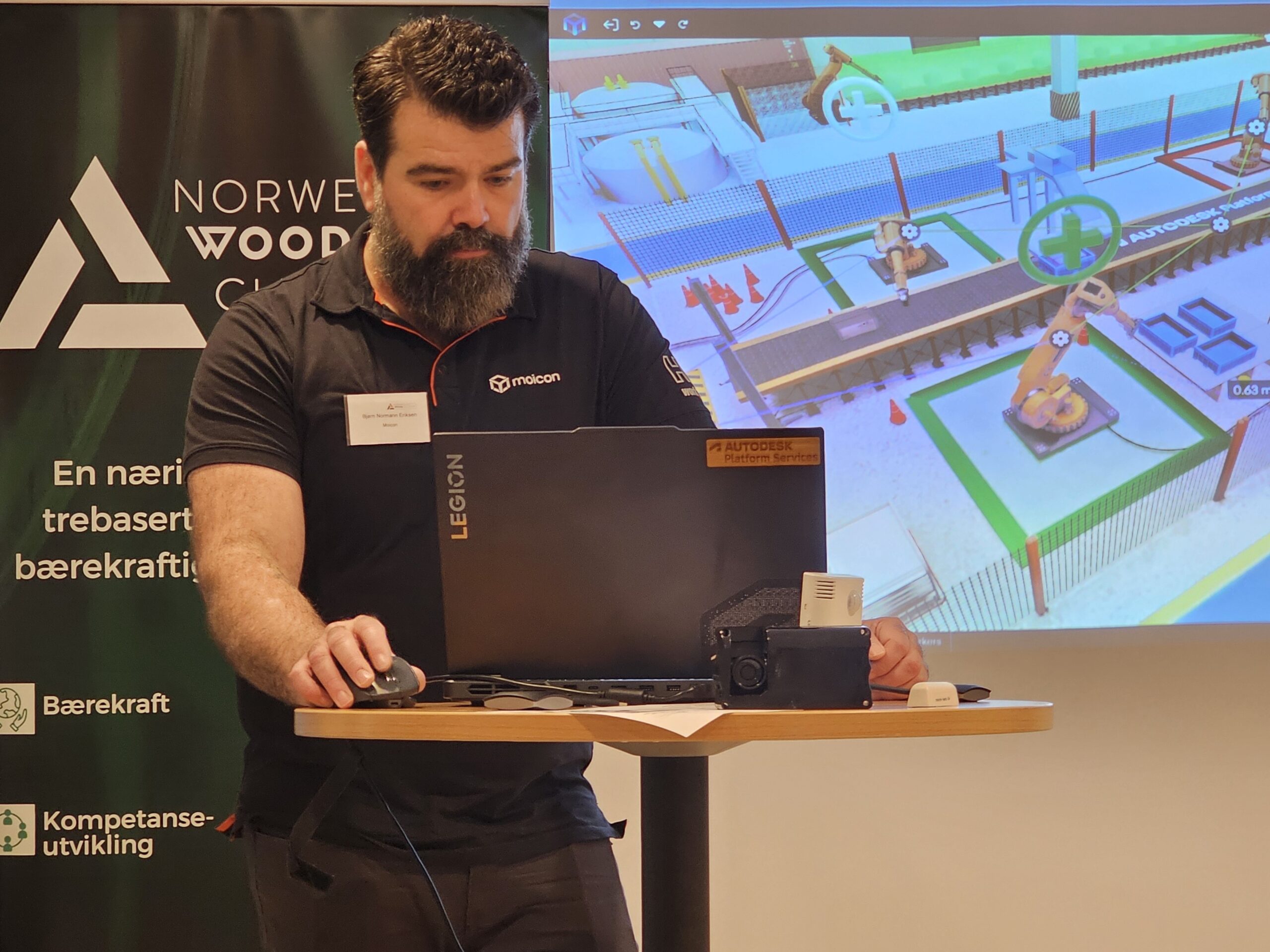
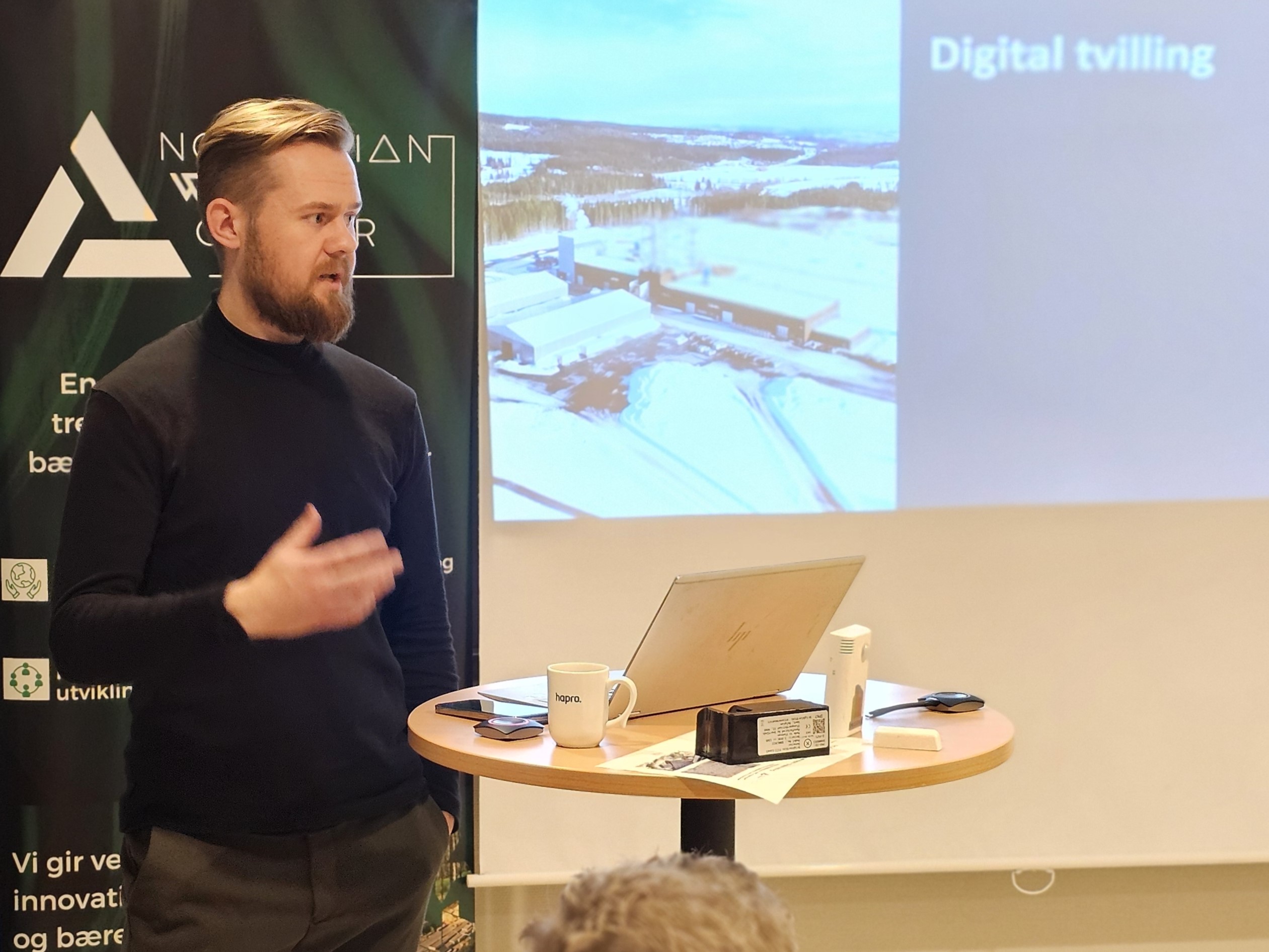
Supplier Moicon specializes in digital twins for industry, and has collaborated with the two companies to create a digital “copy” of their industrial operations. Because that’s exactly what a digital twin is: a copy of the building, the machines, the warehouses, the equipment – created in 3D in a digital solution. So you can practice or test processes and changes in a digital world before implementing them. A bit like a computer game, really.
A tool for communication
Bjørn Eriksen of Moicon calls the digital twin a communication tool: “We create a digital replica of your factory, which allows you to communicate visually, which is much more effective,” he explained.
He showed us how visual communication trumps the written word by handing out Lego construction kits with various instructions. Some were given a sheet of paper with text explaining how to build the Lego car. Others received drawings showing the building process step by step. Can you guess who solved the task the fastest?
Enormous help when moving a factory
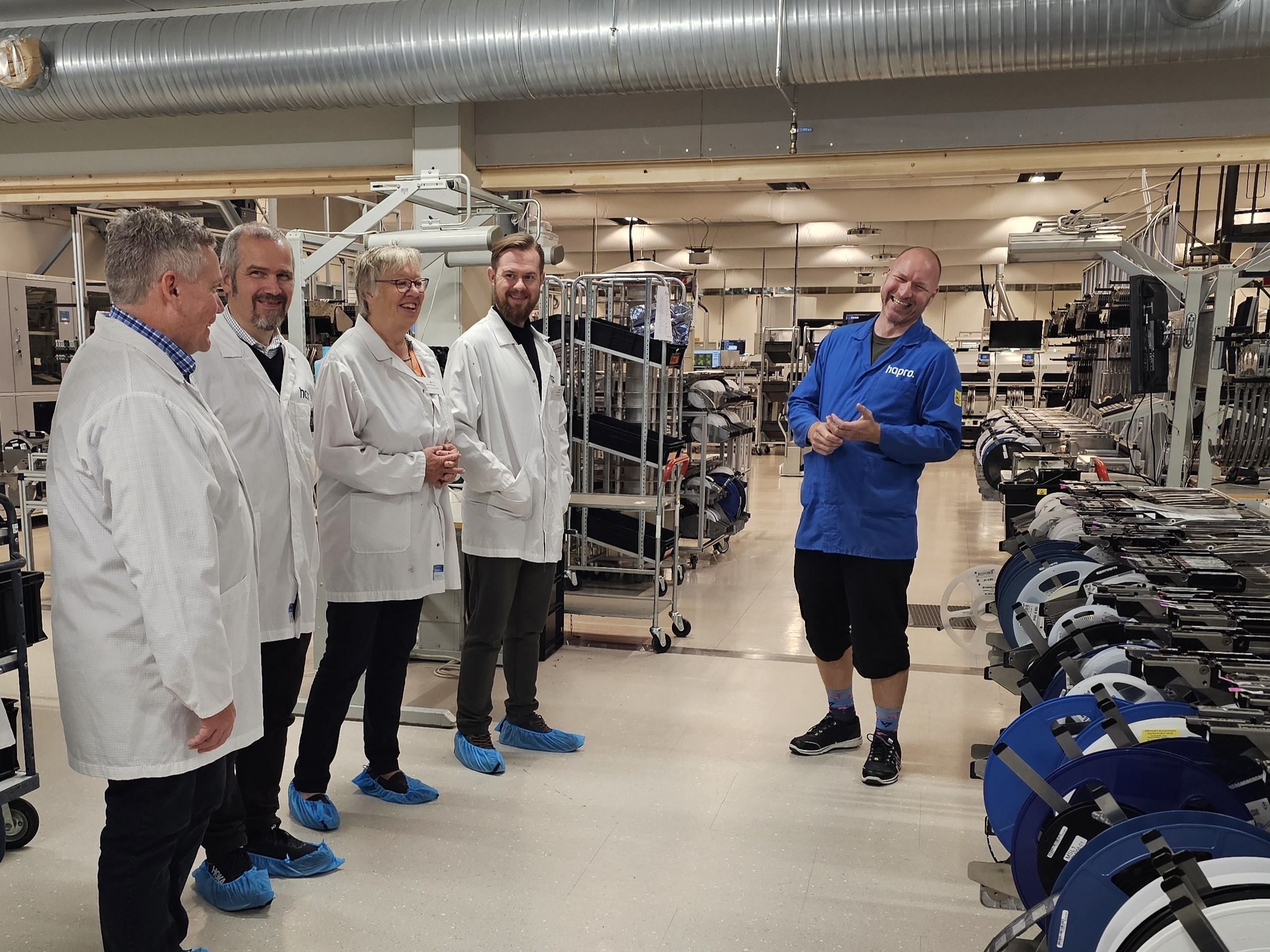
In 2022, Hapro invested in a lot of new equipment. This, together with a need to optimize production and the flow of goods, led to a decision to rebuild the factory. “We would never have dared to do this without a digital twin,” said factory manager Roy Hansen. With the help of the twin, various layouts for the new factory have been visualized and all employees have been able to provide input from their point of view and their work operation. In addition, all measurements of rooms and equipment are completely accurate.
Many positive effects
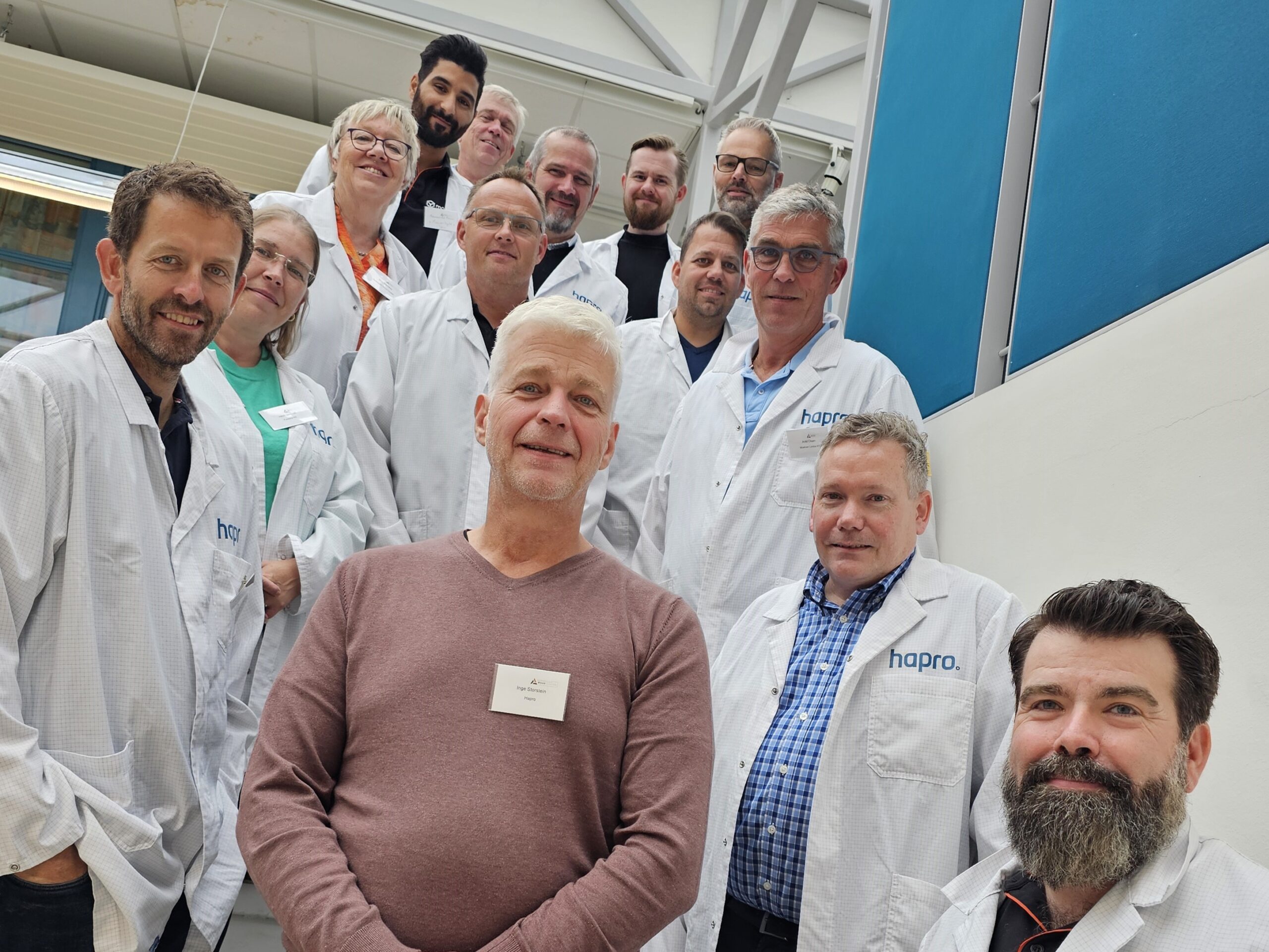
– The fact that people recognize themselves in a visual 3D figure offers many advantages. “For example, HSE is taken care of by having escape routes, medicine cabinets and industrial safety in place, and we can simulate ‘what if’ scenarios without spending a lot of time physically moving the processes,” explained LEAN coordinator Inge Storstein, who has been central to the work on the digital twin. He added that the twin is mobile and displayed in a browser.
With the twin, you can also look at the flow between the lines. “We can quickly see where there is a lot of trampling and unnecessary meters, and this has resulted in us creating a new doorway in the factory,” said Roy Hansen.
Development project at Hunton in Gjøvik
Erling Leine is an IT consultant at Hunton, which established a digital twin for its Skjerven factory (wood fiber insulation) in 2022. – “We spent about a week working with Moicon to set up a model of the factory. This was done ahead of a large internal conference for the company, and we asked all employees for suggestions on how the twin could be used,” he said.
The wood industry has large machines that are not moved very often, unlike Hapro or the automotive industry, which have a constant need for changes and rebuilding. But how can a digital twin still be useful?
– “We were quick to suggest using the digital twin for 3D fire drawings. Hydrants and hoses, extinguishers and fire doors were added with so-called “Mark ups” so that you can see them visually well in the digital twin,” explained Leine. “You could then plan fictitious fire drills, lay out hoses and see where the fire brigade can get to, how far the strokes reach and so on.
The operations and maintenance team was also quick to make suggestions, including marking the equipment with green, red or yellow flags depending on the need for maintenance. They would also like to see sensors that can warn of faults and wear and tear – and a digital twin can also be used to train new operators. They can get a picture of the line and visually see what’s where,” said Leine.
At Hunton, there is no shortage of ideas about how the twin can be used as a tool. For quality and reporting, where on the line do errors occur and where do we need more sensors? For project work to plan new lines and machines or simulate traffic from employees and trucks. We see a lot of exciting opportunities with a digital twin, and we’re looking forward to realizing all our ideas and using the twin more actively,” said Leine.
How to get started?
Leine has some clear recommendations for companies considering a digital twin: – “Try out different tools and programs and find something that works for you. Remember that the 3D files are yours to own, so once your buildings and machinery are scanned, they can be imported and exported to different systems (like Moicon). And the threshold is much lower than you think!
Bergene Holm capes EKSAKT
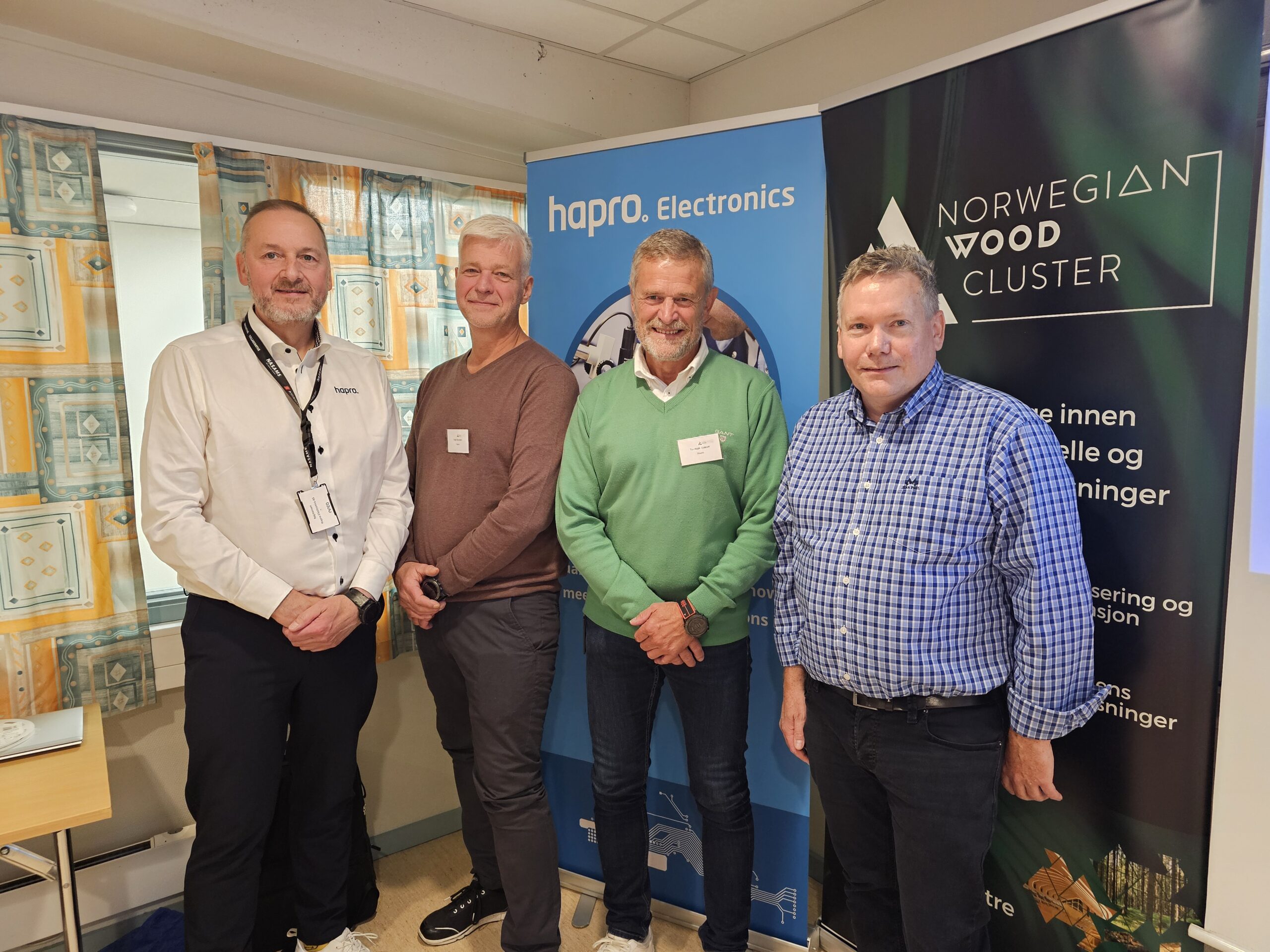
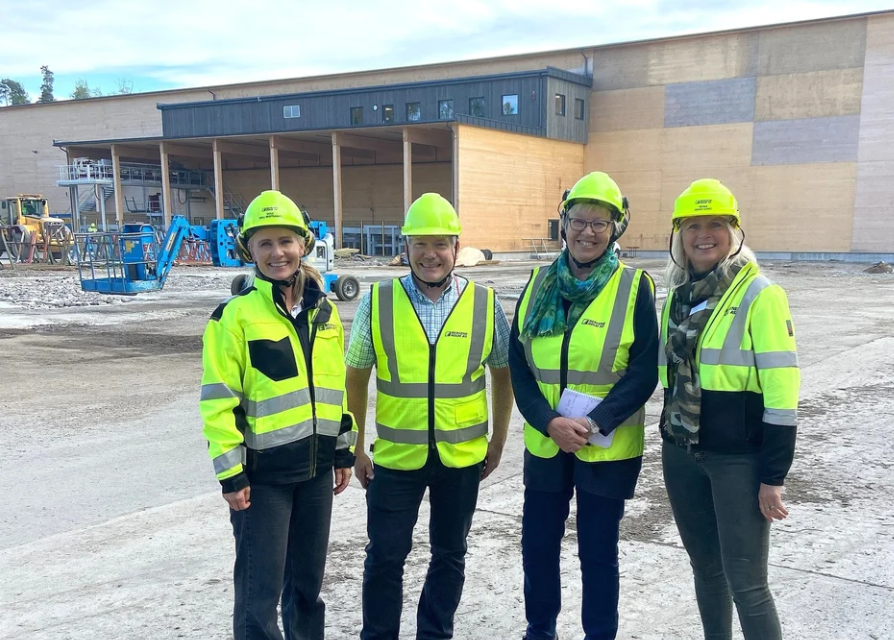
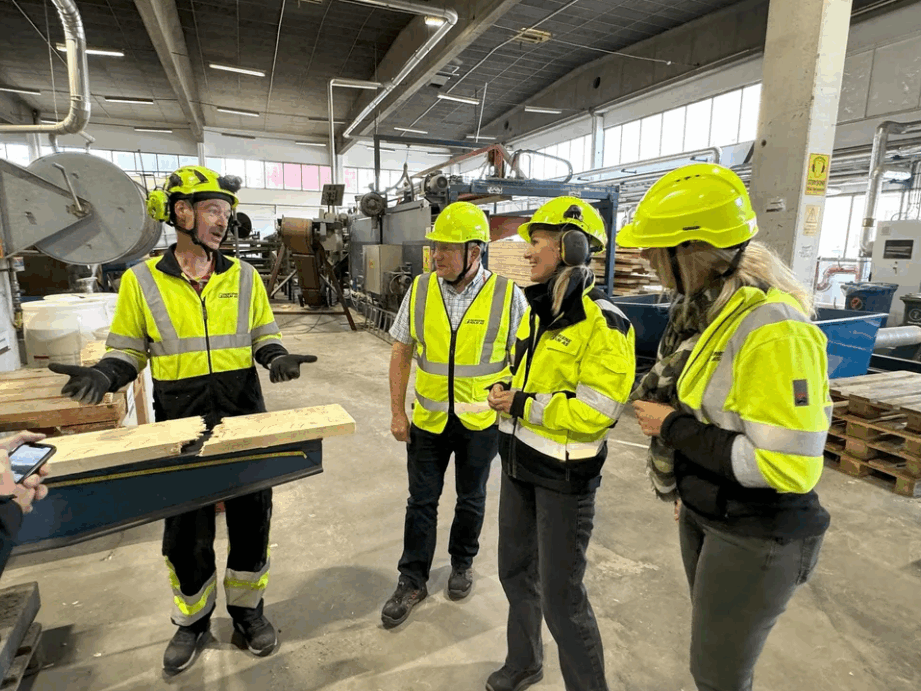
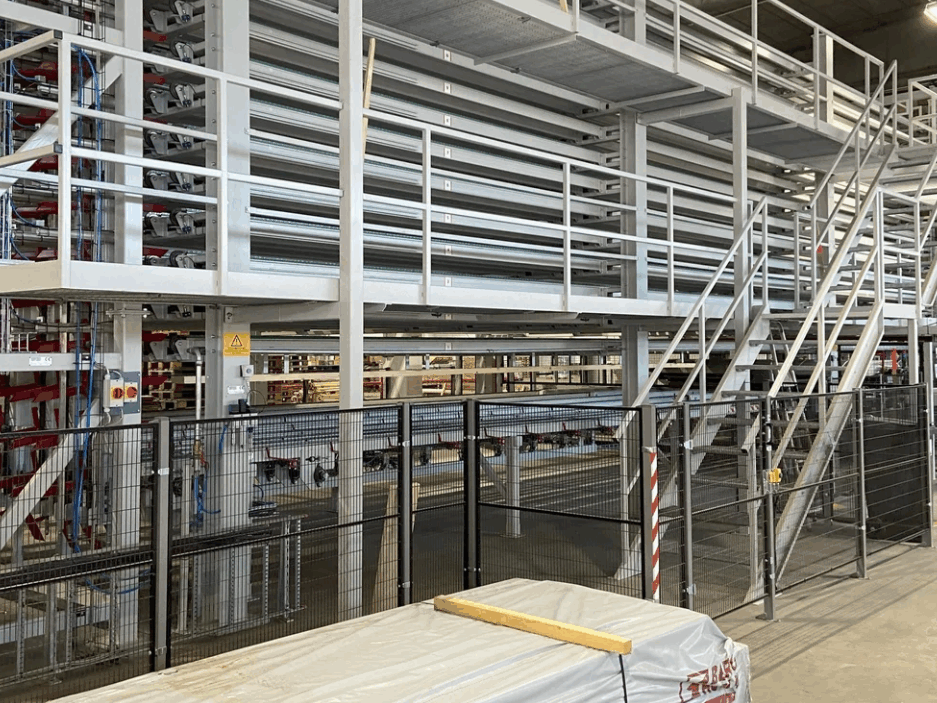
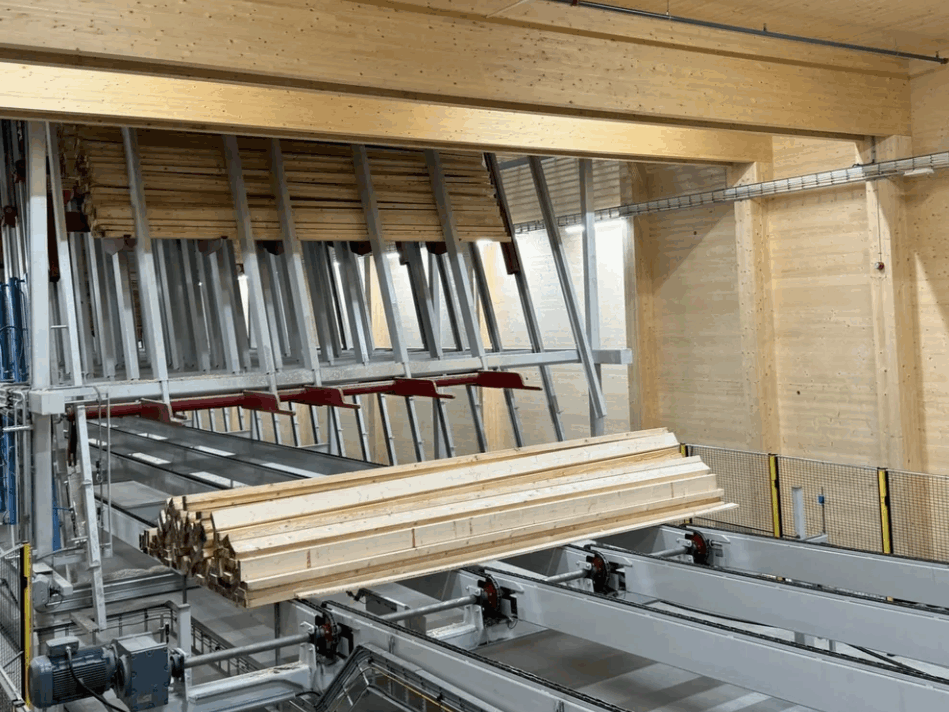
The Norwegian Wood Cluster administration recently visited Bergene Holm’s new flagship in Hof in Vestfold. There we were presented with the new cutting plant, which is connected to a sophisticated system of sorting pockets to sort lumber according to the customer’s exact order.
As little waste as possible
– “At Bergene Holm, we are committed to sustainability, and here we have taken an important step to reduce the amount of waste in the value chain,” says Sustainability Manager Hege Voll-Midtgaard at Bergene Holm.
She explains that on average, an element factory has 5-6% waste, while waste on construction sites can be as high as 25%.
– In addition, we cut away an average of 2.5% when we go from falling lengths provided by the forest to foot-cut loads requested by Bergene Holm’s customers. These are resources that should have been better utilized, and we have done something about it through the EKSAKT concept,” says Voll-Midtgaard.
Committed to product development and innovation
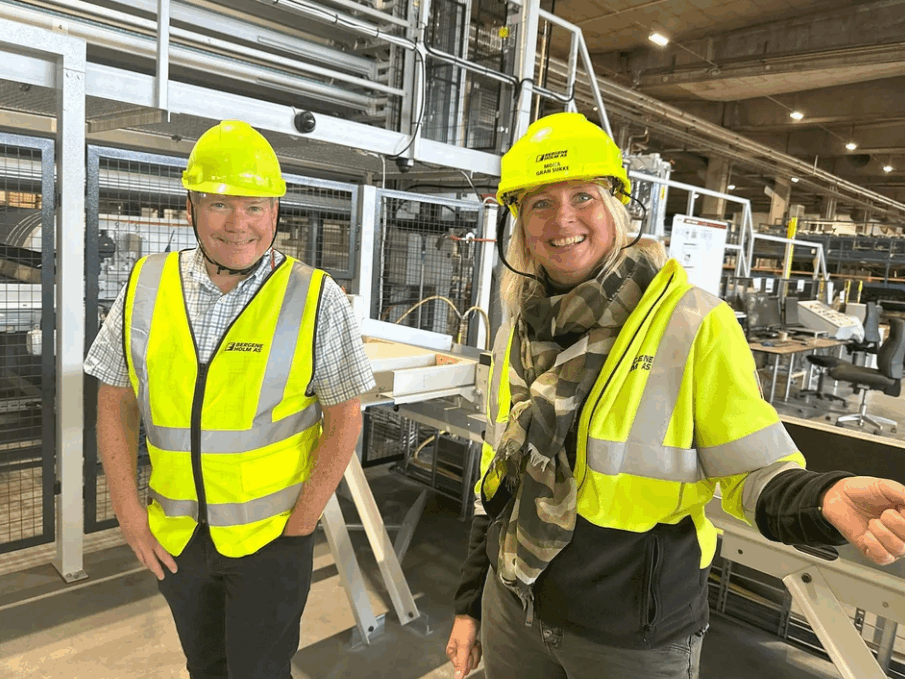
– “We work continuously with product development and innovation. In recent years, there has been a particular focus on waste-free construction sites, which is the reason for our investment in EKSAKT,” says Innovation Manager Mona Gran Sukke, Bergene Holm.
She explains that they have seven decreasing lengths lying in front of the saw in order to optimize cutting in the new facility. These seven lengths are optimized against several cutting orders, so that the cutting machine can always utilize each wooden plank with the least possible waste. In this way, all raw materials are utilized with minimal waste in the company’s own production, at the same time as no waste is delivered to the next link in the value chain.
– With the new facility, we can deliver exact lengths, exact labeling, exact packaging and delivery. The goal is exact assembly in industrial production and on major construction sites. With EKSAKT, waste on construction sites is minimal,” says Gran Sukke.
Important to reduce waste
– “It’s very interesting to see how Bergene Holm has found a way to minimize waste at the construction site, in element production and in its own industry. In the waste pyramid, this is the top level, so they have taken the measure that has the greatest value and found a solution to it,” says cluster manager Berit Sanness in Norwegian Wood Cluster.
At Bergene Holm’s Haslestad plant, the company is gearing up for growth. Almost NOK 250 million is being invested in new raw material sorting, new drying channels and a new intake at the adjustment plant, in addition to the EKSAKT cutting plant. When we have completed all this, Haslestad will be lifted to a capacity of 400,000 m3 of timber.
More recycling operators into the NWC
In the Norwegian Wood Cluster’s new strategy, circular solutions have been given a stronger place. One of the cluster’s strategic goals is to develop the sustainable wooden building solutions of the future and strengthen the circular focus. It is therefore highly relevant to complement the value chain represented in the cluster with companies that are far out in the value chain.
Inter-municipal cooperation
Innsikt is a collaboration between the inter-municipal waste management companies GLØR, SØIR, HRA, Horisont and Sirkula, covering a total of 20 municipalities in Innlandet, Buskerud and Akershus. The Innsikt companies have a total of approximately 400 employees with different professional backgrounds.
Will contribute to increased circularity
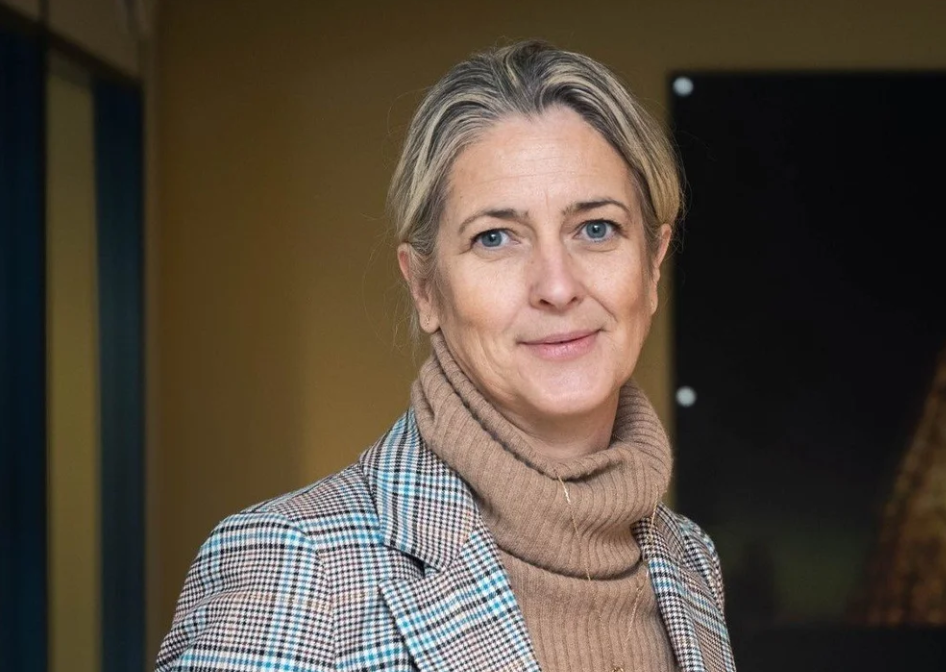
– “At Innsikt, we are committed to increasing the material recycling rate and finding new solutions for the wood fraction. That’s why we want to work with other players in the value chain to both reduce the amount of wood and find other uses for discarded wood,” says Katrine Gilje Aalstad, head of Innsikt.
– The companies participating in Insight are actively working to coordinate their waste volumes so that they can be suppliers of larger volumes adapted to possible industrialization processes. “Together, we have ambitions to increase circularity within several of our waste types and we already have projects related to the reuse of building materials,” says Aalstad.
Strengthens the cluster’s circular focus
Cluster leader Berit Sanness welcomes Innsikt as a member of Norwegian Wood Cluster.
– If we are to succeed with new circular solutions, it is necessary, among other things, to include more players who are far out in the value chain, where the wood is currently defined as waste and goes to energy recovery. It is therefore very positive that Innsikt wants to become a member of the Norwegian Wood Cluster,” says Berit Sanness.
– “In addition to reducing the amount of waste, we need to think in new ways so that wood that is currently burned can be recycled and contribute to increased value creation and a lower climate footprint,” says Sanness.
Formally, it is the board of Norwegian Wood Cluster SA that processes applications for membership of the cluster. Innsikt was admitted as a member during the board meeting on September 16, 2024.

New project manager hired in the cluster
Architect Julie Gedde-Dahl, Lillehammer, comes from the position of project manager and partner at LPO Arkitekter. She has a master’s degree in architecture from NTNU and has solid experience in project management and process management from large complex projects such as airports, schools and office buildings.
Julie Gedde-Dahl has worked closely with developers, contractors and technical disciplines, and has been responsible for teams, budgets, progress and implementation. She has also worked extensively with design concepts and the use of materials. She will now bring this experience into the cluster.
Likes interdisciplinary approach
– Even though I’m happy where I work today, I’m now motivated to move into a new role. I really like the cluster’s vision of providing the world with innovative and sustainable building solutions in wood and would like to contribute to that process. I experience the vision as both forward-looking and meaningful,” says Julie Gedde-Dahl.
She has 21 years of experience in the architectural industry and has solid expertise and experience that will be useful for Norwegian Wood Cluster. She is currently heavily involved in New Airport Mo i Rana. She has led the interaction phase, pre-project and sub-project and has been project manager since 2022.
– “I enjoy working across disciplines so that we can benefit from each other’s expertise in projects. I think this will fit nicely in the role I’m about to take on at Norwegian Wood Cluster,” says Julie Gedde-Dahl.
Strengthening the focus on wooden structures
– “I’m very pleased that Julie has agreed to become our new project manager. She has strong expertise and relevant experience. In addition, she has a personal drive that fits very well into the job of project manager with us,” says cluster manager Berit Sanness.
– “We want to promote our work in timber structures. After all, this is the core of the tasks of the specialist group “Future building solutions”. With Julie’s expertise and experience, we will significantly strengthen this focus. I therefore have great expectations that we will get a boost in this area and warmly welcome Julie to the cluster,” says Sanness.
The new project manager will join Norwegian Wood Cluster on January 1, 2025.