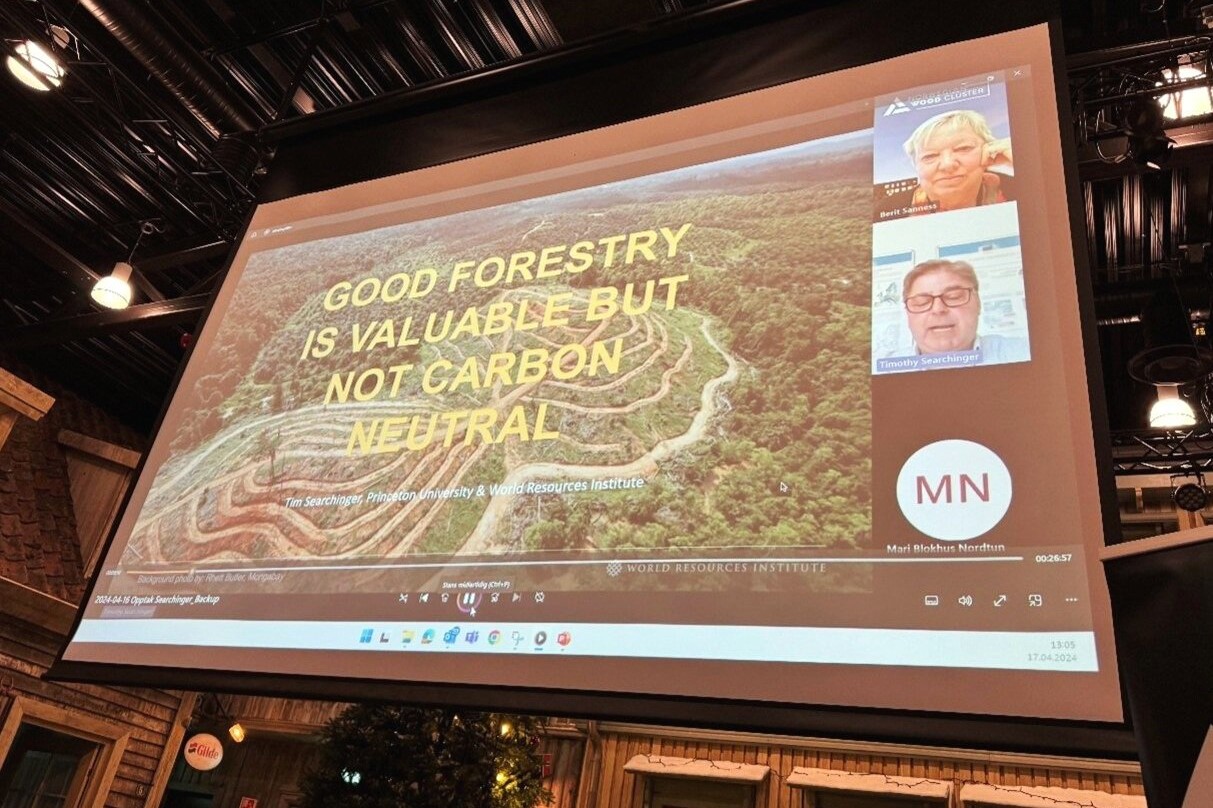
Senior researcher Timothy D. Searchinger at Princton University is, among other things, co-author of a Nature article from 2023 entitled: The Carbon Costs of Global Wood Harvest”. He contributed with a digital presentation at the owners’ meeting, explaining why he believes timber is not carbon neutral and that the climate impacts of logging have been overlooked.
Searchinger: Timber is not carbon neutral
– Modern forestry is valuable, but not carbon-neutral. Even if a forest is used for CLT, most of the carbon will still be lost very quickly. Everything that doesn’t become timber (roots, bark, pulpwood, coppice/chips) is decomposed or burned. This carbon loss is repaid over a long period of time, but not over 30-40 years. Therefore, forestry will lead to more carbon emissions than absorption,” said Searchinger.
He pointed out that consumption is expected to increase by 54% from 2010 to 2050 in the richer part of the world.
– It has been said that wood is carbon neutral as long as we don’t cut down more than we grow. But if we harvest less, the forests will grow more, i.e. bind more carbon. “We believe that we should keep the need for wood down so that more natural forests are maintained. This is the most positive thing for climate emissions over the next 20-30 years,” said Searchinger.
Calculates on a 40-year horizon and ignores substitution
Professor Erik Trømborg from NMBU said there was nothing new in Searchinger’s approach and that this is something NMBU has been teaching for 15 years. But his calculation of carbon neutrality is based on a 30-40 year cycle, while it takes 80-90 years from planting a tree until it is ready for felling in our boreal forests.
– Therefore, after 40 years, the curve shows that emissions from the forest are greater than removals. If he had extended the curve to 90 years, they would have met!” said Trømborg.
Both Trømborg and several members of the audience were critical of the fact that substitution was not mentioned in the presentation. “If we’re going to use less wood, what should we use more of?
– Should we treat biogenic and fossil carbon in the same way? What we release from the forest takes 80-90 years to sequester, and we need to be aware of that. Searchinger doesn’t discuss the alternatives, and I think the oil industry is happy about that. The global challenge is the use of fossil carbon. Is it then okay that we continue to use a lot of fossil fuels and push the problem in front of us? Trømborg asked.
Status of Skjerven Biopark
During the owners’ meeting, the participants received a brief update on the development of Skjerven Biopark. Active efforts are being made to establish an R&D center for the woodworking industry and bio-based materials in connection with Skjerven Biopark in Gjøvik. The investment in Skjerven is part of the Inland portfolio.
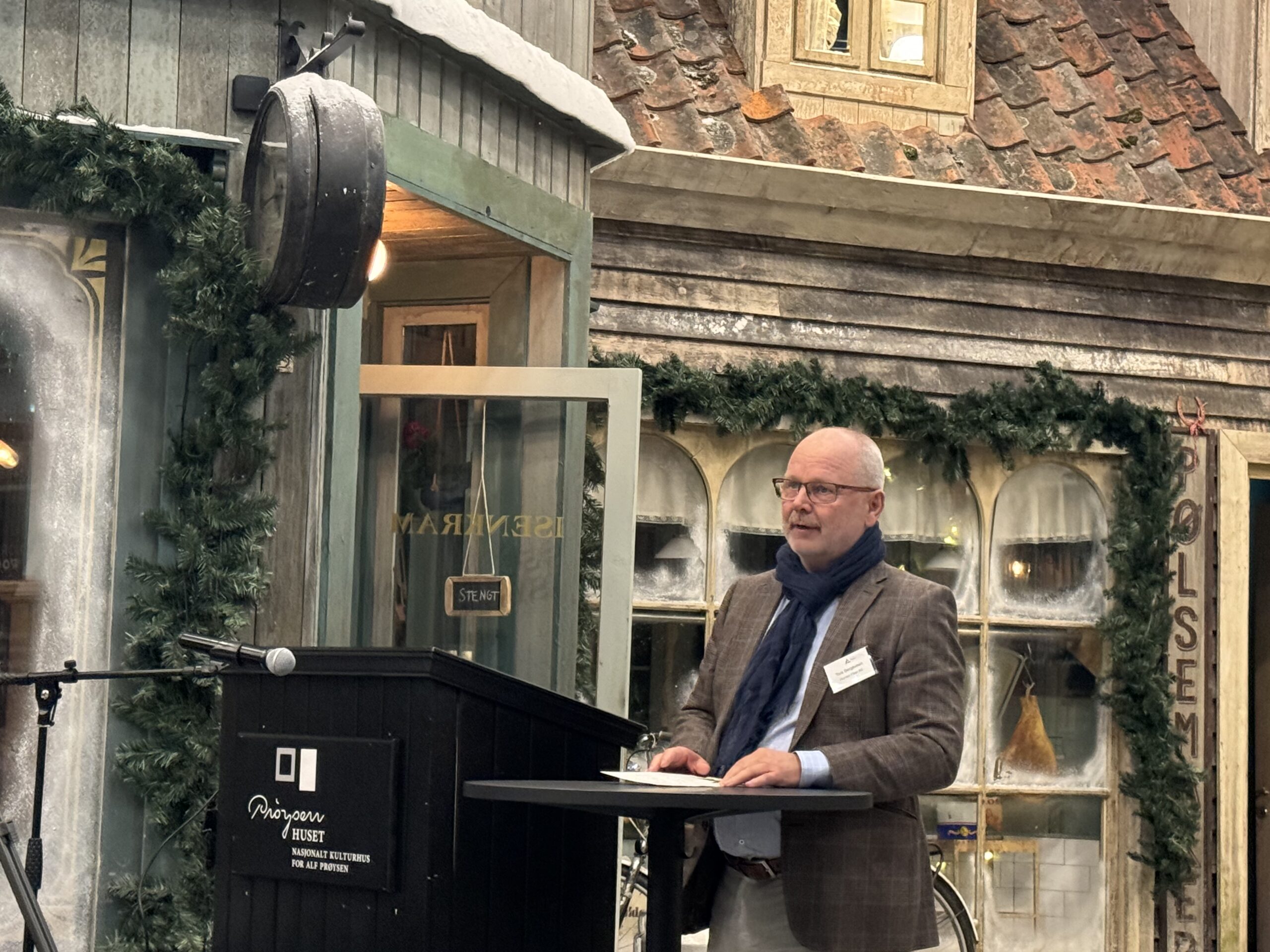
– “As a result of dialog with relevant users, we are now planning to split the building at Skjerven into an office building with meeting rooms, canteen and offices, as well as a test building with a lab and facilities for early-phase testing in the areas of sound/acoustics, fire, emissions and strength properties,” said Hunton Fibre’s HR director Tore Bergsveen.
– We continue the dialog with companies. As of now, 4-5 companies have initiated various types of feasibility studies. We now hope that more companies in the Norwegian Wood Cluster will join in,” said Bergsveen.